
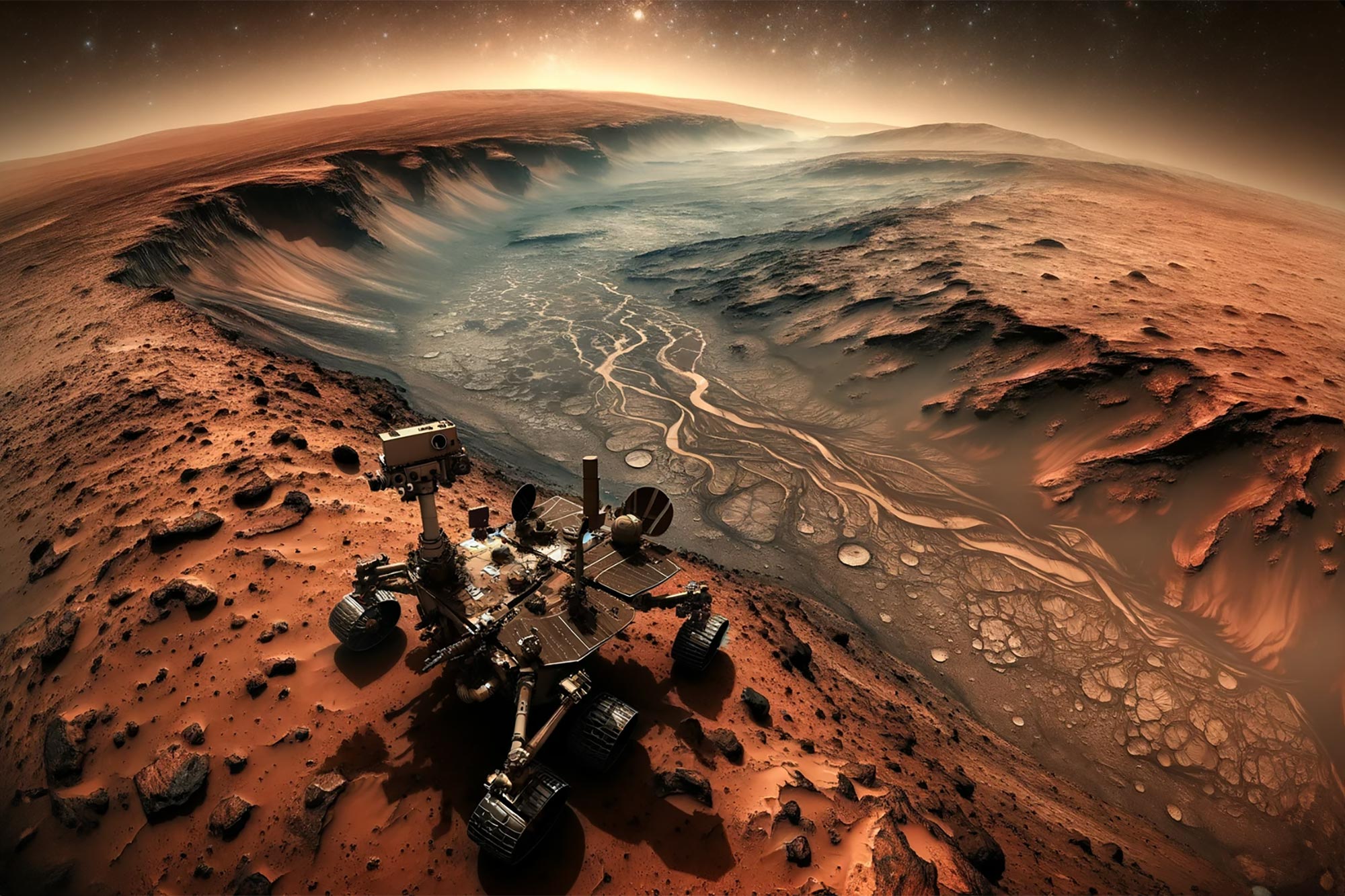
Perseverance rover’s 360-degree panorama of Mars, featuring 2.38 billion pixels from Jezero Crater, offers insights into the planet’s ancient river delta history.
After 1,000 Martian days of exploring the Red Planet, NASA’s Perseverance rover has reached a major milestone, and it’s marking the occasion with a breathtaking new panorama. Captured in November 2023, this detailed image reveals the rover’s surroundings in Jezero Crater, a region that once hosted a flowing river billions of years ago.
Scientists are studying the ancient rocks in this area for clues about Mars’ watery past—and whether it may have once supported microbial life. The Jezero Crater river delta is of particular interest because it preserves multiple layers of Mars’ geological history.
The new 360-degree mosaic, created from 993 individual images and packed with 2.38 billion pixels, offers an all-around view from a spot dubbed “Airey Hill.” Parts of the rover can be seen in the image, which appears slightly warped at the edges due to the stitching of so many photos together.
To make the image more Earth-like, NASA applied a color enhancement that boosts contrast and highlights subtle differences in rock and soil. On Mars, the actual view would be darker and more red-toned, but the enhanced version helps scientists better analyze the terrain using their Earth-based visual instincts.
You can explore the full interactive panorama and even download it here: https://go.nasa.gov/3tmJnGB.
Credit: NASA/JPL-Caltech/ASU/MSSS; ESA/DLR/FU-Berlin
Related: NASA’s Perseverance Rover Probes Secrets of Ancient Martian Lake
Video Transcript
Ken Farley, Perseverance Rover Project Scientist:
After a thousand sunrises on Mars, here’s where NASA’s Perseverance rover is exploring now: a river environment, billions of years old, that tells a dynamic story of the forces that shaped it. Let’s take a tour of this area and see where we’ll send the rover next.
Perseverance is exploring Jezero Crater, where an ancient lake and river system once existed. If microbes ever lived here, signs of them could be preserved in these rocks.
About 3.5 billion years ago, a river carved a canyon through the crater rim, filling the crater with water and depositing sand and rocks that formed a delta. On Earth, the record of such an ancient river and lake would have been erased long ago. That’s why sending a robotic explorer like Perseverance is so valuable: Mars is a special place that preserves a unique record of things that happened in the first billion years of the solar system.
In this area, different rock layers record different parts of the crater’s history. The flat, light-colored rocks were deposited on the banks of a river flowing slowly across the landscape.
The boulders in the distance were deposited later, in what was likely a raging torrent.
And if this peculiar outcrop caught your attention, it did ours as well. It doesn’t look like sediment at all – perhaps it’s a remnant of a lava flow, now mostly eroded away. Lab equipment on Earth can accurately measure when a volcanic rock was formed, so if we can return a sample of this lava to Earth in the future, we may know when and for how long water flowed into Jezero.
From here, Perseverance will continue west. In the distance you can trace the tops of the natural levees that formed at the near and far banks of the river. The rover will pass this area on its way upstream, continuing toward this spot where the river carved through the crater wall. You can see the canyon on the horizon here.
From there, Perseverance will be well-positioned to head south and ascend this natural ramp that leads up and out of the crater. We’re lucky to have a route the rover can safely drive up the rim right where we need it.
Starting the climb would mark a new and exciting phase of the mission: exploring rocks far older than those in Jezero and produced in an entirely different way. One tempting target is these light-colored rocks partway up the rim. They may have interacted with hot water in a hydrothermal environment – another exciting place to hunt for evidence of past life.
Since finishing its study of the crater floor, Perseverance has been climbing the delta and piecing together the history of this once-watery environment. We’ve come a long way in nearly three years of exploring and collecting samples. But there’s still so much more to investigate.
Never miss a breakthrough: Join the SciTechDaily newsletter.
Follow us on Google and Google News.
18 Comments
“. . . now mostly eroded away . . . .”
“Eroded away”??? Is that like “hidden away”? Or “raised up”? Pitiful English. Hire some editors.
‘Hidden’ and ‘raised up’ entail it’s still there. ‘Eroded’ implies it was there but no longer exists. Maybe ‘vanished’ works best for you. You appear to be the only reader who didn’t comprehend what the writer was conveying. Good article. Would love to see the analysis of the samples collected by the rover so the experts can conclusively determine when Mars changed from a diverse ecosystem to a barren planet devoid of any existing life. Might help Earthlings avoid a similar fate, a potential fate our heirs may encounter centuries from today.
“Eroded away” is a redundant phrase. I think Fred understood, but argued it’s like saying “fatally died” or “disappeared from view” or “hello to you”. It’s just unnecessary filler words people say. I could pedantically argue that a river valley can be eroded into being, but this was about an ancient lava flow.
SciTechDaily posted what NASA wrote. That’s NASA for you. They administrate space, you know.
To be fair, “eroded away” is in the transcript, and the NASA transcripts always come out awkwardly. I commented once before when an article seemed written by AI, and found it was just a transcript of inelegant improvised speech. The writing above the transcript still isn’t concise, like “rover has captured”, and changing tenses back and forth mid-sentence, but they don’t administrate poetry.
Means removed by natural processes known to every geologist. Hire a teacher.
All you guys are crazy, thinking there is life out there.There isn’t and it has never been, all those planets out there are just to create a balance, its bigger than you think.
Where is the actual photo?
We see the Perseverance in the photos. Like we saw the spaceship and the astronauts on the moon. Where is the camera taking these photos? It’s like they tell us in some photos you see stars in space and sometimes it’s black, and they tell us they can’t be seen because there’s no light in space. ??? We got into this discussion around a campfire Saturday night.
Actually, “eroded away” is not bad phrasing. A geologic feature could show signs of erosion and be said to be eroded, whereas “eroded away” means it is gone, no longer there anymore.
I hi saw news on Mars how came you made a rover that hasn’t use to create sun rays cause water to drop on a water bed create water on planet best thing you done something like that, if you made a video game on Mars how send people to planet that how it looks they get space craft you carry some tools you choose they haft use a rover pick up stone learned how create own resources from planets thank you for understanding everything and your time.
Pat, that’s the most confusing and incomprehensible comment I have yet read on any comment board. Wait, let me translate : Pat, typewriter ribbon bad bad plus some good equals comment English in NASA rover dirt green water plant now red thank you Time blue orbit sangria lemon wine
It doesn’t look promising, the rovers have been there and haven’t found anything resembling past life. Maybe there was never life there because you would of thought they would of found something unless they need to start digging deeper
I like it
Doesn’t it feel like there was life on Mars a few million years ago? Seeing all these I feel so. Anyways , a lots to explore and discover yet…all the very best to nasa and it’s scientists
Maybe it’s just a prediction and it’s be on our imagination……wow may be nature exists so we must believe in God…..
I believe some Ancient people in Egypt, Babylon and Greece made contact with civilizations from these planets. One day we would get the answers to the secret pasts of these planets here on earth
All you guys are crazy, thinking there is life out there.There isn’t and it has never been, all those planets out there are just to create a balance, its bigger than you think.
You guys are just crazy, thinking there is life out there. It isn’t and it has never been.All the planets there are just to create a balance. Its bigger than you think.