
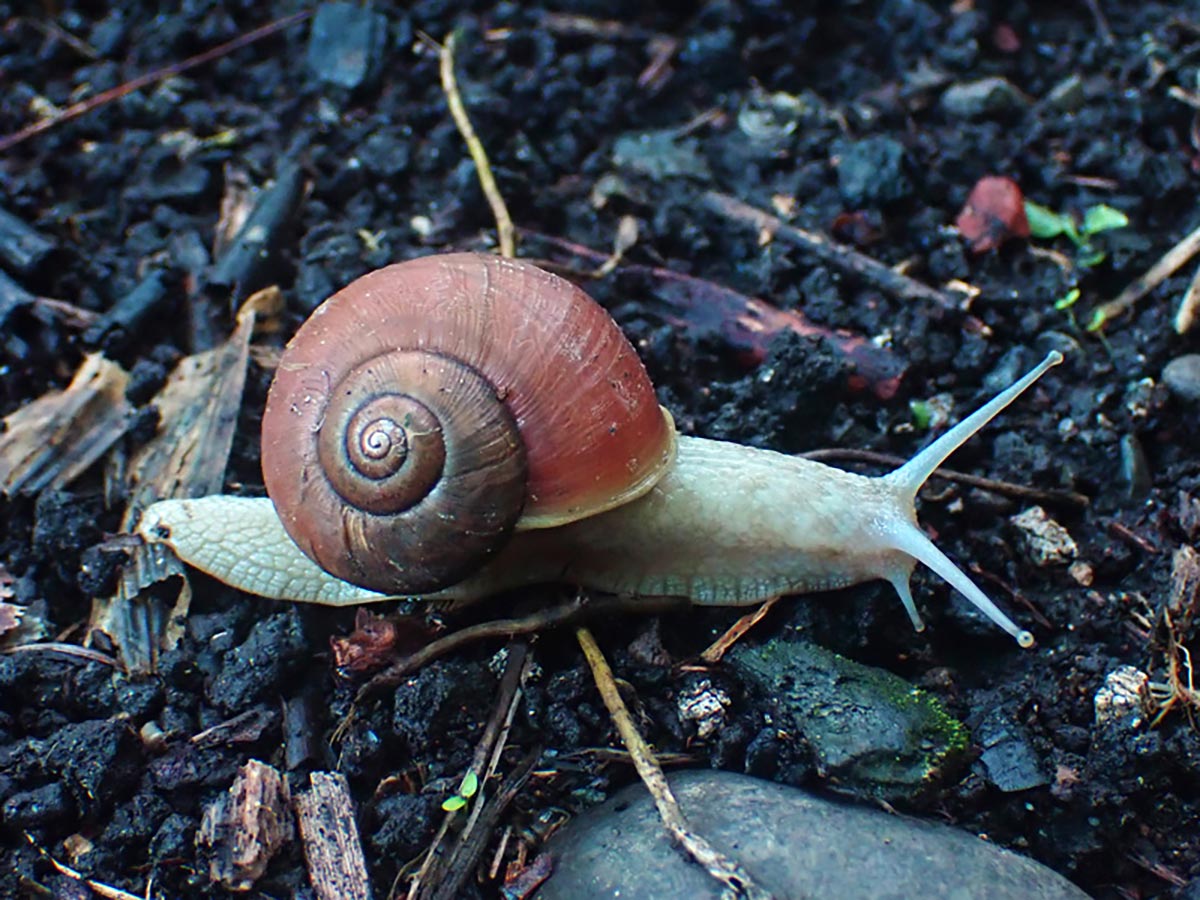
A study by Kyoto and Hokkaido Universities reveals that two snail species, K. editha and K. gainesi, show unique defensive behaviors, challenging common perceptions of snails as passive and slow.
Snails might have a reputation for being slow and lazy, but new research says otherwise. In fact, when danger strikes, some snails shift into high gear—literally.
A team of scientists from Kyoto and Hokkaido has discovered that two species of snails, both from the Karaftohelix genus, react in dramatically different ways when they sense a predator. One of them, K. gainesi (also known locally as ezo-maimai), doesn’t just hide—it accelerates, boosting its speed by up to 30% when it detects danger.
“Snails usually seem to escape from predators by withdrawing into their shells, but our study is the first report of a snail escaping in top gear,” muses Yuta Morii of Kyoto University’s Hakubi Center.
Two Snails, Two Survival Strategies
In contrast to its bold cousin, K. editha (or hime-maimai) takes the more traditional approach: it retreats into its shell at the first sign of trouble.
The researchers simulated attacks from a predatory beetle to study the snails’ responses. While K. gainesi sped up from about 1.05 mm/sec to as fast as 1.35 mm/sec, K. editha stuck to a more cautious strategy.
Interestingly, K. gainesi is also active both day and night—unusual behavior for snails—while K. editha only ventures out at night.
“Individuality is also not a uniquely human trait,” suggests Reiichi Ueki of Sapporo Keisei High School, “in that non-human animals also demonstrate this animal personality.”
The sharp contrast between these two closely related species offers rare insight into animal personality and the evolution of behavior, showing how even snails can demonstrate distinct “fight or flight” strategies as they adapt and evolve.
Evolutionary Insights and Collaborative Research
In the case of the snails, K editha expresses reactive behavioral syndrome, which tends to be labeled as shy and passive. On the other hand, K gainesi is proactive, and seen as bold, active, or aggressive.
“By showcasing multiple behavioral traits within the framework of animal personality and behavioral syndromes, it might be possible to understand their evolutionary processes better,” says Morii.
Speaking of his research team, Morii adds, “Collaborating on a volunteer basis with expert and non-expert citizens and students has also been deeply meaningful and rewarding, especially in terms of contributing to science literacy.”
Reference: “The divergence of mobility and activity associated with anti-predator adaptations in land snails” by Yuta Morii, Ryota Kimura, Rion Sato, Nana Shiobara, Honoka Maeda, Kaede Nakagawa, Ririka Ito and Reiichi Ueki, 30 October 2023, Behaviour.
DOI: 10.1163/1568539X-bja10249
Never miss a breakthrough: Join the SciTechDaily newsletter.
Follow us on Google and Google News.
1 Comment
>This resulted in an average speed increase from about 1.05 mm/sec to 1.27 and 1.35 mm/sec.
While that is very interesting, at the same time does nothing to change my preconceptions.