
The NASA mission, a project with deep roots at MIT, is setting course for a metallic space rock that could be the remnant of a planetary core like our own.
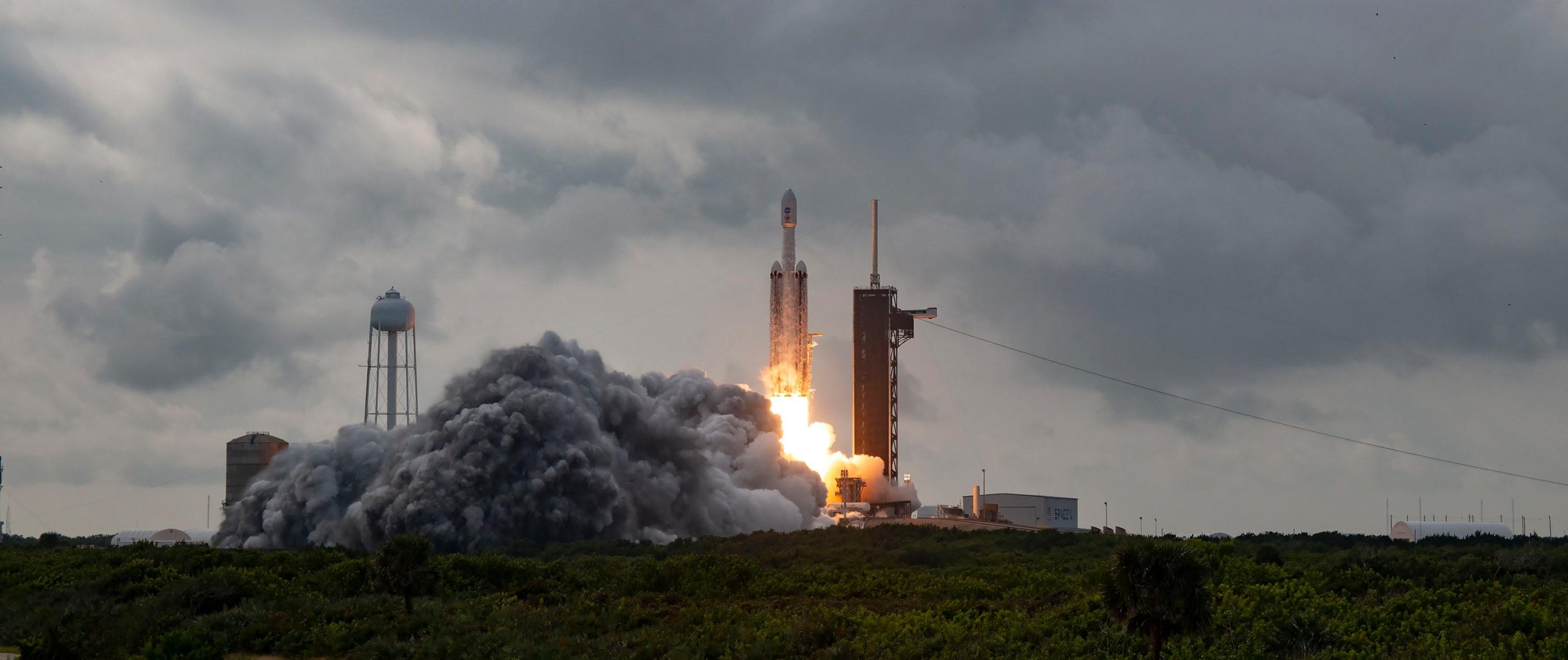
On October 13, NASA’s Psyche mission launched, and now the spacecraft is headed to a metal world.
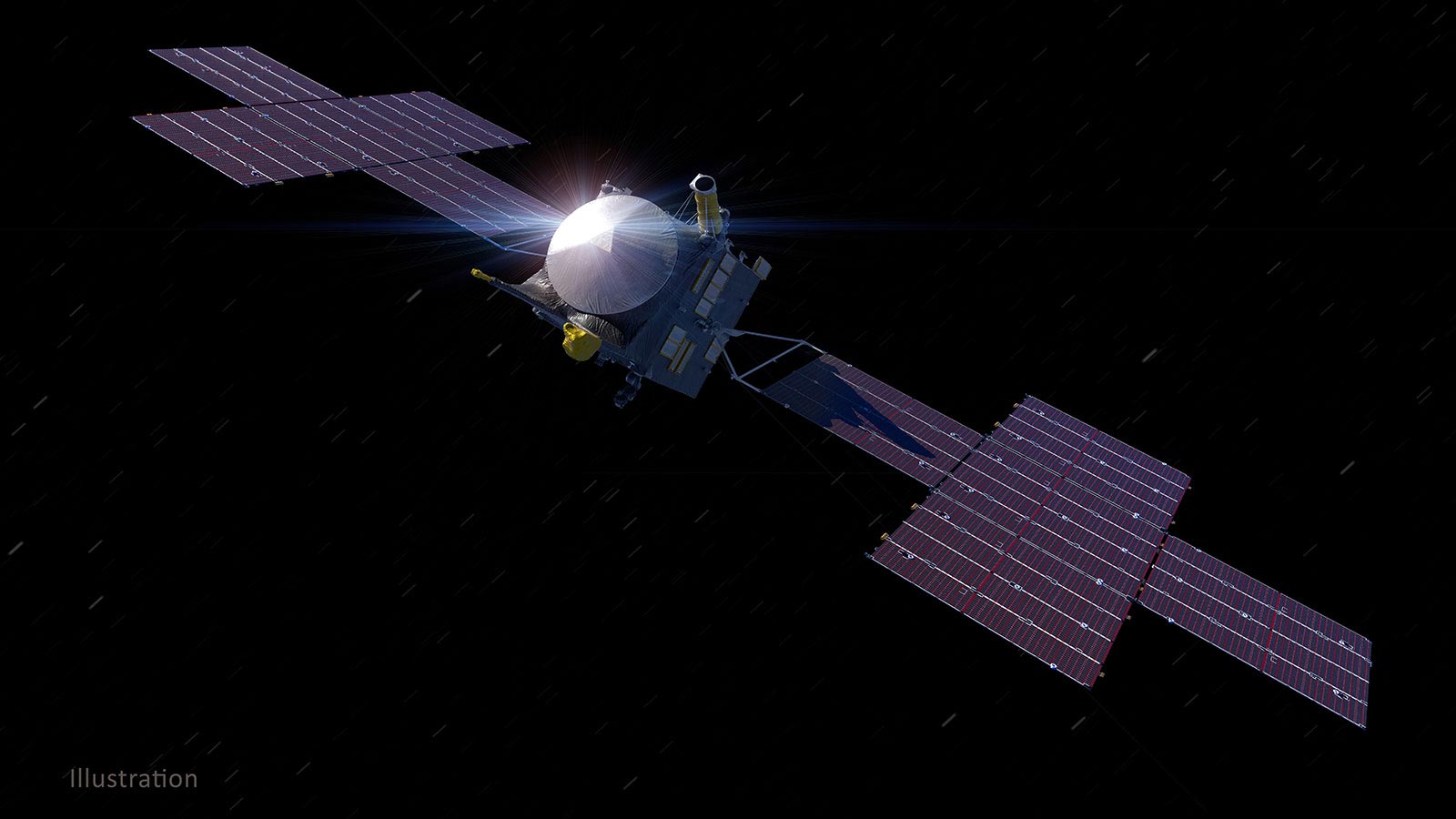
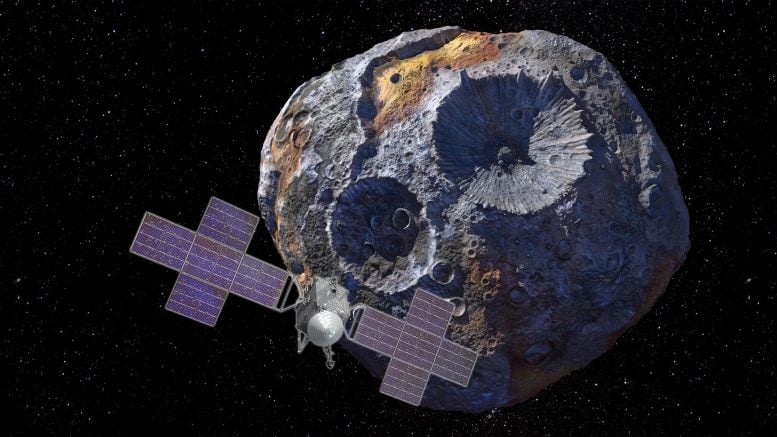
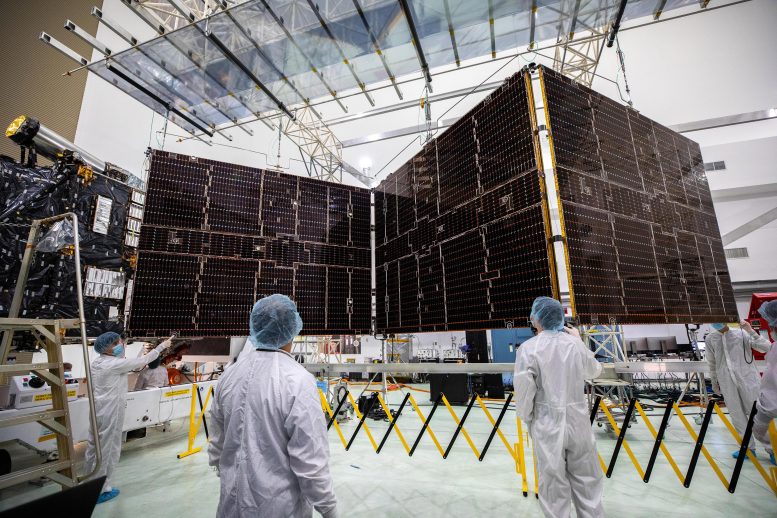
Psyche, a van-sized spacecraft with winglike solar panels, blasted off aboard a SpaceX Falcon Heavy rocket last Friday at 10:19 a.m. Eastern Time. Psyche’s destination is a potato-shaped asteroid by the same name that orbits the sun within the main asteroid belt between Mars and Jupiter.
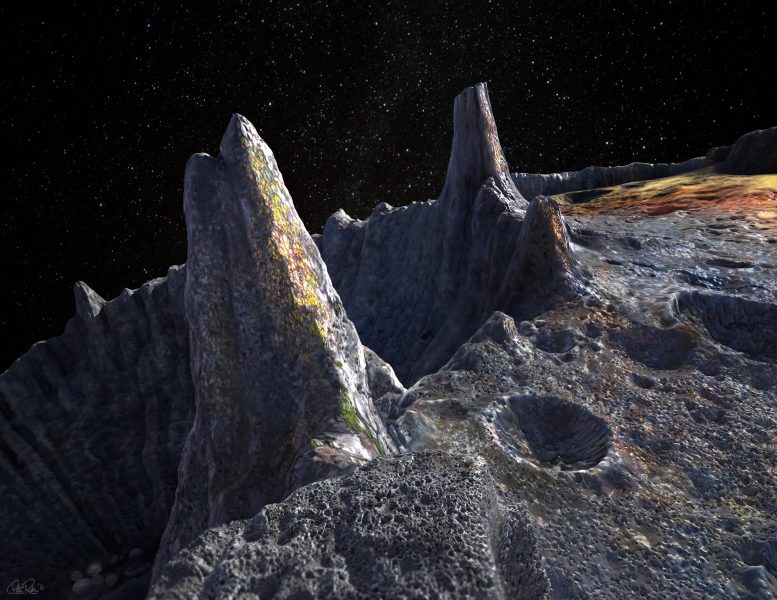
Astronomers suspect that the asteroid Psyche, which is about the size of Massachusetts, is made mostly of metal. If that’s the case, the asteroid could be the exposed core of an early, infant planet that might hold clues to how the Earth’s own metal-rich core formed.
“It’s a puzzle. And you have to not only figure out how the pieces fit together, but you have to figure out what the pieces are,” says MIT Research Scientist Jodie Ream, who helped in the magnetometer’s design.
Journey Details and MIT Connections
After it launched from NASA’s Kennedy Space Center, the Psyche mission embarked on a six-year interplanetary journey. In 2026, the spacecraft will approach Mars, where the planet’s gravitational pull will slingshot the spacecraft out to the asteroid. The mission will arrive at Psyche sometime in 2029, where it will spend another 26 months orbiting and surveying the space rock, analyzing its surface composition, mapping its gravity, and measuring any magnetic field that it might possess.
Scientists at MIT are leading Psyche’s magnetic field and gravity studies. And, the mission as a whole has a history that traces back to MIT. Psyche’s principal investigator is MIT alumna and former professor Lindy Elkins-Tanton ’87, SM ’87, PhD ’02, now a professor at Arizona State University, while its deputy principal investigator is Benjamin Weiss, an MIT professor of planetary science. In her role as mission PI, Elkins-Tanton, who is also vice president of the ASU Interplanetary Initiative, is leading a team including longtime MIT colleagues on the first mission to a metal world.
“Being able to undertake fundamental exploration of a new kind of world is a thrill and a privilege beyond anything I had envisioned for my life,” Elkins-Tanton says. “But the best part of it is helping to create and support a huge team of people who are all on this journey together.”
A Hypothesis on Psyche’s Origin
Scientists have hypothesized that Psyche may represent a case of planetary arrested development. While Earth and other rocky planets continued to accumulate material around their metal-rich cores some 4.5 billion years ago, Psyche may have met an untimely end, sustaining multiple collisions that blew off its rocky surface, leaving behind a naked metallic core. That core, scientists believe, could retain the elements that also formed Earth’s center.
“This will be the first time we’ve sent a mission to a body that is not mostly rock or ice, but metal,” Weiss says. “Not only is this asteroid potentially a metal world, but asteroids are building blocks of planets. So Psyche could tell us something about how planets formed.”
The seeds of a mission to explore an asteroid like Psyche were planted during a chance conversation between Weiss and Elkins-Tanton in 2010 at MIT. At the time, Elkins-Tanton was a professor in MIT’s Department of Earth, Atmospheric and Planetary Sciences, and had just finished teaching for the day.
“As she was passing by my office, I said, ‘Hey, do you have a minute?’” Weiss recalls.
Weiss was studying samples of Allende, a meteorite that fell to Earth in 1969 as a shower of fragments. The samples appeared to be magnetized, but also curiously unmelted. Weiss wondered how such a body could have become magnetized without any sign of the melting and churning that typically produces magnetic fields in space.
Having just lectured on the topic of melting cores and planet formation, Elkins-Tanton offered an idea: When a planet first forms, it is little more than an accumulation of unmelted rock and dust. As more material smashes into the infant planet, the collisions jostle the innermost regions, producing a melted, churning core, surrounded by unmelted material. The molten, swirling core could spin up a magnetic field, that could imprint upon a planet’s outer, unmelted layers.
Perhaps, the two realized, Allende’s magnetized, unmelted fragments came from the outer layer of a planetismal, or early planet, that harbored a melted, magnetic core. If that were the case, then perhaps other meteorite fragments are also remnants of early, differentiated planets.
“Hearing Ben talk about his shocking discovery of magnetism in the Allende meteorite, and then immediately having a mental model of the physics and chemistry of formation that could have led to that, was just a moment of pure joy,” Elkins-Tanton says of their realization.
She and Weiss wrote up their ideas in two 2011 papers. Then, the engineers came knocking.
“Lindy got a call from JPL (NASA’s Jet Propulsion Laboratory),” Weiss says. “They’d read the paper and said, ‘This is really cool. Is there a way you could test this idea, that you could partially melt bodies, and magnetize meteorites?’”
The call set off a series of brainstorming back-and-forths that eventually developed into a mission concept: to send a spacecraft to explore an ancient planetary core. The asteroid Psyche, they realized, was their best shot, as it’s relatively close to Earth and has shown signs of metal-rich, core-like content.
An Asteroid’s Field
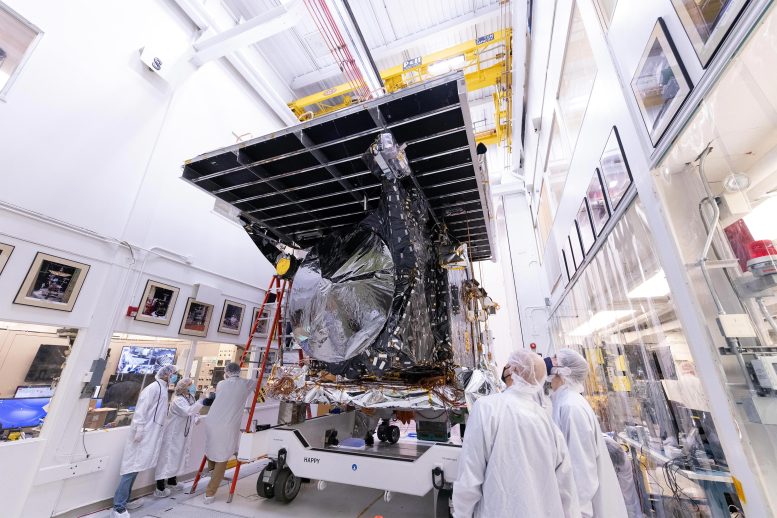
In 2017, the team’s proposal for a mission to Psyche was greenlit as part of NASA’s Discovery Program. Elkins-Tanton, who had since moved to ASU, became head of the mission, while Weiss; Maria Zuber, MIT’s E.A. Griswold Professor of Geophysics and vice president for research; and others at MIT joined the mission’s science team. Together, the scientists and engineers at JPL planned out the hardware that a spacecraft would need in order to determine whether Psyche is a metal-rich core.
Celebrating successful completion of environmental testing of the @MissionToPsyche spacecraft with mission PI and former student @ltelkins ! pic.twitter.com/U3YueLJRA7
— Maria Zuber (@maria_zuber) April 16, 2022
They decided on three instruments: a magnetometer that will look for signs of an ancient magnetic field that could be imprinted in Psyche’s surface layers; a pair of cameras that will take images and spot any visual signs of metal on Psyche’s surface; and a gamma-ray and neutron spectrometer that will measure the asteroid’s emissions of neutrons and gamma rays. These measurements can tell scientists whether and which metallic elements lie on its surface.
The spacecraft will also carry a communications system, which will mainly be used to send data and receive commands in the form of radio waves. A science team led by Zuber will also use the system to carry out a gravity study. The team will analyze the radio waves as the spacecraft orbits the asteroid, to see how they and the spacecraft are influenced by the asteroid’s gravitational pull. These analyses will help the scientists map Psyche’s gravity field, which can then determine the asteroid’s mass and how likely that mass is made of metal.
NASA’s Psyche team will measure the asteroid’s magnetic field using a magnetometer. This instrument is composed of two identical high-sensitivity magnetic field sensors located at the middle and outer end of a 6-foot (2-meter) boom on the spacecraft. The magnetometer team is based at MIT and Technical University of Denmark. Credit: NASA
The magnetometer investigation is led by Weiss and involves others at MIT. The instrument was designed and built by researchers at the Technical University of Denmark. The team worked with JPL engineers to refine the magnetometer’s design, which consists of two sensors installed on an arm-like boom — a configuration that will help the instrument pick up any magnetic signal from the asteroid itself, amid the “noise” from the spacecraft, its solar panels, and its surroundings.
To interpret whatever magnetic field the magnetometer does pick up from Psyche, the MIT team has developed a “library” of simulated magnetic field patterns.
A Look Ahead
“Space is filled with magnetic fields coming from planets, our own sun, and the solar wind,” says MIT Research Scientist Rona Oran. “Our simulation library will allow us to examine different scenarios, so that when we get to Psyche, we’ll use those tools to derive the asteroid’s actual, real field.”
In fact, the team will have many chances to refine the library, and their understanding of the magnetic fields around the spacecraft, as it makes its way to the asteroid. Soon after Psyche launches, engineers will turn on the magnetometer, which will then continuously measure the magnetic fields around the spacecraft, throughout its journey. These data will regularly downlink to JPL and be transmited to two data processing centers at MIT, where Oran, Weiss, and others will use the data to hone their understanding of what they might find around the asteroid itself.
“This is the first time our group has led a science investigation on a spacecraft,” Weiss says. “Once the mission launches, we’re on the hotseat to run this. It’s a big responsibility, and also incredibly exciting.”
Never miss a breakthrough: Join the SciTechDaily newsletter.
Follow us on Google and Google News.