
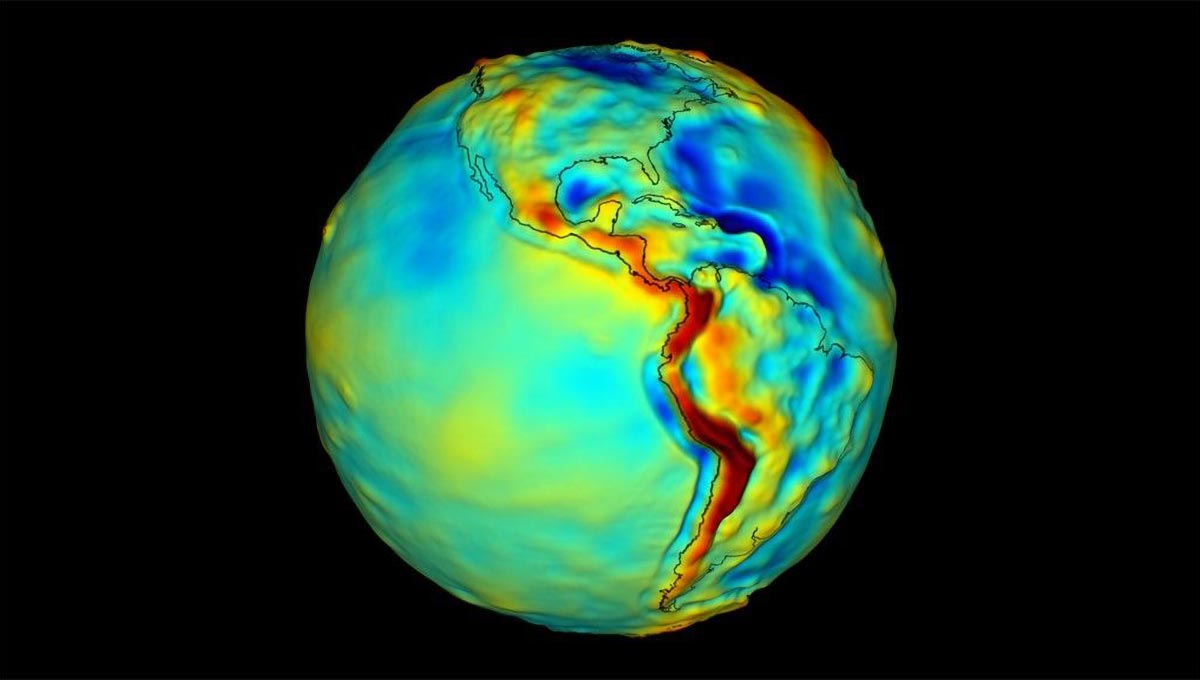
NASA and partners are building the first quantum gravity sensor for space, a breakthrough instrument that uses ultra-cold atoms to detect tiny shifts in Earth’s gravity from orbit.
With potential applications ranging from mapping hidden aquifers to exploring distant planets, this compact, highly sensitive device could transform how we understand both our planet and the cosmos.
Pioneering Space-Based Quantum Sensing
Scientists at NASA’s Jet Propulsion Laboratory (JPL) in Southern California, along with partners from private industry and academia, are developing the first quantum sensor designed to measure gravity from space. Backed by NASA’s Earth Science Technology Office (ESTO), the project represents a major milestone in quantum sensing technology. If successful, it could unlock powerful new ways to observe Earth’s hidden features — from underground water reserves to oil and mineral deposits.
Earth’s gravitational field isn’t fixed; it changes constantly as natural processes shift mass beneath the planet’s surface. Areas with more mass exert a slightly stronger pull of gravity.
Detecting the Invisible with Gravity Gradiometers
These tiny variations go unnoticed in daily life, but with sensitive instruments known as gravity gradiometers, scientists can detect and map them. The resulting gravity maps reveal subsurface structures like aquifers and mineral deposits — valuable data for navigation, environmental monitoring, and national security.
“We could determine the mass of the Himalayas using atoms,” said Jason Hyon, chief technologist for Earth Science at JPL and director of JPL’s Quantum Space Innovation Center. Hyon and colleagues laid out the concepts behind their Quantum Gravity Gradiometer Pathfinder (QGGPf) instrument in a recent paper in EPJ Quantum Technology.
How the Quantum Gravity Gradiometer Works
Gravity gradiometers track how fast an object in one location falls compared to an object falling just a short distance away. The difference in acceleration between these two free-falling objects, also known as test masses, corresponds to differences in gravitational strength. Test masses fall faster where gravity is stronger.
QGGPf will use two clouds of ultra-cold rubidium atoms as test masses. Cooled to a temperature near absolute zero, the particles in these clouds behave like waves. The quantum gravity gradiometer will measure the difference in acceleration between these matter waves to locate gravitational anomalies.
Precision and Portability in Space
Using clouds of ultra-cold atoms as test masses is ideal for ensuring that space-based gravity measurements remain accurate over long periods of time, explained Sheng-wey Chiow, an experimental physicist at JPL. “With atoms, I can guarantee that every measurement will be the same. We are less sensitive to environmental effects.”
Using atoms as test masses also makes it possible to measure gravity with a compact instrument aboard a single spacecraft. QGGPf will be around 0.3 cubic yards (0.25 cubic meters) in volume and weigh only about 275 pounds (125 kilograms), smaller and lighter than traditional space-based gravity instruments.
Quantum Sensitivity: A New Benchmark
Quantum sensors also have the potential for increased sensitivity. By some estimates, a science-grade quantum gravity gradiometer instrument could be as much as 10 times more sensitive at measuring gravity than classical sensors.
The main purpose of this technology validation mission, scheduled to launch near the end of the decade, will be to test a collection of novel technologies for manipulating interactions between light and matter at the atomic scale.
From Earth Science to Cosmic Exploration
“No one has tried to fly one of these instruments yet,” said Ben Stray, a postdoctoral researcher at JPL. “We need to fly it so that we can figure out how well it will operate, and that will allow us to not only advance the quantum gravity gradiometer, but also quantum technology in general.”
This technology development project involves significant collaborations between NASA and small businesses. The team at JPL is working with AOSense and Infleqtion to advance the sensor head technology, while NASA’s Goddard Space Flight Center in Greenbelt, Maryland is working with Vector Atomic to advance the laser optical system.
Expanding the Frontiers of Science
Ultimately, the innovations achieved during this pathfinder mission could enhance our ability to study Earth, and our ability to understand distant planets and the role gravity plays in shaping the cosmos. “The QGGPf instrument will lead to planetary science applications and fundamental physics applications,” said Hyon.
Reference: “Quantum gravity gradiometry for future mass change science” by Ben Stray, Xavier Bosch-Lluis, Robert Thompson, Clayton Okino, Nan Yu, Norman Lay, Brian Muirhead, Jason Hyon, Holly Leopardi, Peter Brereton, Anand Mylapore, Bryant Loomis, Scott Luthcke, Parminder Ghuman, Srinivas Bettadpur, Maike Diana Lachmann, Thomas Stolz, Christopher Kuehl, Dennis Weise, Holger Ahlers, Christian Schubert, Ahmad Bawamia and Sheng-wey Chiow, 14 March 2025, EPJ Quantum Technology.
DOI: 10.1140/epjqt/s40507-025-00338-1
Never miss a breakthrough: Join the SciTechDaily newsletter.
Follow us on Google and Google News.