
Farnesol, a natural compound, may combat Parkinson’s by deactivating the PARIS protein and preserving dopamine neurons.
Johns Hopkins Medicine researchers say they have added to evidence that the compound farnesol, found naturally in herbs, berries, and other fruits, prevents and reverses brain damage linked to Parkinson’s disease in mouse studies.
The compound, used in flavorings and perfume-making, can prevent the loss of neurons that produce dopamine in the brains of mice by deactivating PARIS, a key protein involved in the disease’s progression. Loss of such neurons affects movement and cognition, leading to hallmark symptoms of Parkinson’s disease such as tremors, muscle rigidity, confusion, and dementia. Farnesol’s ability to block PARIS, say the researchers, could guide development of new Parkinson’s disease interventions that specifically target this protein.
“Our experiments showed that farnesol both significantly prevented the loss of dopamine neurons and reversed behavioral deficits in mice, indicating its promise as a potential drug treatment to prevent Parkinson’s disease,” says Ted Dawson, M.D., Ph.D., director of the Johns Hopkins Institute for Cell Engineering and professor of neurology at the Johns Hopkins University School of Medicine.
Results of the new study, published on July 28, 2021, in Science Translational Medicine, detail how the researchers identified farnesol’s potential by screening a large library of drugs to find those that inhibited PARIS.
Disrupting the PARIS–PGC-1alpha Pathway
In the brains of people with Parkinson’s disease, a buildup of PARIS slows down the manufacture of the protective protein PGC-1alpha. The protein shields brain cells from damaging reactive oxygen molecules that accumulate in the brain. Without PGC-1alpha, dopamine neurons die off, leading to the cognitive and physical changes associated with Parkinson’s disease.
To study whether farnesol could protect brains from the effects of PARIS accumulation, the researchers fed mice either a farnesol-supplemented diet or a regular mouse diet for one week. Then, the researchers administered pre-formed fibrils of the protein alpha-synuclein, which is associated with the effects of Parkinson’s disease in the brain.
The researchers found that the mice fed the farnesol diet performed better on a strength and coordination test designed to detect advancement of Parkinson’s disease symptoms. On average, the mice performed 100% better than mice injected with alpha-synuclein, but fed a regular diet.
When the researchers later studied the brain tissue of mice in the two groups, they found that the mice fed a farnesol-supplemented diet had twice as many healthy dopamine neurons than mice not fed the farnesol-enriched diet. The farnesol-fed mice also had approximately 55% more of the protective protein PGC-1alpha in their brains than the untreated mice.
Farnesol Binds and Disarms PARIS
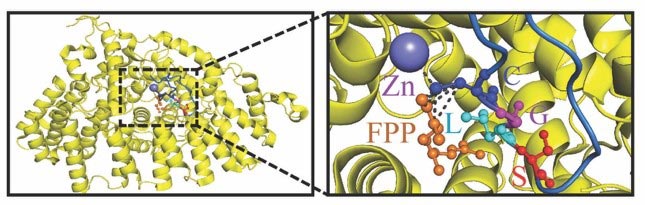
In chemical experiments, the researchers confirmed that farnesol binds to PARIS, changing the protein’s shape so that it can no longer interfere with PGC-1alpha production.
While farnesol is naturally produced, synthetic versions are used in commerce, and the amounts people get through diet is unclear. The researchers caution that safe doses of farnesol for humans have not yet been determined, and that only carefully controlled clinical trials can do so.
Though more research is needed, Dawson and his team hope farnesol can someday be used to create treatments that prevent or reverse brain damage caused by Parkinson’s disease.
Reference: “PARIS farnesylation prevents neurodegeneration in models of Parkinson’s disease” by Areum Jo, Yunjong Lee, Tae-In Kam, Sung-Ung Kang, Stewart Neifert, Senthilkumar S. Karuppagounder, Rin Khang, Hojin Kang, Hyejin Park, Shih-Ching Chou, Sungtaek Oh, Haisong Jiang, Deborah A. Swing, Sangwoo Ham, Sheila Pirooznia, George K. E. Umanah, Xiaobo Mao, Manoj Kumar, Han Seok Ko, Ho Chul Kang, Byoung Dae Lee, Yun-Il Lee, Shaida A. Andrabi, Chi-Hu Park, Ji-Yeong Lee, Hanna Kim, Hyein Kim, Hyojung Kim, Jin Whan Cho, Sun Ha Paek, Chan Hyun Na, Lino Tessarollo, Valina L. Dawson, Ted M. Dawson and Joo-Ho Shin, 28 July 2021, Science Translational Medicine.
DOI: 10.1126/scitranslmed.aax8891
Other researchers involved in this study include Areum Jo, Yunjong Lee, Rin Khang, Hojin Kang, Sangwoo Ham, Ji-Yeong Lee, Hanna Kim, Hyein Kim, Hyojung Kim and Joo-Ho Shin of the Samsung Biomedical Research Institute, Suwon, South Korea; Tae-In Kam, Sung-Ung Kang, Stewart Keifert, Senthilkumar Karuppagounder, Hyejin ParkShih-Ching Chou, Sungtaek Oh, Haisong Jiang, Sheila Pirooznia, George Umanah, Xiaobo Mao, Manoj Kumar, Han Seok Ko, Yun-Il Lee, Shaida Andrabi, Chan Hyun Na and Valina Dawson of the Johns Hopkins University School of Medicine; Deborah Swing and Lino Tessarollo of the Diana Helis Henry Medical Research Foundation; Ho Chul Kang of the Ajou University School of Medicine, Suwon, South Korea; Byoung Dae Lee of the Kyung Hee University School of Medicine, Suwon, South Korea; Jin Whan Cho of the Sungkyunkwan University School of Medicine, Seoul, South Korea and Sun Ha Paek of the Seoul National University College of Medicine, Seoul, South Korea.
This work was supported by grants from the JPB Foundation, the Cure Parkinson’s Trust, the Bachmann-Strauss Dystonia and Parkinson Foundation, the Adrienne Helis Malvin Medical Research Foundation, the Diana Helis Henry Medical Research Foundation and the Intramural Research Program of the National Institutes of Health, Center for Cancer Research, National Cancer Institute.
Patents related to this work include US9274128B2, entitled Transcriptional Repression Leading to Parkinson’s Disease, and WO2017161155A1, Methods for Preventing or Treating Parkinson’s Disease by the Farnesylation of PARIS.
Additional funder: Center for Cancer Research, National Cancer Institute
Never miss a breakthrough: Join the SciTechDaily newsletter.
Follow us on Google and Google News.
5 Comments
One of two recent studies is on aromatic-turmerone from Turmeric. The other is on farnesol. Both showed reversal of Parkinson’s.
I think, Ar-turmerone and farnesol, are somehow related and they probably use the same pathway to clear α-synuclein plaques in PD and beta amyloid plaques of AD. C15H20O Ar-Turmerone and C15H26O Farnesol
Also, “Vitamin K2 as menaquinone-7 (MK-7) is derived from geraniol and farnesol. MK-7 – C46H64O2
I read somewhere, that MK-7 dissolves arterial plaque by breaking calcium bonds. And, is a good candidate for doing the same for the plaques of PD and AD. Makes you wonder how much calcium is in plaques…
Hi. I suffer from Parkinson disease over 10 years . Tried hundreds of different supplements , also taking levadopa 3x a day , nothing works have problem with walking freeze a lot . I need more info concerning this Farnesol , where to get it and dosage liquid or powder? I thank you Donna.
I’ve googled and read a lot of stuff on Farnesol. I want more info too. Do you belong to any blog sites?
I brought a bottle (sold as an ingredient to be used in homemade body lotions – mostly as a deodorizer). Everything I’ve read indicates “do not ingest”. I also brought a bottle of chamolmile oil (thinking there might be some in it), but then read that the process of making cold pressed oils flushes any farnesol out. A few drops in chamolmile oil really softens my skin.