
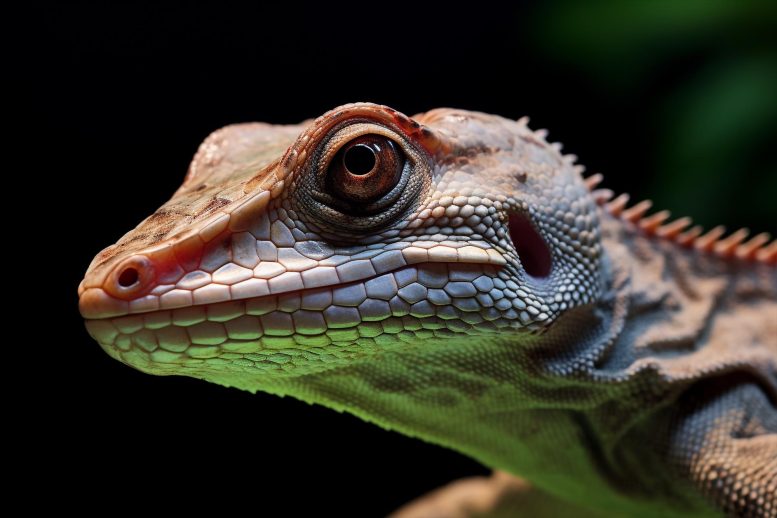
Long-term lizard observation challenges the conventional understanding of natural selection, suggesting species can remain consistent in appearance while still undergoing evolution.
Many species experience little to no change over long periods of time. Biologists often fall back on the same explanation for why this is true: that natural selection favors individuals with more moderate characteristics. Individuals with more extreme features — longer limbs, for example — have a disadvantage, while more moderate or average individuals are more likely to survive and reproduce, passing on their common features.
Redefining Evolutionary Relations
However, new research from Washington University in St. Louis and the Georgia Institute of Technology provides a more complete explanation of how evolution plays out among species that live side-by-side. By directly measuring the long-term survival of lizards in the wild, the scientists showed that co-existing species each occupy a distinct “fitness peak” that is best understood as part of a communitywide “fitness surface” or landscape.
The study, led by James Stroud at Georgia Tech and published this week in the Proceedings of the National Academy of Sciences, offers a new way of thinking about how species relate to each other over time and how the differences between them reinforce their distinctness.
Testing Theories With Lizards
Jonathan Losos, the William H. Danforth Distinguished University Professor and a professor of biology in Arts & Sciences at Washington University, said: “If species are adapted to their environment, and the environment doesn’t change, then you wouldn’t expect the species to change. However, when scientists have gone out and studied natural selection, they rarely find evidence of such stabilizing selection.
“Given this disconnect, we set out to study natural selection on the organisms we know so well, Anolis lizards, to measure selection over several years and try to understand what’s going on,” Losos said.
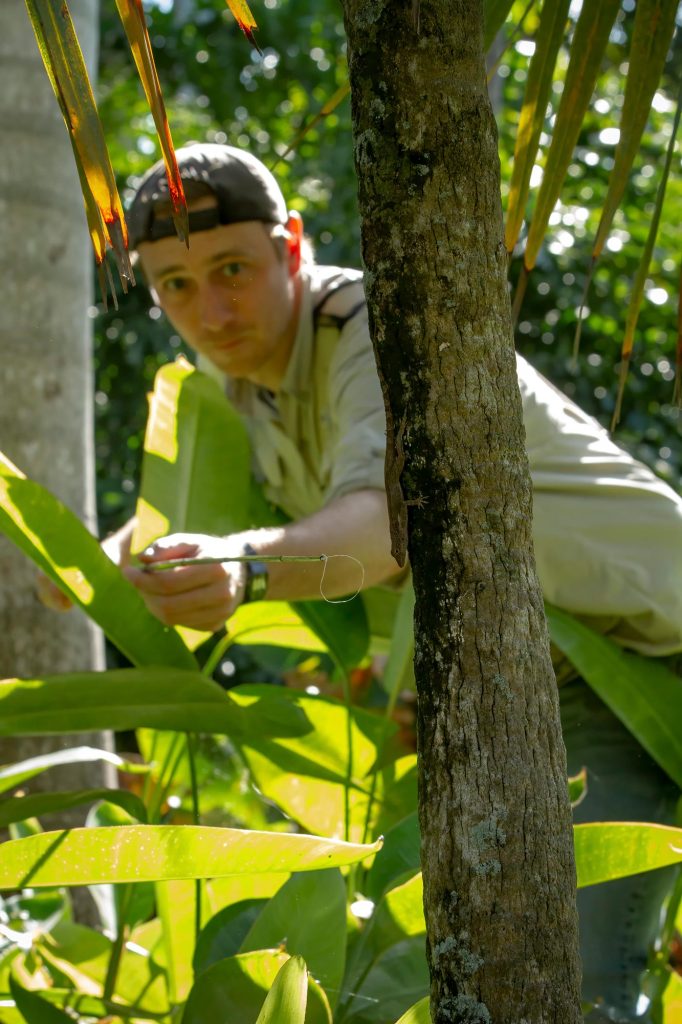
Stroud, who was working as a postdoctoral researcher in Losos’ lab at WashU at the time, identified a place where four different species of anoles were living together on a small island in a lake in the Fairchild Tropical Botanical Garden near Miami.
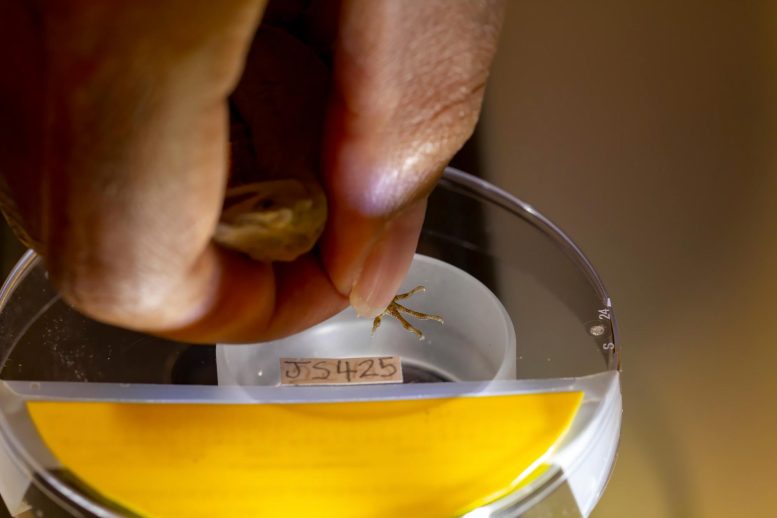
He caught thousands of individual lizards on the island, tagged them, and measured their body proportions. Stroud then re-caught all of the lizards on the island every six months for 2 ½ years, a period of time representing two to three generations of lizards.
New lizards that showed up were island babies, obviously. If a lizard disappeared from his census rolls, it was safe for Stroud to assume it had died, because the surrounding lake, filled with predatory fish, didn’t let them leave. By determining which lizards survived from one year to the next, the researchers could evaluate whether survival was related to the body traits they had been measuring, like leg length.
“What is special about this study is that we simultaneously measured natural selection on four co-existing species, something that has rarely been accomplished,” said Losos, who also serves as the director of the Living Earth Collaborative. “By coincidence, just as our paper was published, another group published a similar study on Darwin’s famous finches of the Galapagos Islands.”
Findings and Implications
In the Florida lizards, Losos and Stroud found that the stabilizing form of natural selection — that which maintains a species’ same, average features — was extremely rare. In fact, natural selection varied massively through time. In some years, lizards with longer legs would survive better, and in other years, lizards with shorter legs fared better. At other times, there was no clear pattern at all.
“The most fascinating result is that natural selection was extremely variable through time,” Stroud said. “We often saw that selection would completely flip in direction from one year to the next. When combined into a long-term pattern, however, all this variation effectively canceled itself out: species remained remarkably similar across the entire time period.”
Scientists do not yet fully understand how evolution works on the community level. There are very few long-term studies like this one because of the great amount of work and time required.
“Evolution can and does happen — it’s this ongoing process, but it doesn’t necessarily mean things are constantly changing in the long run,” Stroud said. “Now we know that even if animals appear to be staying the same, evolution is still happening.”
For more on this research, see “Paradox of Stasis” Lizard Study Challenges the Rules of Evolutionary Biology.
Reference: “Fluctuating selection maintains distinct species phenotypes in an ecological community in the wild” by James T. Stroud, Michael P. Moore, R. Brian Langerhans and Jonathan B. Losos, 9 October 2023, Proceedings of the National Academy of Sciences.
DOI: 10.1073/pnas.2222071120
Never miss a breakthrough: Join the SciTechDaily newsletter.
Follow us on Google and Google News.