
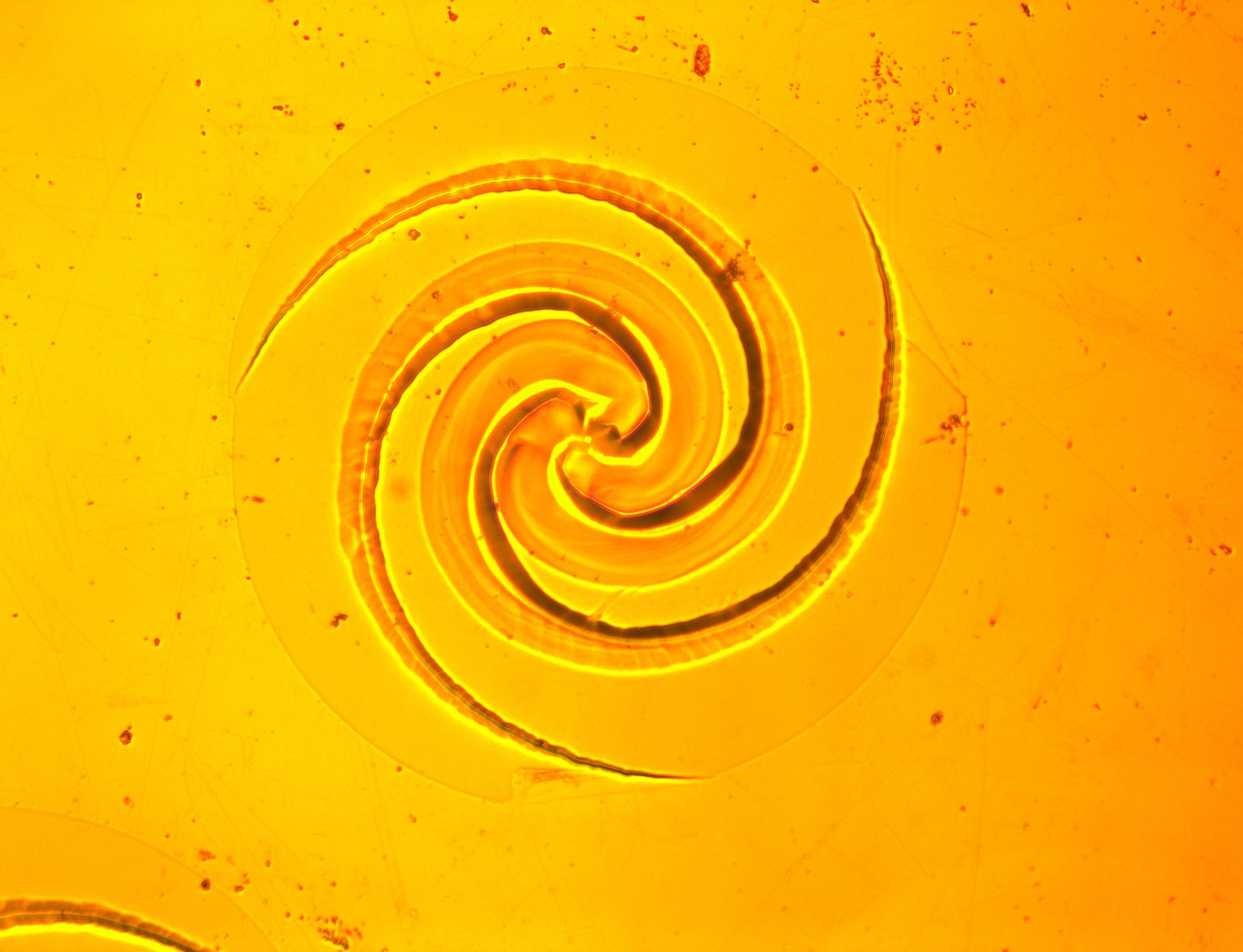
Hundreds of regular patterns spontaneously emerge on a small germanium chip.
A curiosity about tiny dots on a germanium wafer with metal films led to the discovery of intricate spiral patterns etched by a chemical reaction. Further experiments revealed that these patterns emerge from chemical reactions interacting with mechanical forces through a deforming catalyst. This breakthrough marks the most significant advance in studying chemical pattern formation since the 1950s. Understanding these complex systems could shed light on natural processes like crack formation in materials and the effects of stress on biological growth.
University of California, Los Angeles doctoral student Yilin Wong noticed tiny dots appearing on one of her samples, which had been accidentally left out overnight. The layered sample consisted of a germanium wafer topped with evaporated metal films in contact with a drop of water. On a whim, she examined the dots under a microscope and couldn’t believe her eyes. Beautiful spiral patterns had been etched into the germanium surface by a chemical reaction.
Wong’s curiosity led her on a journey of discovery, revealing something never seen before: hundreds of nearly identical spiral patterns spontaneously forming on a centimeter-square germanium chip. Even more remarkably, small changes in experimental parameters, such as the thickness of the metal film, produced different patterns, including Archimedean spirals, logarithmic spirals, lotus flower shapes, radially symmetric patterns, and more.
The discovery, published in Physical Review Materials, occurred fortuitously when Wong made a small mistake while attempting to bind DNA to the metal film.
“I was trying to develop a measurement technique to categorize biomolecules on a surface through breaking and reforming of the chemical bonds,” Wong said. “Fixing DNA molecules on a solid substrate is pretty common. I guess nobody who made the same mistake I did happened to look under the microscope.”
Understanding the Catalytic Process
To learn more about how the patterns formed, Wong and co-author Giovanni Zocchi, a UCLA physics professor, investigated a system that involved evaporating a 10-nanometer thick layer of chromium on the surface of a germanium wafer, followed by a 4-nanometer layer of gold. Next, the researchers placed a drop of mild etching solution onto the surface and dried it overnight, then washed and re-incubated the chip with the same etching solution in a wet chamber to prevent evaporation.
“The system basically forms an electrolytic capacitor,” Zocchi said.

Over the course of 24-48 hours, a chemical reaction catalyzed by the metal film etched remarkable patterns on the germanium surface. Investigation of the process revealed that the chromium and gold films were under stress and had delaminated from the germanium as the catalytic reaction proceeded. The resulting stress created wrinkles in the metal film that, under further catalysis, etched the amazing patterns the researchers had seen.
“The thickness of the metal layer, the initial state of mechanical stress of the sample, and the composition of the etching solution all play a role in determining the type of pattern that develops,” Zocchi said.
One of the most exciting findings in this study is that the patterns are not purely chemical but are influenced by residual stress in the metal film. The research suggests that the metal’s preexisting tension or compression determines the shapes that emerge. Thus, two processes, one chemical and one mechanical, worked together to yield the patterns.
Connections to Biological Growth and Pattern Formation
This type of coupling, formed between catalysis-driven deformations of an interface and the underlying chemical reactions, is unusual in laboratory experiments but common in nature. Enzymes catalyze growth in nature, which deforms cells and tissue. It’s this mechanical instability that makes tissue grow into particular shapes, some of which resemble the ones seen in Wong’s experiments.
“In the biological world, this kind of coupling is actually ubiquitous,” Zocchi said. “We just don’t think of it in laboratory experiments because most laboratory experiments about pattern formation are done in liquids. That’s what makes this discovery so exciting. It gives us a non-living laboratory system in which to study this kind of coupling and its incredible pattern-forming ability.”
The study of pattern formation in chemical reactions began in 1951 when the Soviet chemist Boris Belousov accidentally discovered a chemical system that could spontaneously oscillate in time, which inaugurated the new fields of chemical pattern formation and nonequilibrium thermodynamics. At the same time and independently, the British mathematician Alan Turing discovered that chemical systems, later termed “reaction-diffusion systems,” could spontaneously form patterns in space, such as stripes or polka dots. The reaction-diffusion dynamics observed in Wong’s experiments mirrored the theoretical ones posited by Turing.
Although the field of complex systems in physics and pattern formation enjoyed a time in the spotlight during the 1980s and 90s, to this day, the experimental systems used to study chemical pattern formation in the laboratory are essentially variants of ones introduced in the 1950s. The Wong-Zocchi system represents a major advance in the experimental study of chemical pattern formation.
Reference: “Metal-assisted chemical etching patterns at a Ge/Cr/Au interface modulated by the Euler instability” by Yilin Wong and Giovanni Zocchi, 3 March 2025, Physical Review Materials.
DOI: 10.1103/PhysRevMaterials.9.035201
Never miss a breakthrough: Join the SciTechDaily newsletter.
Follow us on Google and Google News.
1 Comment
Very interesting considering the universe is filled with these spiral patterns