
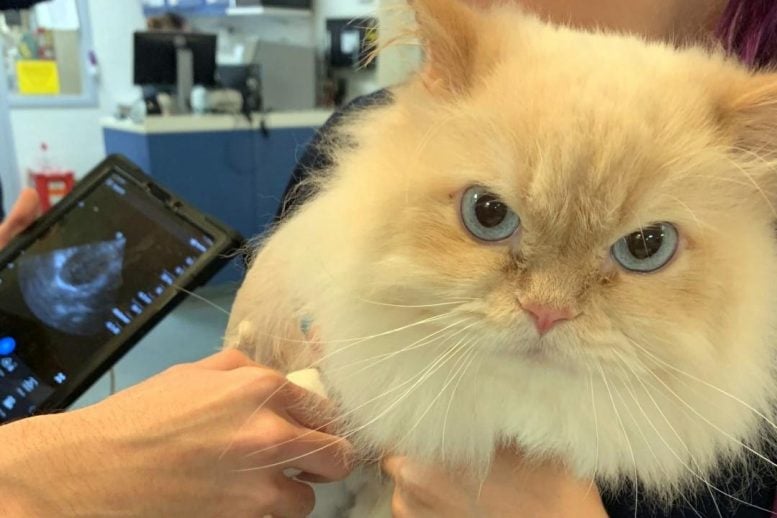
A new, two-minute screening technique could help save cats from dying prematurely of heart disease. Morris Animal Foundation-funded researchers at the Cummings School of Veterinary Medicine at Tufts University recently developed a focused cardiac ultrasound (FCU) protocol for use by veterinarians in general practice to increase the detection of cardiac issues in cats that aren’t outwardly showing signs of disease. The team published their study in the Journal of Veterinary Internal Medicine.
“Heart disease is one of the biggest killers of our cats. It’s very common but often undiagnosed, as many cats don’t reveal symptoms,” said Dr. Elizabeth Rozanski, veterinary researcher, clinician, and associate professor at Cummings School. “This method is something small animal practitioners can add to their yearly physical exams as cats get older to catch heart disease earlier.”
Some studies indicate that up to 20% of cats die from heart disease every year. Many cats don’t show any noticeable signs of distress until they are already in heart failure. Cats hide disease well and have evolved to hide illnesses and vulnerabilities to survive predation. They also usually live sedentary lifestyles that help hide signs of disease.
Full echocardiograms can successfully detect heart problems, but can be costly, require special training, and are usually reserved for when a cat is already showing distress – often too late to make a difference. Dr. Rozanski proposed that a focused cardiac ultrasound (FCU), an abbreviated echocardiogram using equipment already available in a practice, could screen and determine if a cat should receive a more in-depth evaluation.
FCUs already help detect hidden heart disease in human patients and require less instruction. Veterinarians could be trained to specifically look for some easily measurable criteria of feline heart disease. Based on their findings, they could recommend further evaluation if cats met the criteria for heart disease as determined by the FCU.
To test this, Dr. Rozanski’s team taught 22 general practice veterinarians in the New England and Philadelphia area to perform FCUs on about 300 cats. None of the practitioners had any prior, formal cardiac ultrasound training. The cats were all at least 1 year old and none had shown any clinical signs of heart disease.
The veterinarians first performed standard physical examinations and electrocardiograms on each of their cats. Then they performed FCUs and were asked to indicate yes, no or equivocal as to whether they believed clinically-significant heart disease was present. A board-certified cardiologist then evaluated each of the cats to confirm their status.
Even with limited training, the veterinarians were 93% successful at diagnosing cats with moderate heart disease and 100% successful at diagnosing severe heart disease.
Dr. Rozanski has already helped produce a video to teach veterinarians in general practice how to perform this technique. She also said the practitioners she trained are now using it on a regular basis.
“This appears to be a very feasible and useful tool for general practitioners to accurately identify cats that would benefit from going to see a cardiologist,” said Dr. Janet Patterson-Kane, Morris Animal Foundation Chief Scientific Officer. “Early detection is so important, not only for cats but for the owners who love them.”
###
Also contributing significantly to this study were corresponding author John E. Rush at Cummings School of Veterinary Medicine at Tufts University and Kerry A. Loughran, Mark A. Oyama, Eva Larouche-Lebel and Marc S. Kraus at the University of Pennsylvania School of Veterinary Medicine (Penn Vet). (Loughran was a DVM candidate at Cummings School while this research was being planned.)
Reference: “The use of focused cardiac ultrasound to screen for occult heart disease in asymptomatic cats” by Kerry A. Loughran, John E. Rush, Elizabeth A. Rozanski, Mark A. Oyama, Éva Larouche‐Lebel and Marc S. Kraus, 17 July 2019, Journal of Veterinary Internal Medicine.
DOI: 10.1111/jvim.15549
Never miss a breakthrough: Join the SciTechDaily newsletter.
Follow us on Google and Google News.
1 Comment
These things should be taught in vet schools. Point of care procedures can do much more for the animals wellbeing than a barrage of tests to eliminate what isn’t a problem