
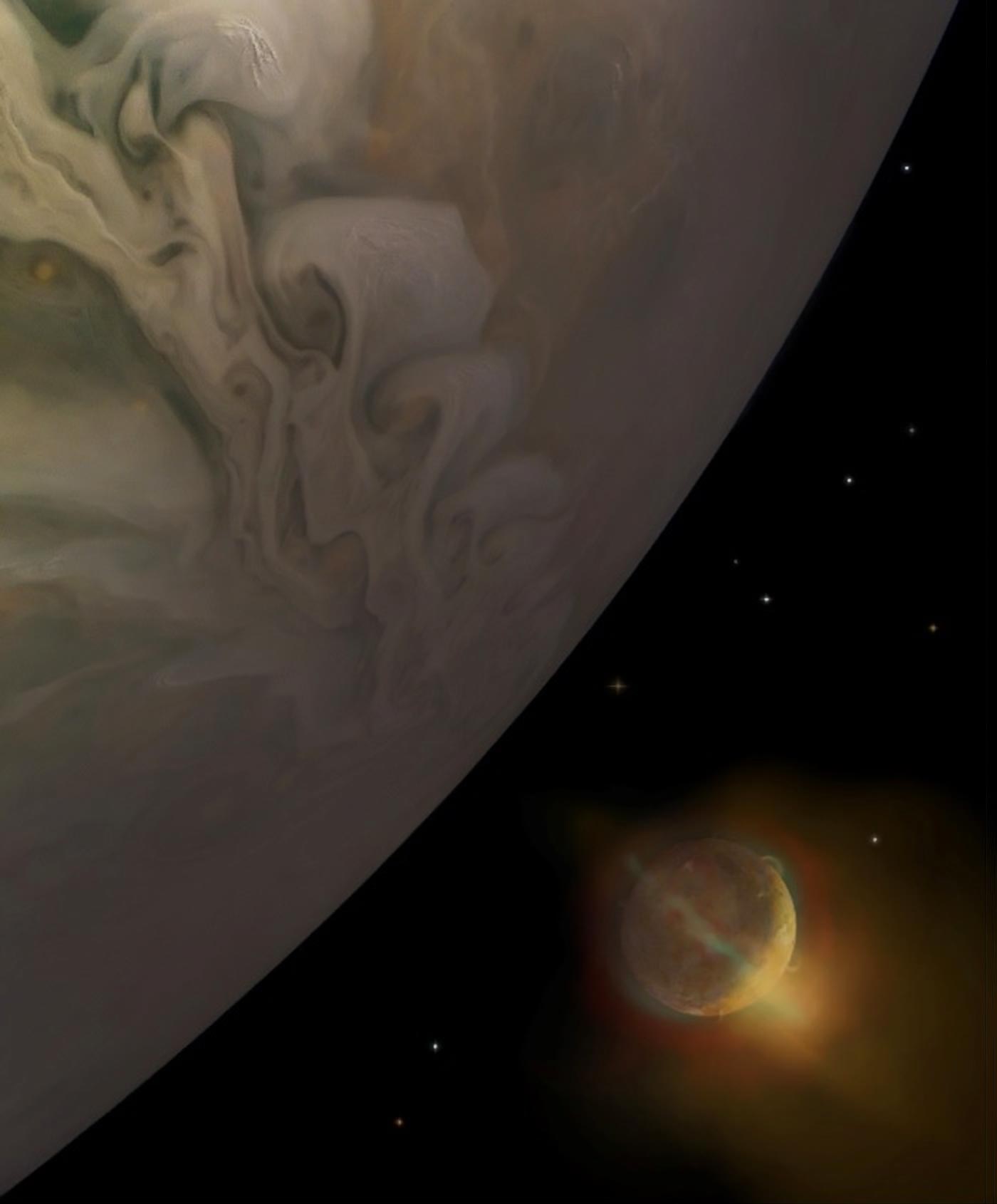
Visible aurorae have been observed on Jupiter’s four largest moons, showcasing unique atmospheric compositions like molecular oxygen and volcanic sodium.
Astronomers using W. M. Keck Observatory on Maunakea in Hawaiʻi have discovered that aurorae at visible wavelengths appear on all 4 major moons of Jupiter: Io, Europa, Ganymede, and Callisto.
A team led by Caltech and Boston University observed the moons in Jupiter’s shadow so that their faint aurorae, which are caused by the gas giant’s strong magnetic field, could be spotted without competition from bright sunlight reflected off of their surfaces. They used Keck Observatory’s High-Resolution Echelle Spectrometer (HIRES), a grating cross-dispersed, echelle spectrograph, as well as high-resolution spectrographs at the Large Binocular Telescope and Apache Point Observatory to make the observations.
“These observations are tricky because in Jupiter’s shadow the moons are nearly invisible. The light emitted by their faint aurorae is the only confirmation that we’ve even pointed the telescope at the right place,” says Katherine de Kleer, Caltech professor and lead author of one of two new research papers published on February 16, 2023, in the Planetary Science Journal describing the discovery.
Oxygen Aurorae Across the Galilean Moons
All four of the Galilean moons show the same oxygen aurora we see in skies near the Earth’s poles, but gases on Jupiter’s moons are much thinner, allowing a deep red color to glow nearly 15 times brighter than the familiar green light.
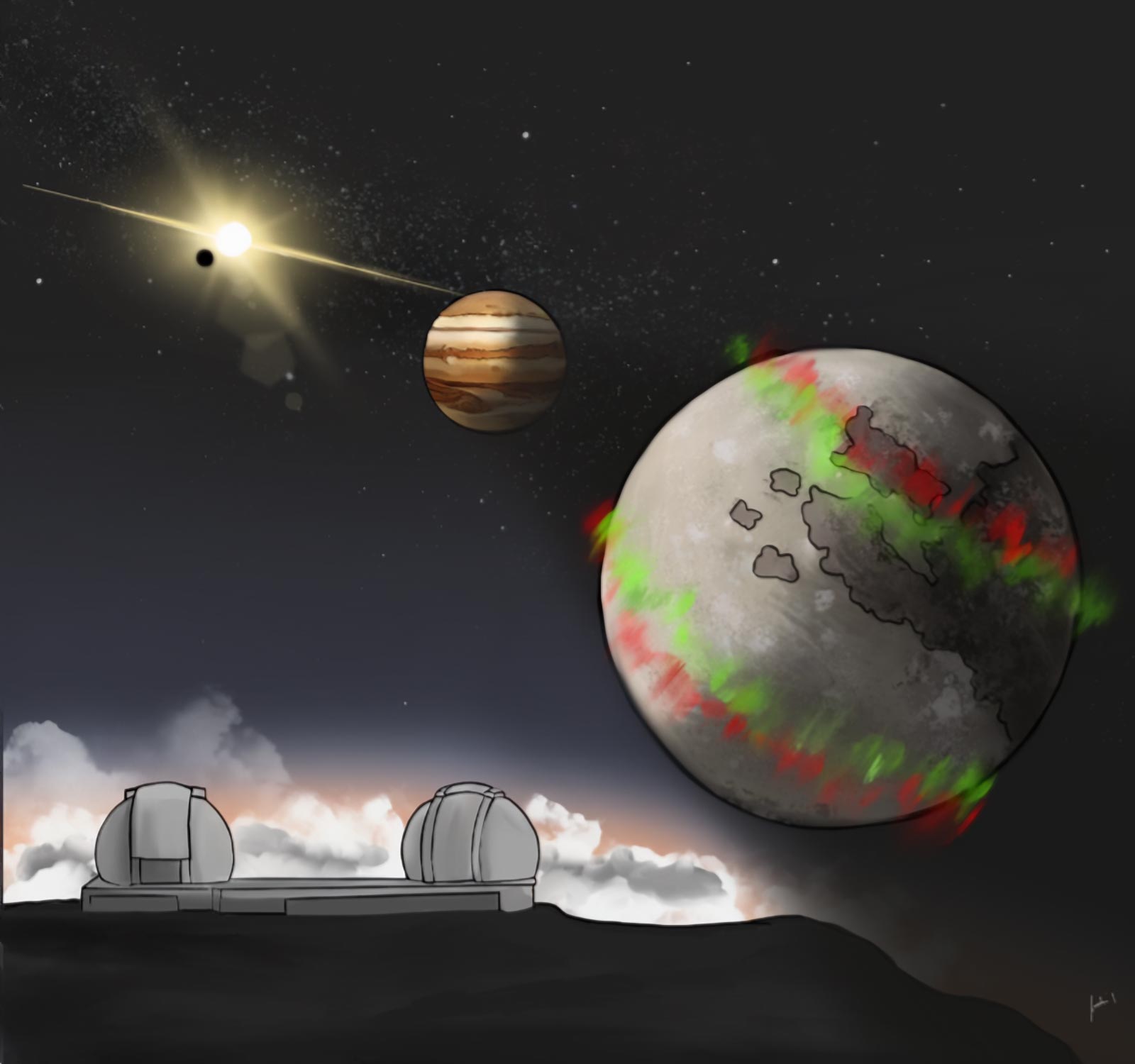
At Europa and Ganymede, oxygen also lights up infrared wavelengths, just a little redder than the human eye can see – the first occurrence of this phenomenon seen in the atmosphere of a body other than Earth.
Unique Auroral Phenomena on Io
At Io, Jupiter’s innermost moon, volcanic plumes of gas and dust are vast in size, reaching hundreds of kilometers in height. These plumes contain salts like sodium chloride and potassium chloride, which break down to produce additional colors. Sodium gives Io’s aurora the same yellowy-orange glow that we see in urban streetlamps. The new measurements also show potassium aurora at Io in infrared light, which has not been detected anywhere else previously.
“The brightness of the different colors of aurora tell us what these moons’ atmospheres are likely made up of,” said de Kleer. “We find that molecular oxygen, just like what we breathe here on Earth, is likely the main constituent of the icy moon atmospheres.”
The new measurements show minimal evidence for water, fueling an active scientific debate over whether the atmospheres of Jupiter’s moons feature significant water vapor. It’s currently believed that the outer 3 Galilean moons of Jupiter contain oceans of liquid water beneath their thick icy surfaces, and there’s tentative evidence that water in Europa’s atmosphere may sometimes be sourced from its ocean or liquid reservoirs within its ice shell.
Aurora Brightness and Atmospheric Dynamics
Since Jupiter’s strong magnetic field is tilted, aurorae on these moons change in brightness as the planet rotates. Additionally, the atmospheres can respond to the rapid transition from warm sunlight to the cold shadow of Jupiter.
“Io’s sodium becomes very faint within 15 minutes of entering Jupiter’s shadow, but it takes several hours to recover after it emerges into sunlight,” explains Carl Schmidt, Astronomy Professor at Boston University and lead author of the second paper. “These new characteristics are really insightful for understanding Io’s atmospheric chemistry. It’s neat that eclipses by Jupiter offer a natural experiment to learn how sunlight affects its atmosphere.”
New types of aurora on the four moons add an exciting aspect to what is already a golden age for fans of Jupiter thanks to NASA’s Juno mission and the James Webb Space Telescope. If you’re lucky enough to see the aurora here on Earth, pause to consider how amazing the show might appear if you were looking up from one of Jupiter’s moons.
References:
“The Optical Aurorae of Europa, Ganymede, and Callisto” by Katherine de Kleer, Zachariah Milby1, Carl Schmidt, Maria Camarca and Michael E. Brown, 16 February 2023, The Planetary Science Journal
DOI: 10.3847/PSJ/acb53c
“Io’s Optical Aurorae in Jupiter’s Shadow” by Carl Schmidt, Mikhail Sharov, Katherine de Kleer, Nick Schneider, Imke de Pater, Phillip H. Phipps, Albert Conrad, Luke Moore, Paul Withers, John Spencer, Jeff Morgenthaler, Ilya Ilyin, Klaus Strassmeier, Christian Veillet, John Hill and Mike Brown, 16 February 2023, The Planetary Science Journal.
DOI: 10.3847/PSJ/ac85b0
Never miss a breakthrough: Join the SciTechDaily newsletter.
Follow us on Google and Google News.