
Close Menu
    Facebook X (Twitter) Instagram
    SciTechDaily
    • Biology
    • Chemistry
    • Earth
    • Health
    • Physics
    • Science
    • Space
    • Technology
    Facebook X (Twitter) Pinterest YouTube RSS
    SciTechDaily
    Home»Space»New Black Hole Merger Simulations Could Power Next-Gen Gravitational Wave Detectors
    Space

    New Black Hole Merger Simulations Could Power Next-Gen Gravitational Wave Detectors

    By Rochester Institute of TechnologyJanuary 28, 20211 Comment3 Mins Read
    Facebook Twitter Pinterest Telegram LinkedIn WhatsApp Email Reddit
    Share
    Facebook Twitter LinkedIn Pinterest Telegram Email Reddit
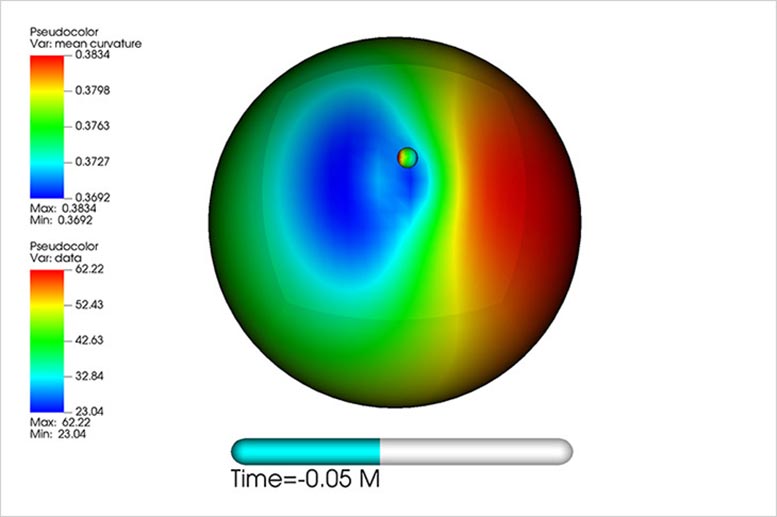
    Curvature Large Black Hole Horizon
    Color map of the curvature on the large black hole horizon generated by the near merging small black hole. Credit: Nicole Rosato

    Researchers at the Rochester Institute of Technology simulate extreme black hole mergers to support next-gen gravitational wave observatories like LISA.

    Rochester Institute of Technology scientists have developed new simulations of black holes with widely varying masses merging that could help power the next generation of gravitational wave detectors. RIT Professor Carlos Lousto and Research Associate James Healy from RIT’s School of Mathematical Sciences outline these record-breaking simulations in a new Physical Review Letters paper.

    As scientists develop more advanced detectors, such as the Laser Interferometer Space Antenna (LISA), they will need more sophisticated simulations to compare the signals they receive with. The simulations calculate the properties of the merged black holes including the final mass, spin, and recoil velocity, as well as peak frequency, amplitude, and luminosity of the gravitational waveforms the mergers produce.

    “Right now, we can only observe black holes of comparable masses because they are bright and generate a lot of radiation,” said Lousto. “We know there should be black holes of very different masses that we don’t have access to now through current technology and we will need these third generational detectors to find them. In order for us to confirm that we are observing holes of these different masses, we need these theoretical predictions and that’s what we are providing with these simulations.”

    The scientists from RIT’s Center for Computational Relativity and Gravitation created a series of simulations showing what happens when black holes of increasingly disparate masses—up to a record-breaking ratio of 128:1—orbit 13 times and merge.

    “From a computational point of view, it really is testing the limits of our method to solve Einstein’s general relativity equations on supercomputers,” said Lousto. “It pushes to the point that no other group in the world has been able to come close to. Technically, it’s very difficult to handle two different objects like two black holes, in this case one is 128 times larger than the other.”

    For more on this research, read Solving the Equations of General Relativity for Colliding Black Holes.

    Reference: “Exploring the Small Mass Ratio Binary Black Hole Merger via Zeno’s Dichotomy Approach” by Carlos O. Lousto and James Healy, 5 November 2020, Physical Review Letters.
    DOI: 10.1103/PhysRevLett.125.191102

    Collaborators on the project included Lousto, Healy, and Nicole Rosato ’18 MS (applied and computational mathematics), a mathematical modeling Ph.D. student. The research was supported through National Science Foundation funding and the simulations were performed using local computing clusters as well as national supercomputers such including the Texas Advanced Computing Center’s Frontera System and Extreme Science and Engineering Discovery Environment.

    Never miss a breakthrough: Join the SciTechDaily newsletter.
    Follow us on Google and Google News.

    Astrophysics Black Hole Gravitational Waves Rochester Institute of Technology
    Share. Facebook Twitter Pinterest LinkedIn Email Reddit

    Related Articles

    Highly Eccentric Black Hole Merger Detected for the First Time

    Massive, Spinning Black Holes Could Be the Result of ‘Pac-Man-Like’ Mergers

    New Research Shows LIGO’s Twin Black Holes Might Have Been Born Inside a Single Star

    First Time Solutions Provide New Insight in Black Hole Collisions

    Three Closely Orbiting Supermassive Black Holes Could Help in the Search for Gravitational Waves

    Simulations Re-Create the Complex Dynamics Near a Black Hole

    Supersensitive Detectors to Aid in the Discovery of Gravitational Waves

    NASA Study Bridges the Gap Between Theory and Black Hole Observations

    Simulation Shows What Happens in the Last Stages of a Black Hole Merger

    1 Comment

    1. Bibhutibhusanpatel on January 30, 2021 9:17 pm

      Theratio128isto1seemsquietrightbuttheinsþrumetmustbeneùþralisedwithgravityofthesuntwicewithcomìnedgravìtaþìonalandelectromagneticwavemaytreatingelectricandmegneticpartsepàratelyisabletoproducecertainresultsofexperimentatstomapblackholesoftheuniverse

      Reply
    Leave A Reply Cancel Reply

    • Facebook
    • Twitter
    • Pinterest
    • YouTube

    Don't Miss a Discovery

    Subscribe for the Latest in Science & Tech!

    Trending News

    Popular Vitamin B3 Supplements May Help Cancer Cells Survive, Scientists Warn

    Scientists Discover Strange Property of Rice and Turn It Into a Smart Material

    NASA Artemis II Skips Burn As Astronaut Captures Stunning View of Earth

    NASA’s Artemis II: Humans Just Left Earth Orbit for the First Time Since 1972

    What Causes Chronic Pain? Scientists Identify Key Culprit in the Brain

    Semaglutide Shows Surprising Mental Health Benefits in Massive 100,000-Person Study

    This Liquid Snapped Instead of Flowing and Scientists Were Shocked

    Breakthrough Alzheimer’s Drug Rewires the Brain Instead of Just Clearing Plaques

    Follow SciTechDaily
    • Facebook
    • Twitter
    • YouTube
    • Pinterest
    • Newsletter
    • RSS
    SciTech News
    • Biology News
    • Chemistry News
    • Earth News
    • Health News
    • Physics News
    • Science News
    • Space News
    • Technology News
    Recent Posts
    • Scientists Uncover the Secret “Glue” That Helps Soil Hold Water
    • Climate Change Is Altering a Key Greenhouse Gas in a Way Scientists Didn’t Expect
    • Why Antarctic Sea Ice Suddenly Collapsed After Decades of Growth
    • Astronomers Discover the Most Pristine Star Ever Found
    • New Study Suggests Gravitational Waves May Have Created Dark Matter
    Copyright © 1998 - 2026 SciTechDaily. All Rights Reserved.
    • Science News
    • About
    • Contact
    • Editorial Board
    • Privacy Policy
    • Terms of Use

    Type above and press Enter to search. Press Esc to cancel.