
Close Menu
    Facebook X (Twitter) Instagram
    SciTechDaily
    • Biology
    • Chemistry
    • Earth
    • Health
    • Physics
    • Science
    • Space
    • Technology
    Facebook X (Twitter) Pinterest YouTube RSS
    SciTechDaily
    Home»Chemistry»New Catalyst Discovery Cuts Costs and Boosts Green Chemistry
    Chemistry

    New Catalyst Discovery Cuts Costs and Boosts Green Chemistry

    By Osaka UniversityFebruary 9, 2024No Comments4 Mins Read
    Facebook Twitter Pinterest Telegram LinkedIn WhatsApp Email Reddit
    Share
    Facebook Twitter LinkedIn Pinterest Telegram Email Reddit
    Abstract Chemistry Molecule
    Osaka University researchers have developed a more sustainable and cost-effective catalyst for chemical synthesis, significantly reducing the need for rare and expensive metals. Their nickel carbide nanoparticle catalyst efficiently converts nitriles to primary amines under mild conditions, offering a promising solution for the environmentally friendly production of pharmaceuticals and everyday products.

    A team from Osaka University, along with their collaborators, has created a cost-effective catalyst for a key chemical process, potentially paving the way for further initiatives to reduce expenses within the chemical sector.

    The chemical industry often relies on scarce and costly metals to manufacture pharmaceuticals and other crucial materials. Substituting these metals with more readily available and affordable alternatives could enhance environmental sustainability, reduce expenses, and decrease the likelihood of supply chain interruptions.

    Now, in a study recently published in Chemistry – A European Journal, researchers from Osaka University and collaborating partners have met this need in their work on an industrially useful chemical transformation. The simple, gentle reaction conditions reported here might inspire researchers who are working to reduce use of expensive metals for as many chemical reactions as possible.

    The Role of Noble Metals and Alternatives

    So-called noble metals are especially versatile materials. For example, palladium is a metal of choice for catalyzing a chemical transformation – converting nitriles into primary amines – that is a common step in nylon and plastics production. However, such metals are rare and costly. Substitutes based on common metals such as nickel could be cheaper catalysts.
    Nano Ni3CAl2O3 Catalyst Graphic
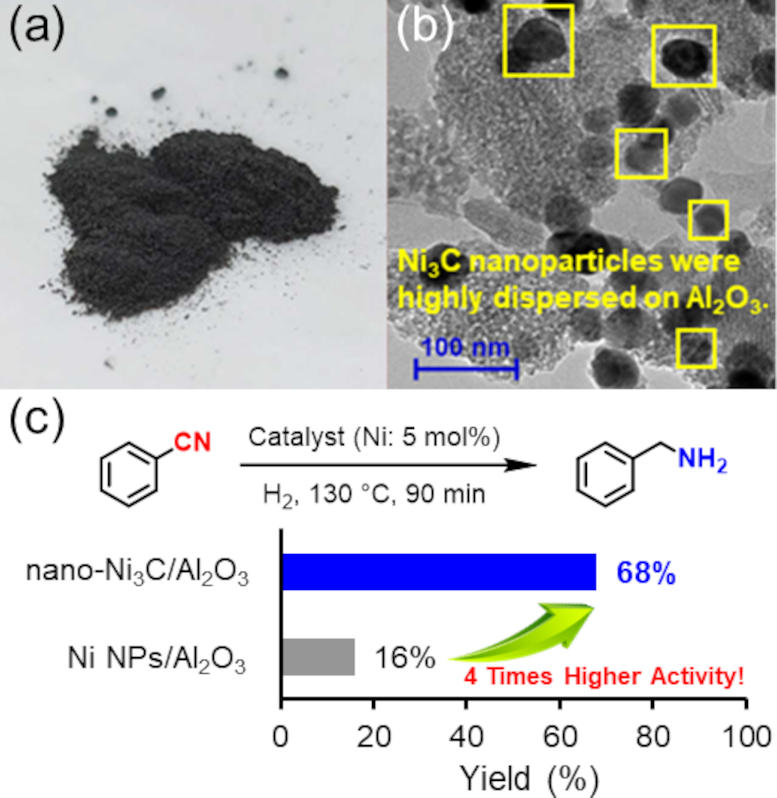
    (a) The photo of nano-Ni3C/Al2O3 catalyst. (b) Transmission electron microscope image of nano-Ni3C/Al2O3. (c) Hydrogenation of nitrile to benzylamine using nano-Ni3C or Ni nanoparticle catalyst, and the substrate scope for the nitrile hydrogenation catalyzed by nano-Ni3C/Al2O3. Credit: 2024 Yamaguchi et al., Nickel Carbide Nanoparticle Catalyst for Selective Hydrogenation of Nitriles to Primary Amines, Chemistry – A European Journal

    Unfortunately, many cheap metals require challenging experimental conditions, such as high pressures and temperatures, for the previously mentioned chemical transformation. Determining whether nickel carbide has the same limitations – and if not, evaluating the scope of the chemical transformations that are possible with this catalyst – was the goal of the research team’s study.

    Research Findings and Catalyst Benefits

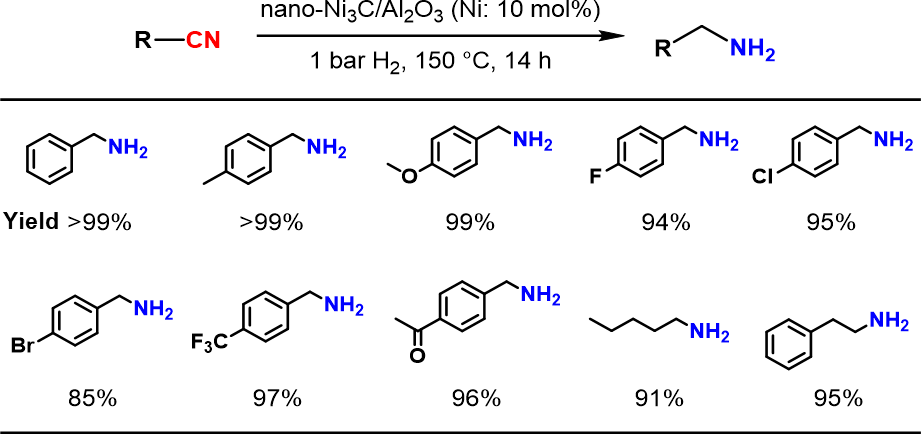
    “In our work, we thoroughly study the reaction chemistry that underlies a novel nickel carbide nanoparticle heterogeneous catalyst for selective hydrogenation of nitriles into primary amines,” explains Sho Yamaguchi, lead author of the study. “The substrate scope is broad – many types of heteroaromatic and aliphatic nitriles can undergo this transformation.”
    Hydrogenation of Various Nitriles Using the Nano Ni3CAl2O3 Catalyst
    Hydrogenation of various nitriles using the nano-Ni3C/Al2O3 catalyst under 1 bar H2. Credit: 2024 Yamaguchi et al., Nickel Carbide Nanoparticle Catalyst for Selective Hydrogenation of Nitriles to Primary Amines, Chemistry – A European Journal

    There are several advantages of the researchers’ catalyst. One, despite the mild required reaction conditions – 1-atmosphere pressure of hydrogen and a relatively low temperature of approximately 150°C – the catalyst still exhibited 4 times the activity of simple nickel nanoparticles. Two, the catalyst was reusable: at least 3-times. Three, the reaction yields were high: up to 99%.

    “We’re excited because our research will help minimize the use of expensive metals for and simplifies the experimental setup of a common class of chemical syntheses,” says Tomoo Mizugaki, senior author. “Furthermore, our theoretical calculations provide insights that will help us optimize the catalyst for additional applications.”

    This work is an important step forward in increasing the sustainability of a class of chemical reactions that are required for synthesizing pharmaceuticals and many other everyday products. Because the nickel catalyst is much cheaper than a noble metal, and the required experimental procedures are simple, feasible applications to further chemical transformations should be straightforward.

    Reference: “Nickel Carbide Nanoparticle Catalyst for Selective Hydrogenation of Nitriles to Primary Amines” by Sho Yamaguchi, Daiki Kiyohira, Kohei Tada, Taiki Kawakami, Akira Miura, Takato Mitsudome and Tomoo Mizugaki, 5 January 2024, Chemistry – A European Journal.
    DOI: 10.1002/chem.202303573

    The study was funded by the Japan Society for the Promotion of Science and the Ministry of Education, Culture, Sports, Science and Technology.

    Never miss a breakthrough: Join the SciTechDaily newsletter.
    Follow us on Google and Google News.

    Catalysts University of Osaka
    Share. Facebook Twitter Pinterest LinkedIn Email Reddit

    Related Articles

    Revolutionary Super Polymer: Unbelievably Tough and Endlessly Recyclable

    Cobalt-Graphene Catalyst Performs Nearly As Well as Platinum

    Dempsey’s Mechanism, Pathway that Catalysts Use to Generate Hydrogen

    Scientists Examine Platinum-Based Catalyst Design

    Amino Acid Organocatalyst Halves Synthesis of Prostaglandin-Class Drugs

    Searching for an Efficient Way to Make Methanol

    Zeolite Catalyst Creates P-Xylene From Biomass

    Working to Recycle Greenhouse Gases

    Gold Improves the Performance of Nanoparticle Fuel-Cell Reactions

    Leave A Reply Cancel Reply

    • Facebook
    • Twitter
    • Pinterest
    • YouTube

    Don't Miss a Discovery

    Subscribe for the Latest in Science & Tech!

    Trending News

    Scientists Uncover Potential Brain Risks of Popular Fish Oil Supplements

    Scientists Discover a Surprising Way To Make Bread Healthier and More Nutritious

    After 60 Years, Scientists Uncover Unexpected Brain Effects of Popular Diabetes Drug Metformin

    New Research Uncovers Hidden Side Effects of Popular Weight-Loss Drugs

    Scientists Rethink Extreme Warming After Surprising Ocean Discovery

    Landmark Study Links Never Marrying to Significantly Higher Cancer Risk

    Researchers Discover Unknown Beetle Species Just Steps From Their Lab

    Largest-Ever Study Finds Medicinal Cannabis Ineffective for Anxiety, Depression, PTSD

    Follow SciTechDaily
    • Facebook
    • Twitter
    • YouTube
    • Pinterest
    • Newsletter
    • RSS
    SciTech News
    • Biology News
    • Chemistry News
    • Earth News
    • Health News
    • Physics News
    • Science News
    • Space News
    • Technology News
    Recent Posts
    • Not Just Alzheimer’s: Scientists Uncover Clues to a Second, Overlooked Disorder
    • Scientists Uncover Dangerous Connection Between Serotonin and Heart Valve Disease
    • Scientists Discover a “Protector” Protein That Could Help Reverse Hair Loss
    • Powerful Lasers Reveal How Matter Becomes Plasma in Trillionths of a Second
    • A Simpler Path to Super-Resolution: Scientists Reinvent Microscopy
    Copyright © 1998 - 2026 SciTechDaily. All Rights Reserved.
    • Science News
    • About
    • Contact
    • Editorial Board
    • Privacy Policy
    • Terms of Use

    Type above and press Enter to search. Press Esc to cancel.