

Close Menu
    Facebook X (Twitter) Instagram
    SciTechDaily
    • Biology
    • Chemistry
    • Earth
    • Health
    • Physics
    • Science
    • Space
    • Technology
    Facebook X (Twitter) Pinterest YouTube RSS
    SciTechDaily
    Home»Health»New “Cellular” Target Could Transform How We Treat Alzheimer’s Disease
    Health

    New “Cellular” Target Could Transform How We Treat Alzheimer’s Disease

    By University of MalagaFebruary 26, 2026No Comments4 Mins Read
    Facebook Twitter Pinterest Telegram LinkedIn WhatsApp Email Reddit
    Share
    Facebook Twitter LinkedIn Pinterest Telegram Email Reddit
    Doctor Examines Brain Scan Disease Treatment
    Scientists have identified prematurely aged astrocytes in the brains of Alzheimer’s patients, particularly those with the APOE4 risk gene. Their findings suggest that cellular senescence in these support cells may actively fuel neurodegeneration, pointing to a promising new therapeutic target. Credit: Shutterstock

    A new study from researchers highlights an unexpected player in Alzheimer’s disease: aging astrocytes.

    Senescent astrocytes have been identified as a major contributor to Alzheimer’s progression. The cells lose protective functions and fuel inflammation, particularly in APOE4 carriers. The findings highlight senolytic drugs as a potential new therapy.

    For the first time, the research team has shown that senescent astrocytes are present in the brains of people with Alzheimer’s disease. These cells remain alive but have lost their normal function, and their accumulation suggests that cellular aging plays a direct and significant role in neurodegeneration.

    The findings were published in the Journal of Neuroinflammation. The study was led by Dr. Antonia Gutiérrez, Professor of Cell Biology and Principal Investigator of the NeuroAD group, alongside Dr. Juan Antonio García León, Associate Professor of Cell Biology. The research team also included Laura Cáceres, Laura Trujillo, Elba López, Elisabeth Sánchez, and Inés Moreno.

    Astrocytes are the most common type of glial cell in the brain. They are essential for maintaining healthy neurons and supporting proper brain function. However, the researchers found that in individuals with the strongest genetic risk factor for Alzheimer’s disease (APOE4), astrocytes show signs of abnormal early aging.

    APOE4 Genotype Drives Premature Astrocyte Aging

    “We have confirmed that these damaged astrocytes not only lose their ability to protect neurons but also adopt a pro-inflammatory profile that severely compromises neuronal survival,” the authors explain. Upon entering a state of senescence, the cells accumulate DNA damage, exhibit mitochondrial alterations—the cellular ‘powerhouses’—and ’release toxic molecules that amplify inflammation and tissue damage in the brain.
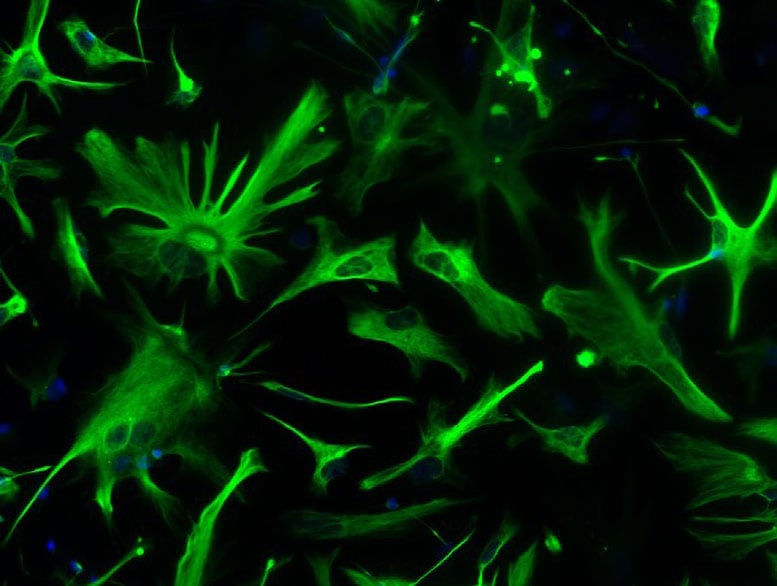
    Astrocytes Derived From hiPSCs of a Patient With Alzheimer’s Disease
    Astrocytes derived from hiPSCs of a patient with Alzheimer’s disease, with green being GFAP (intermediate filaments composed of glial fibrillary acidic protein; cellular cytoskeleton) and blue being DNA (cell nucleus). Credit: University of Malaga

    To investigate these processes, the scientists used induced pluripotent stem cells (iPSCs). By taking small skin samples from patients, they were able to reprogram the cells in the laboratory and generate functional human astrocytes for detailed study.

    This approach allowed the team to examine disease mechanisms directly in human cells, avoiding some of the limitations of animal models, which do not always capture the full complexity of the human brain.

    Human Validation Confirms Central Role in Neurodegeneration

    The laboratory findings were reinforced by examining brain tissue obtained after death from individuals with Alzheimer’s disease. The analysis strongly suggested that nearly 80 percent of the cells in the cerebral cortex that displayed signs of premature aging were astrocytes. This proportion was much higher than what is seen in healthy people of the same age.

    Researchers From the NeuroAD Group at the University of Málaga
    Researchers from the NeuroAD group (Neuropathology of Alzheimer’s Disease) within the Department of Cell Biology, Genetics, and Physiology at the University of Málaga, also affiliated with the IBIMA–BIONAND Platform and CIBERNED, have made a pioneering breakthrough in the fight against this disease by identifying astrocytes as a promising cellular target for the development of future therapies. Credit: University of Málaga

    Together, these results support the idea that astrocyte senescence is not simply a byproduct of the disease but a driving force behind its progression.

    The discovery is especially important given that there is currently no effective treatment capable of curing Alzheimer’s disease or stopping its advance. In Spain alone, more than 1.2 million people are affected.

    The findings suggest a new therapeutic direction focused on developing innovative strategies such as senolytic drugs. These treatments would aim to eliminate or “reprogram” aged astrocytes, with the goal of preserving neurons and slowing cognitive decline.

    Reference: “Human iPSC-derived APOE4/4 Alzheimer´s disease astrocytes exhibit a senescent and pro-inflammatory state that compromises neuronal support” by Laura Caceres-Palomo, Elisabeth Sanchez-Mejias, Laura Trujillo-Estrada, Juan Jose Perez-Moreno, Elba Lopez-Oliva, Tau En Lim, Leah DeFlitch, Serena H. Chang, Lucas Kampman, M. Ryan Corces, Mathew Blurton-Jones, Ines Moreno-Gonzalez, Alberto Pascual, Javier Vitorica, Juan Antonio Garcia-Leon and Antonia Gutierrez, 12 December 2025, Journal of Neuroinflammation.
    DOI: 10.1186/s12974-025-03607-z

    Never miss a breakthrough: Join the SciTechDaily newsletter.
    Follow us on Google and Google News.

    Alzheimer's Disease Cells Dementia Disease University of Malaga
    Share. Facebook Twitter Pinterest LinkedIn Email Reddit

    Related Articles

    Researchers Move Closer to a Blood Test for Alzheimer’s Disease

    FDA Approved Bexarotene Reverses Alzheimer’s Disease Deficits in Mice

    New Imaging Method Detects Alzheimer’s Risk Years before the Disease Strikes

    Vitamin D3 and Omega-3 May Help Fight Alzheimer’s

    Galactic Cosmic Radiation Poses Significant Threat to Astronauts, Could Accelerate the Onset of Alzheimer’s

    Disrupted Sleep Patterns Linked to Alzheimer’s

    Souvenaid Appears to Stimulate Growth of New Synapses in Patients With Early Alzheimer’s

    Role of the SMN Gene in Spinal Muscular Atrophy

    Flavonoid Compound Shown to Prevent Blood Clots

    Leave A Reply Cancel Reply

    • Facebook
    • Twitter
    • Pinterest
    • YouTube

    Don't Miss a Discovery

    Subscribe for the Latest in Science & Tech!

    Trending News

    Why Popular Diabetes Drugs Like Ozempic Don’t Work for Everyone: The “Genetic Glitch”

    Scientists Stunned After Finding Plant Thought Extinct for 60 Years

    Scientists Discover Tiny New Spider That Hunts Prey 6x Its Size

    Natural Component From Licorice Shows Promise for Treating Inflammatory Bowel Disease

    Scientists Warn: Popular Sweetener Linked to Dangerous Metabolic Effects

    Monster Storms on Jupiter Unleash Lightning Beyond Anything on Earth

    Scientists Create “Liquid Gears” That Spin Without Touching

    The Simple Habit That Could Help Prevent Cancer

    Follow SciTechDaily
    • Facebook
    • Twitter
    • YouTube
    • Pinterest
    • Newsletter
    • RSS
    SciTech News
    • Biology News
    • Chemistry News
    • Earth News
    • Health News
    • Physics News
    • Science News
    • Space News
    • Technology News
    Recent Posts
    • Seeing the Invisible: Scientists Develop New Way To Track Particles in 3D
    • The Atomic Gap That Could Cost the Semiconductor Industry Billions
    • Earth’s Secret Advantage: Why Most Alien Worlds May Be Too Dry for Life
    • Ancient Bacteria Turned a DNA System Into a Cell Skeleton
    • Researchers Finally Solve 50-Year-Old Blood Group Mystery
    Copyright © 1998 - 2026 SciTechDaily. All Rights Reserved.
    • Science News
    • About
    • Contact
    • Editorial Board
    • Privacy Policy
    • Terms of Use

    Type above and press Enter to search. Press Esc to cancel.