

Close Menu
    Facebook X (Twitter) Instagram
    SciTechDaily
    • Biology
    • Chemistry
    • Earth
    • Health
    • Physics
    • Science
    • Space
    • Technology
    Facebook X (Twitter) Pinterest YouTube RSS
    SciTechDaily
    Home»Health»New Clue in Alzheimer’s: It Might Be in Your Blood Vessels, Not Just Your Brain
    Health

    New Clue in Alzheimer’s: It Might Be in Your Blood Vessels, Not Just Your Brain

    By University of CalgaryApril 13, 20251 Comment4 Mins Read
    Facebook Twitter Pinterest Telegram LinkedIn WhatsApp Email Reddit
    Share
    Facebook Twitter LinkedIn Pinterest Telegram Email Reddit
    Blood Vessel Damage Concept Art
    New research from the University of Calgary highlights the role of the brain’s vascular system in Alzheimer’s disease, focusing on a protein called CD2AP. Reduced levels of CD2AP were found in the brain blood vessels of Alzheimer’s patients, correlating with worse memory, especially in men. The study suggests Alzheimer’s may be more closely linked to vascular diseases than previously thought. Credit: SciTechDaily.com

    The interaction between the brain and the vascular system could hold the key to lowering disease risk.

    According to the Alzheimer Society of Canada, one in four Canadians over the age of 85 is living with dementia, with Alzheimer’s disease (AD) accounting for more than 60% of those cases.

    While Alzheimer’s is commonly associated with the buildup of abnormal proteins in the brain, forming plaques and tangles, a new study from researchers at the University of Calgary suggests that the brain’s blood vessels may also play a critical role in the disease.

    The research highlights the importance of a protein called CD2AP, which may offer new insight into how Alzheimer’s develops. This finding could significantly shift current understanding and approaches to treatment, says Dr. Minh Dang Nguyen, PhD, the study’s lead investigator and a professor in the Department of Clinical Neurosciences at the Cumming School of Medicine, as well as a member of the Hotchkiss Brain Institute.
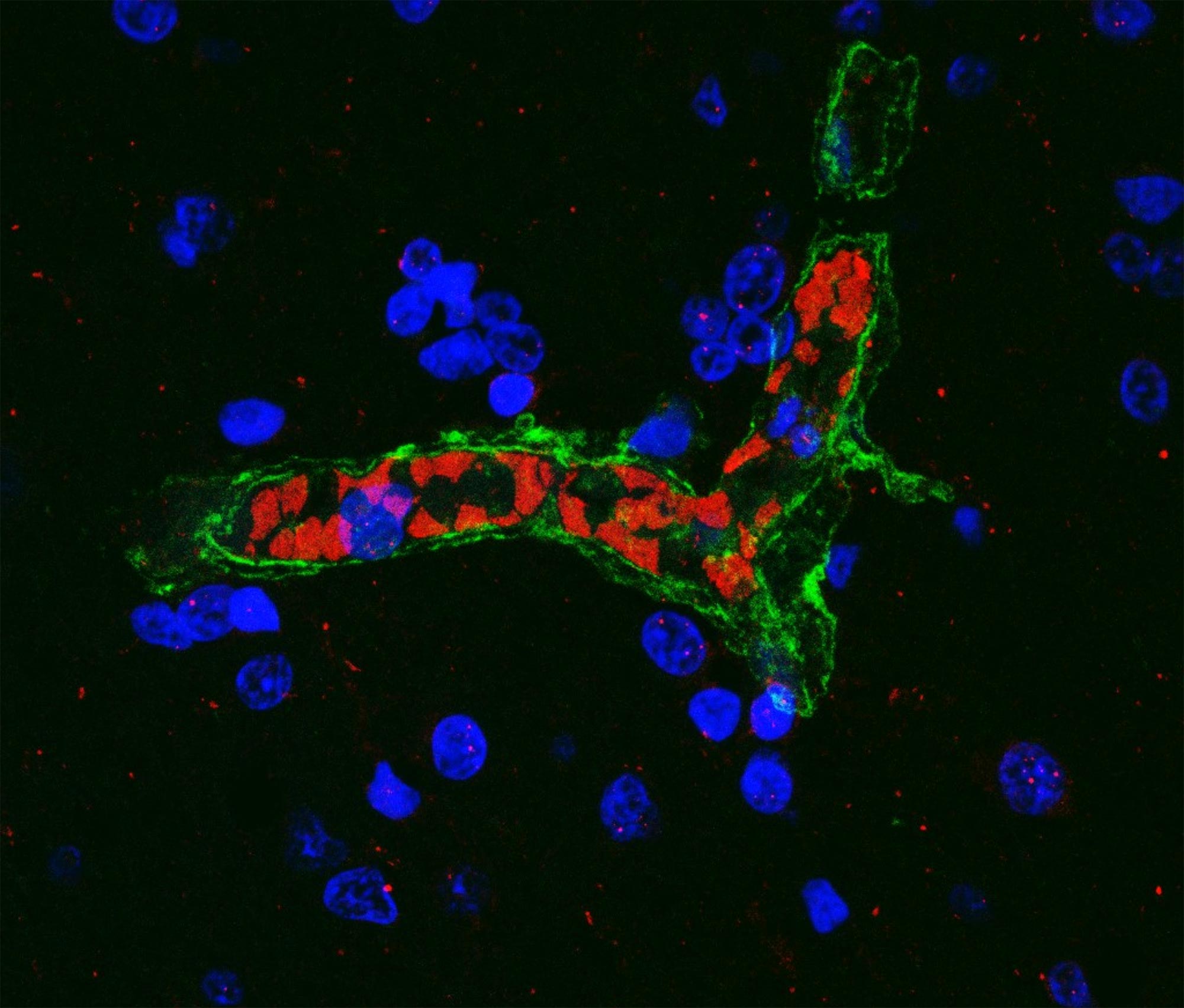
    Healthy Human Brain Vessel
    Image of a healthy brain vessel with high levels of CD2AP protein shown in red. Credit: Louise Reveret, co-author on study

    Nguyen compares the brain’s vascular system to a tree. The complex branches—arteries, capillaries, and veins—are critical to delivering nutrients throughout the brain. The cerebrovascular system in AD patients, he says, doesn’t deliver those nutrients properly.

    AD may be more related to diseases of the vascular system, such as arteriosclerosis or diabetes, than anticipated, he says.

    The Role of CD2AP in Brain Health

    Nguyen says the discovery, published in the journal Neuron, reveals important factors to consider about how the brain interacts with the vascular system and, particularly, the cells that form the brain blood vessels, called brain endothelial cells.

    Importantly, the researchers discovered that the levels of CD2AP are reduced in the brain blood vessels of patients who died with AD.

    Minh Dang Nguyen and Milène Vandal
    Minh Dang Nguyen and Milène Vandal members of the Hotchkiss Brain Institute at the University of Calgary. Credit: Quentin Collier, Department of Clinical Neurosciences

    “The lower the levels, the worse was their memory function prior to death,” says Nguyen. “This correlation is particularly striking in males.”

    Sex-Based Differences and CD2AP

    The researchers dived deeper and applied what they observed in human samples to studies using mice that have altered levels of CD2AP.

    “We saw a lot of differences in how the vasculature was functioning related to CD2AP levels with consequences on memory function,” says Dr. Milène Vandal, PhD, first author on the study.

    In fact, says Vandal, CD2AP may be protective for females, adding to the sex-dependent result. More research into new approaches based on sex may be needed.

    “If you’re trying to improve the vascular system of a person to reduce their risk of AD, you might want to have different strategies for men and women, because their vascular system is just not reacting the same way,” she says.

    While this discovery could lead to future treatments that target CD2AP—at least in half the population—Vandal says the timeline for most new drugs is very long.

    Instead, the researchers say there are easier ways to reduce the risk of AD and all other vascular diseases.

    “I think the immediate strategy is, really, take care of yourself and your lifestyle—anything that affects the vascular system,” says Nguyen. “A good diet, exercise, less stress, and better sleep—interventions that work for both sexes.”

    Reference: “Loss of endothelial CD2AP causes sex-dependent cerebrovascular dysfunction” by Milène Vandal, Adam Institoris, Louise Reveret, Ben Korin, Colin Gunn, Sotaro Hirai, Yulan Jiang, Sukyoung Lee, Jiyeon Lee, Philippe Bourassa, Ramesh C. Mishra, Govind Peringod, Faye Arellano, Camille Belzil, Cyntia Tremblay, Mada Hashem, Kelsea Gorzo, Esteban Elias, Jinjing Yao, Bill Meilandt, Oded Foreman, Meron Roose-Girma, Steven Shin, Daniel Muruve, Wilten Nicola, Jakob Körbelin, Jeff F. Dunn, Wayne Chen, Sang-Ki Park, Andrew P. Braun, David A. Bennett, Grant R.J. Gordon, Frédéric Calon, Andrey S. Shaw and Minh Dang Nguyen, 31 January 2025, Neuron.
    DOI: 10.1016/j.neuron.2025.01.006

    The study was funded by the Canadian Institutes of Health Research and the Krembil Foundation.

    Never miss a breakthrough: Join the SciTechDaily newsletter.
    Follow us on Google and Google News.

    Alzheimer's Disease Brain Dementia Neurology University of Calgary
    Share. Facebook Twitter Pinterest LinkedIn Email Reddit

    Related Articles

    These Signs of Memory Loss Could Actually Predict Alzheimer’s Brain Changes

    Are We Evolving? New Research Reveals That Human Brains Are Getting Larger

    Scientists Discover New Telltale Sign of Alzheimer’s

    Certain Protein May Predict Mild Cognitive Impairment Years Before Symptoms

    Losing Your Sense of Smell – A Potential Warning of Future Memory and Thinking Problems

    Early Menopause May Increase Risk of Alzheimer’s Disease

    Alleviating Symptoms: Brain Stimulation Could Help Treat Alzheimer’s Disease

    Alzheimer’s Breakthrough: New Therapeutic Target Found

    A Diabetes Drug Could Protect Against Alzheimer’s

    1 Comment

    1. kamir bouchareb st on April 13, 2025 1:23 pm

      thank you for this

      Reply
    Leave A Reply Cancel Reply

    • Facebook
    • Twitter
    • Pinterest
    • YouTube

    Don't Miss a Discovery

    Subscribe for the Latest in Science & Tech!

    Trending News

    Scientists May Have Found the Key to Jupiter and Saturn’s Moon Mystery

    Scientists Uncover Brain Changes That Link Pain to Depression

    Saunas May Do More Than Raise Body Temperature – They Activate Your Immune System

    Exercise in a Pill? Metformin Shows Surprising Effects in Cancer Patients

    Hidden Oceans of Magma Could Be Protecting Alien Life

    New Study Challenges Alzheimer’s Theories: It’s Not Just About Plaques

    Artificial Sweeteners May Harm Future Generations, Study Suggests

    Splashdown! NASA Artemis II Returns From Record-Breaking Moon Mission

    Follow SciTechDaily
    • Facebook
    • Twitter
    • YouTube
    • Pinterest
    • Newsletter
    • RSS
    SciTech News
    • Biology News
    • Chemistry News
    • Earth News
    • Health News
    • Physics News
    • Science News
    • Space News
    • Technology News
    Recent Posts
    • Ancient DNA Reveals Irish Goats Have a 3,000-Year-Old Lineage Still Alive Today
    • Historians Reveal Secrets of the Strange Hat Wars That Shook Early Modern England
    • “A Plague Is Upon Us”: The Mass Death That Changed an Ancient City Forever
    • This Strange Material Can Turn Superconductivity on and off Like a Switch
    • Scientists Discover Game-Changing New Way To Treat High Cholesterol
    Copyright © 1998 - 2026 SciTechDaily. All Rights Reserved.
    • Science News
    • About
    • Contact
    • Editorial Board
    • Privacy Policy
    • Terms of Use

    Type above and press Enter to search. Press Esc to cancel.