
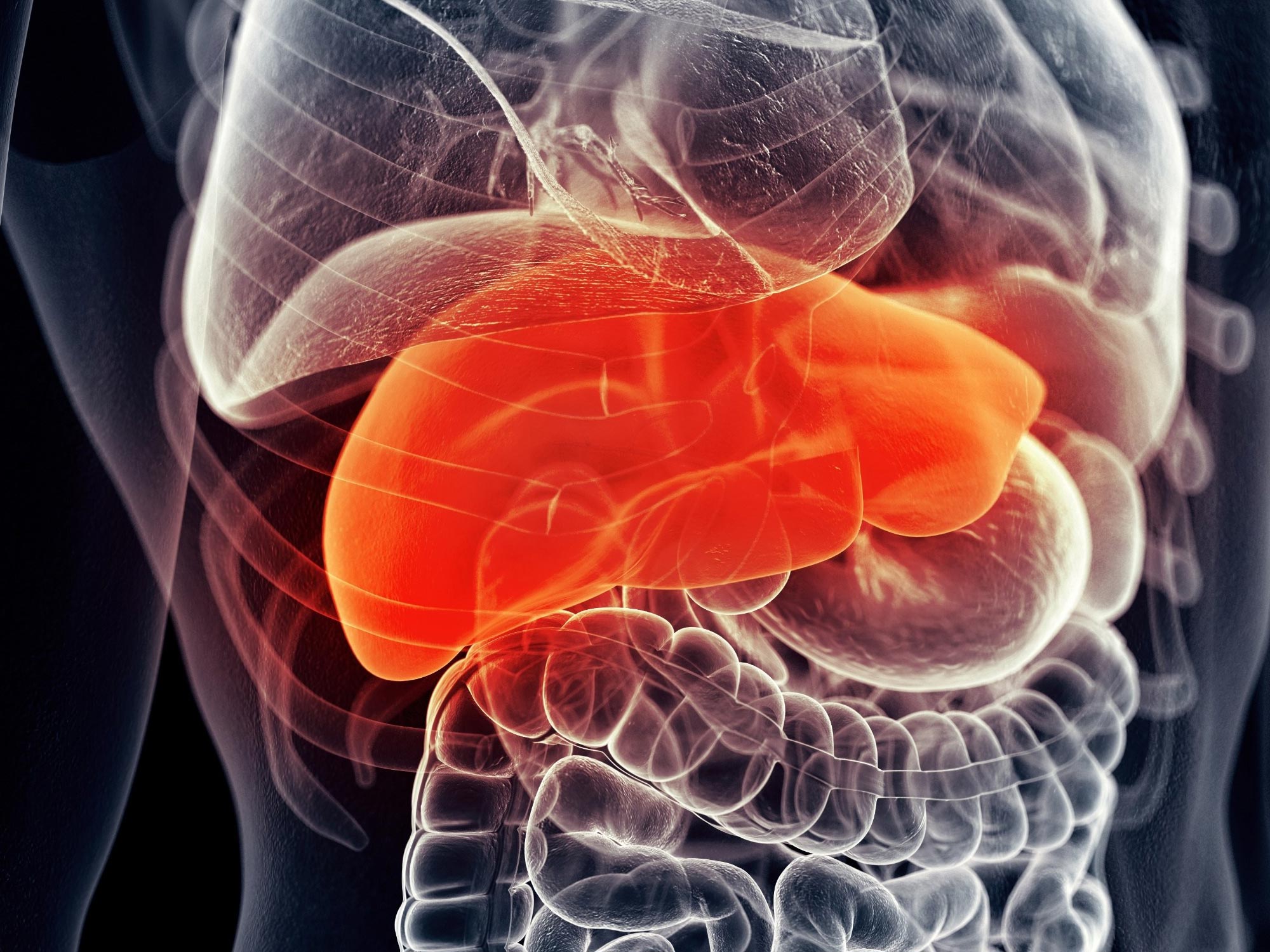
A new experimental compound may help protect the liver after surgical removal of parts of the small intestine.
When sections of the small intestine become severely damaged or die, surgeons may need to remove the affected tissue. Although this operation can save a patient’s life, the procedure — known as a radical small bowel resection — can trigger serious long-term complications. In some patients, it leads to progressive liver damage and even liver failure, which may ultimately require a liver transplant. Currently, no medications exist to prevent or treat this complication, which studies suggest may affect as many as 15% of people who undergo small bowel resection.
Researchers at Washington University School of Medicine in St. Louis have now developed and tested a new experimental compound in mice that may help address this problem. Their findings suggest the drug could help protect the liver while also improving the body’s ability to absorb nutrients following small bowel surgery. Importantly, the researchers found that the compound acts only within the gastrointestinal tract, which could reduce the risk of side effects elsewhere in the body.
The findings were published March 6 in the journal Gastroenterology.
“Our goal is to advance a therapeutic drug capable of preserving liver function and mitigating the necessity for liver transplants in people who’ve undergone small bowel surgery,” said Gwendalyn Randolph, PhD, the study’s senior author and the Emil R. Unanue Distinguished Professor of Immunology in the WashU Medicine Department of Pathology & Immunology. “This study offers a promising pathway for developing such a treatment.”
Protecting the liver through the gut
Small bowel resection is often performed in premature infants with necrotizing enterocolitis, a severe gastrointestinal disease that causes sections of the intestine to die and must be surgically removed. While the surgery can be lifesaving, it frequently results in short bowel syndrome. This condition occurs when a shortened intestine cannot effectively absorb nutrients.
Children living with short bowel syndrome often depend on long-term nutritional support delivered through a feeding pump that sends nutrients directly into a vein. They also face a significantly higher risk of developing liver disease and may require a liver transplant later in life.
The late Brad Warner, MD, a pediatric surgeon and researcher at WashU Medicine who specialized in gastrointestinal surgery in children, devoted much of his work to improving outcomes for patients with short bowel syndrome. In a study conducted with Randolph and published in 2021, the team discovered that a harmful substance produced by gut bacteria can travel to the liver after small bowel resection and contribute to liver injury. Their research also showed that high-density lipoprotein, or HDL, often called “good” cholesterol, can help shield the liver from these damaging substances that originate in the gut.
In the new study, Warner is listed as a co-author. The research team focused on a category of drugs known as liver X receptor agonists. These compounds stimulate the production of HDL in the liver and intestines.
Earlier attempts to develop drugs in this class revealed a major limitation. Compounds that act throughout the body, called systemic liver X receptor agonists, produced serious side effects. To address this issue, the scientists designed an approach that targets the intestines specifically. They tested a “gut-restricted” liver X receptor agonist that is intended to act only within the intestines rather than throughout the body.
The compound used in the study had originally been identified by a pharmaceutical company but was never brought to market. For this project, it was synthesized by Bahaa Elgendy, PhD, an associate professor of anesthesiology at WashU Medicine and a study co-author with expertise in medicinal chemistry.
When the researchers administered the compound orally to mice, they found that it remained concentrated in the intestines rather than circulating widely through the body. The compound was named WUSTL0717.
Testing the Compound in Mice
The scientists next investigated whether WUSTL0717 could counter the severe weight loss that often occurs after small bowel resection. Mice received the drug three weeks after surgery.
Compared with untreated mice, animals given WUSTL0717 absorbed nutrients more effectively and gained more weight. These results suggest the compound may help address one of the major challenges faced by patients with shortened intestines.
The team also examined the drug’s effects on the liver. They found that the treatment helped protect against fibrosis — the buildup of scar tissue that can interfere with normal liver function.
Mice that had undergone bowel resection and received WUSTL0717 showed lower levels of collagen in their livers. Collagen is a major component of scar tissue. These levels were reduced compared with untreated mice and also compared with mice that underwent a sham surgery in which the intestine was cut and immediately reconnected without removing tissue.
Further genetic analysis revealed decreased activity in several genes linked to fibrosis, including genes involved in collagen buildup, in the livers of treated mice.
“Our future goal is to create the next generation of tissue-specific therapies that preserve therapeutic benefit while reducing unintended systemic effects,” said Elgendy, whose research aims to create treatments that specifically activate the LXR receptor only in the tissues where they’re needed, to improve the effectiveness and reduce the side effects of current LXR-based therapies. “This precision-based strategy allows us to revisit important biological targets that were previously considered too challenging to develop safely.”
Toward Future Treatments for Short Bowel Syndrome
The research team has worked with WashU’s Office of Technology Management (OTM) to file a patent covering the use of WUSTL0717 as a potential treatment for short bowel syndrome.
In future studies, the scientists plan to examine whether the compound continues to protect the liver when animals are also receiving intravenous nutrition. Long-term use of this feeding method is known to place additional strain on the liver.
“The absence of therapies for patients with short bowel syndrome has profound implications for their long-term health,” said Colin A. Martin, MD, the Brad and Barbara Warner Endowed Professor of Surgery at WashU Medicine, a co-author on the study and a pediatric surgeon who treats children with gastrointestinal problems. “These preclinical findings represent a crucial leap forward in our goal of developing a treatment that safeguards liver function and improves nutrient absorption, enhancing the quality of life for patients affected by short bowel syndrome.”
Reference: “A Gut-Restricted Liver X Receptor Agonist Ameliorates Liver Injury in Experimental Short Bowel Syndrome” by Ayoung Kim, Daniel M. Alligood, Lingaiah Maram, Hannah M. Phelps, Michael Cameron, Jacob T. DeRousse, Jichang Han, Taylor J. Dunning, Rachel L. Mintz, Alex Park, Daniel D. Lee, Deanna L. Davis, Christopher G. Huckstep, Rachael L. Field, Lamees Hegazy, Bernd H. Zinselmeyer, Jonathan R. Brestoff, Colin A. Martin, Brad W. Warner, Bahaa Elgendy and Gwendalyn J. Randolph, 6 March 2026, Gastroenterology.
DOI: 10.1053/j.gastro.2025.12.015
This work was supported by the National Institutes of Health, grant numbers R01DK119147, R01AI168044, U01AI63064, T32AI007163, T32AR007279, DK077653, R01NS134932, S10OD030332, P30 DK020579, P30 DK052574, P30 AR074992, P30 CA91842, P30 CA091842, UL1 TR002345, UL1 TR002345 and P30 DK020579; the Children’s Discovery Institute, grant numbers CDI-CORE-2015-505 and CDI-CORE-2019-813; the Foundation for Barnes-Jewish Hospital, grant numbers 3770 and 4642. This content is solely the responsibility of the authors and does not necessarily represent the official views of the NIH.
Conflict of interest: Authors Kim A, Warner B, Elgendy B, and Randolph G are part of an intellectual property claim for the use of intestinal LXR agonists to treat SBS, US Patent Application No. 18/997, 728 entitled “Compositions for the Treatment of Intestinal Failure and Use Thereof.”
Never miss a breakthrough: Join the SciTechDaily newsletter.
Follow us on Google and Google News.