
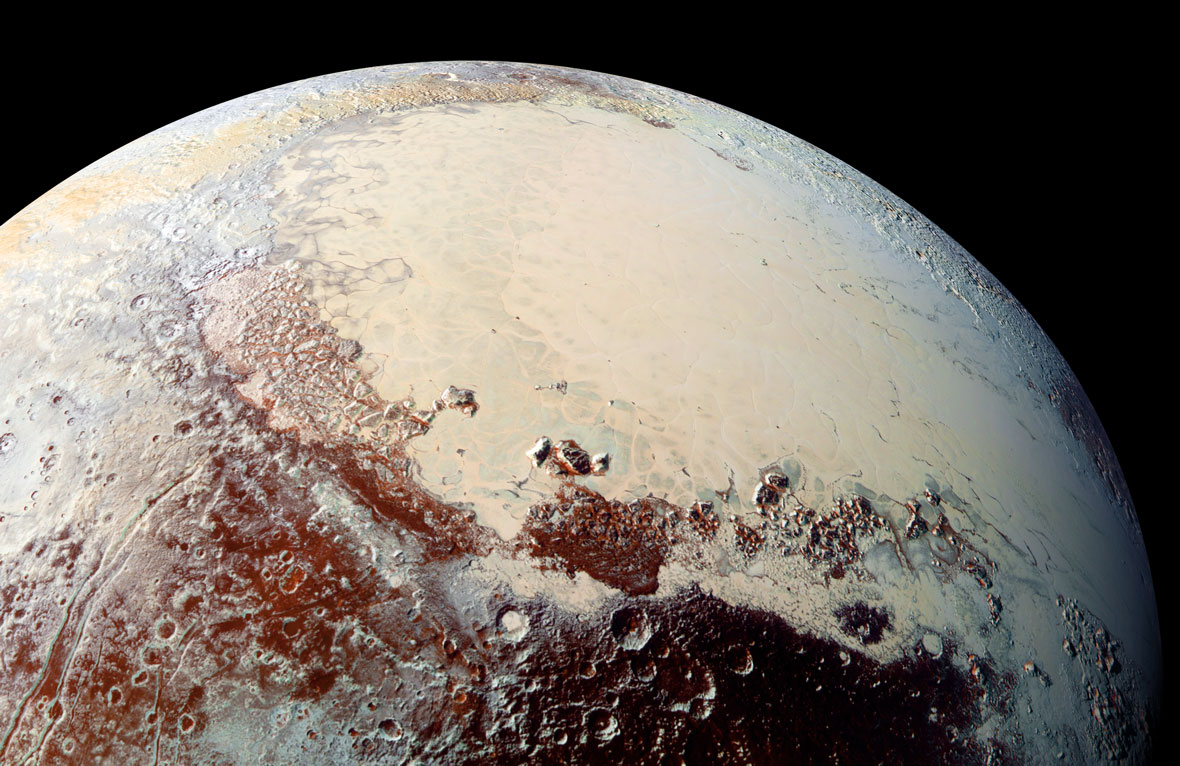
The first research paper based on data from NASA’s New Horizons recent flyby of Pluto was published today, revealing a degree of diversity and complexity in the Pluto system that few expected in the frigid outer reaches of the solar system.
The New Horizons team describes a wide range of findings about the Pluto system in its first science paper, released today (October 16, 2015). “The Pluto System: Initial Results from its Exploration by New Horizons,” led by mission Principal Investigator Alan Stern, appears as the cover story in the October 16 issue of Science, just three months after NASA’s historic first exploration of the Pluto system in July.
“The New Horizons mission completes our initial reconnaissance of the solar system, giving humanity our first look at this fascinating world and its system of moons,” said Jim Green, director of planetary science at NASA Headquarters in Washington. “New Horizons is not only writing the textbook on the Pluto system, it’s serving to inspire current and future generations to keep exploring—to keep searching for what’s beyond the next hill.”
NASA’s New Horizons spacecraft reached a distance of 7,750 miles (12,500 kilometers) from Pluto’s surface during its July 14 closest approach, gathering so much data it will take almost another year to return to Earth. The data returned so far show a surprisingly wide variety of landforms and terrain ages on Pluto, as well as variations in color, composition and albedo (surface reflectivity). Team members also discovered evidence for a water-ice rich crust, multiple haze layers above the surface in Pluto’s atmosphere, and that Pluto is somewhat larger and a bit more ice rich than expected.
“The Pluto system surprised us in many ways, most notably teaching us that small planets can remain active billions of years after their formation,” said Stern, with the Southwest Research Institute (SwRI) in Boulder, Colorado. “We were also taught important lessons by the degree of geological complexity that both Pluto and its large moon Charon display.”
Some of the processes on Pluto appear to have occurred geologically recently, including those that involve the water-ice rich bedrock as well as the more volatile, and presumably more mobile, ices of the western lobe of Pluto’s “heart.” The diverse geology and apparent recent activity raise fundamental questions about how small planetary bodies remain active many billions of years after formation. The research suggests that other large worlds in the Kuiper belt — such as Eris, Makemake, and Haumea — could also have similarly complex histories that rival those of terrestrial planets such as Mars and Earth.
The New Horizons team notes that Triton, likely a former Kuiper Belt planet captured by Neptune, was considered the best analog for Pluto prior to the July 14 flyby. The team now believes that the geologies of Triton and Pluto are more different than similar, but will know more as additional data are returned.
New Horizons is part of NASA’s New Frontiers Program, managed by the agency’s Marshall Space Flight Center in Huntsville, Alabama. The Johns Hopkins University Applied Physics Laboratory, Laurel, Maryland, designed, built, and operates the New Horizons spacecraft and manages the mission for NASA’s Science Mission Directorate. SwRI leads the science mission, payload operations, and encounter science planning.
Reference: “The Pluto system: Initial results from its exploration by New Horizons” by S. A. Stern, F. Bagenal, K. Ennico, G. R. Gladstone, W. M. Grundy, W. B. McKinnon, J. M. Moore, C. B. Olkin, J. R. Spencer, H. A. Weaver, L. A. Young, T. Andert, J. Andrews, M. Banks, B. Bauer, J. Bauman, O. S. Barnouin, P. Bedini, K. Beisser, R. A. Beyer, S. Bhaskaran, R. P. Binzel, E. Birath, M. Bird, D. J. Bogan, A. Bowman, V. J. Bray, M. Brozovic, C. Bryan, M. R. Buckley, M. W. Buie, B. J. Buratti, S. S. Bushman, A. Calloway, B. Carcich, A. F. Cheng, S. Conard, C. A. Conrad, J. C. Cook, D. P. Cruikshank, O. S. Custodio, C. M. Dalle Ore, C. Deboy, Z. J. B. Dischner, P. Dumont, A. M. Earle, H. A. Elliott, J. Ercol, C. M. Ernst, T. Finley, S. H. Flanigan, G. Fountain, M. J. Freeze, T. Greathouse, J. L. Green, Y. Guo, M. Hahn, D. P. Hamilton, S. A. Hamilton, J. Hanley, A. Harch, H. M. Hart, C. B. Hersman, A. Hill, M. E. Hill, D. P. Hinson, M. E. Holdridge, M. Horanyi, A. D. Howard, C. J. A. Howett, C. Jackman, R. A. Jacobson, D. E. Jennings, J. A. Kammer, H. K. Kang, D. E. Kaufmann, P. Kollmann, S. M. Krimigis, D. Kusnierkiewicz, T. R. Lauer, J. E. Lee, K. L. Lindstrom, I. R. Linscott, C. M. Lisse, A. W. Lunsford, V. A. Mallder, N. Martin, D. J. McComas, R. L. McNutt, D. Mehoke, T. Mehoke, E. D. Melin, M. Mutchler, D. Nelson, F. Nimmo, J. I. Nunez, A. Ocampo, W. M. Owen, M. Paetzold, B. Page, A. H. Parker, J. W. Parker, F. Pelletier, J. Peterson, N. Pinkine, M. Piquette, S. B. Porter, S. Protopapa, J. Redfern, H. J. Reitsema, D. C. Reuter, J. H. Roberts, S. J. Robbins, G. Rogers, D. Rose, K. Runyon, K. D. Retherford, M. G. Ryschkewitsch, P. Schenk, E. Schindhelm, B. Sepan, M. R. Showalter, K. N. Singer, M. Soluri, D. Stanbridge, A. J. Steffl, D. F. Strobel, T. Stryk, M. E. Summers, J. R. Szalay, M. Tapley, A. Taylor, H. Taylor, H. B. Throop, C. C. C. Tsang, G. L. Tyler, O. M. Umurhan, A. J. Verbiscer, M. H. Versteeg, M. Vincent, R. Webbert, S. Weidner, G. E. Weigle, O. L. White, K. Whittenburg, B. G. Williams, K. Williams, S. Williams, W. W. Woods, A. M. Zangari and E. Zirnstein, 16 October 2015, Science.
DOI: 10.1126/science.aad1815
Never miss a breakthrough: Join the SciTechDaily newsletter.
Follow us on Google and Google News.