
The Reign of Papua New Guinea’s Megafauna Continued Long After Humans Arrived
A new study suggests that a giant kangaroo that formerly traversed the Papua New Guinea Highlands on four legs may have lived as recently as 20,000 years ago, long after large-bodied megafauna on mainland Australia became extinct.
In an effort to learn more about the fascinating natural history of PNG, paleontologists from Flinders University and archaeologists and geoscientists from Australian National University (ANU) have reexamined megafauna bones from the rich Nombe Rock Shelter fossil site in Chimbu Province.
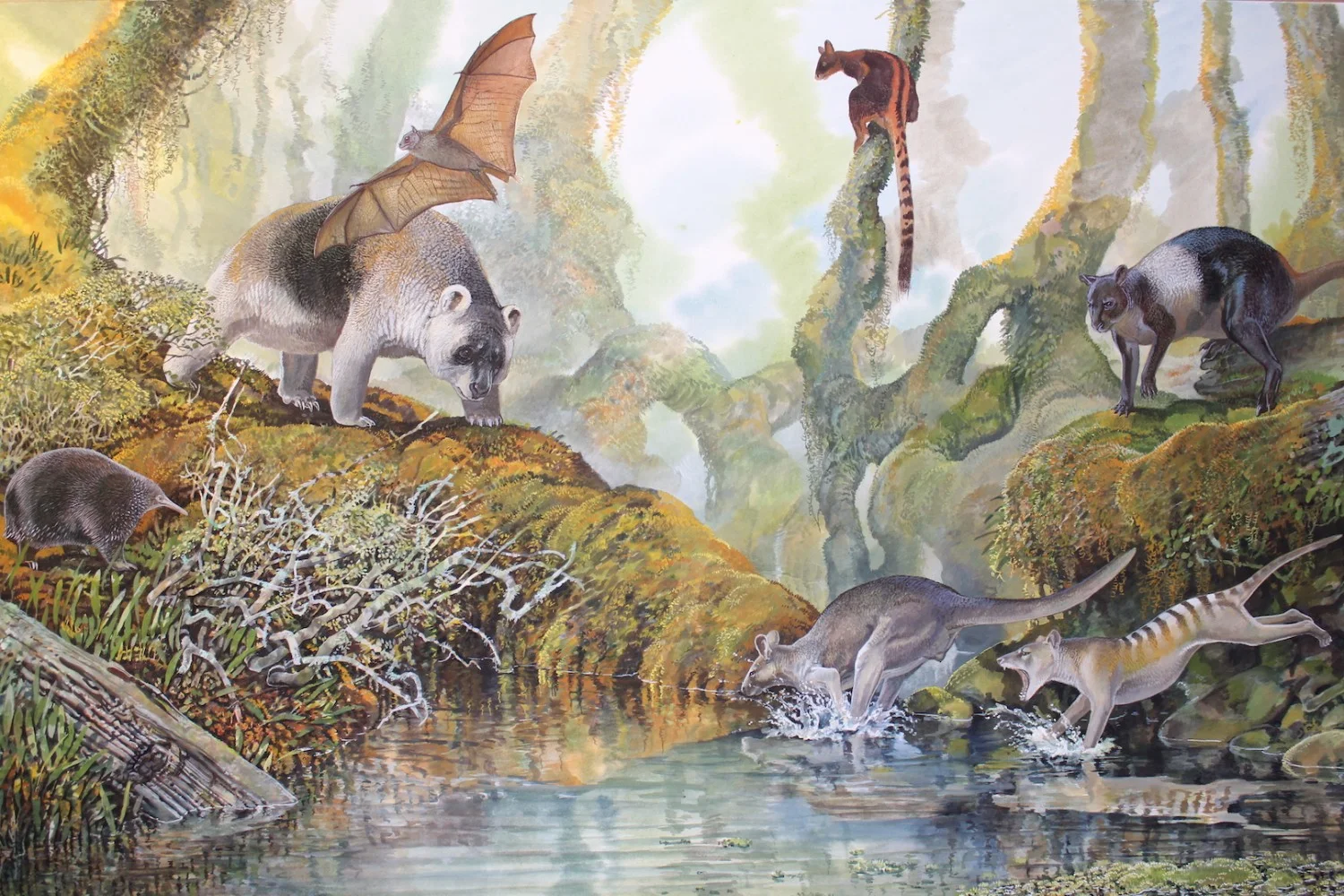
New dating methods from the research reveal that when humans first arrived in the PNG Highlands, roughly 60,000 years ago, numerous giant mammal species, including the extinct thylacine and a marsupial that resembled a panda (named Hulitherium tomasettii), were still present.

Surprisingly, two large extinct kangaroo species, one of which bounded on four legs rather than two, may have survived in the region for an additional 40,000 years.
Unique Survival Patterns in PNG’s Remote Highlands
“If these megafaunal species did indeed survive in the PNG Highlands for much longer than their Australian equivalents, then it may have been because people only visited the Nombe area infrequently and in low numbers until after 20,000 years ago,” says ANU Professor of Archaeological Science Tim Denham, co-lead author in the new study published in the journal Archaeology in Oceania.
“Nombe rock shelter is the only site in New Guinea known to have been occupied by people for tens of thousands of years and preserves remains of extinct megafaunal species, most of them unique to New Guinea.
“New Guinea is a forested, mountainous, northern part of the formerly more extensive Australian continent called ‘Sahul’ but our knowledge of its faunal and human history is poor compared with that of mainland Australia,” says Professor Denham who initially undertook fieldwork in the PNG Highlands in 1990.
Research co-author Professor Gavin Prideaux, from the Flinders University Palaeontology Laboratory, says the latest Nombe study is consistent with similar evidence from Kangaroo Island, previously produced by Flinders paleontologists, that also suggests megafaunal kangaroos may have persisted to around 20,000 years ago in some of the less accessible areas of the continent.
He says many general assumptions about megafaunal extinction timelines have been “more harmful than helpful.”
“Although it is often assumed that all of the megafaunal species in Australia and New Guinea became extinct coast to coast by 40,000 years ago, this generalization is not based on very much actual evidence,” says Professor Prideaux. “It is probably more harmful than helpful in resolving exactly what happened to the dozens of large mammals, birds, and reptiles that were living on the continent when people first arrived.”
The Historical Importance of the Nombe Rock Shelter
The Nombe rock shelter, located in the vicinity of the Nongefaro, Pila, and Nola communities in PNG, would have been infrequently visited by nomadic groups of Highlands peoples in prehistoric times.
The hidden rock shelter was first excavated by archaeologists in the 1960s, but the most intensive phase of fieldwork was conducted in 1971 and 1980 by ANU archaeologist Dr. Mary-Jane Mountain, who is also an author on the latest paper. Her initial research yielded the first detailed description and interpretation of the Nombe site and played a pivotal role in shaping our understanding of the human history of the PNG Highlands.
“Mary-Jane (Mountain) initially hypothesized that megafauna at the site may have survived for tens of millennia after human colonization, but this has only been confirmed with the advent of new techniques in archaeology, dating, and palaeontological science,” Professor Denham says.
Professor Prideaux says these new applications of modern analytical techniques, or new excavations at the Nombe site, would further confirm timelines of late surviving megafauna and duration of occupation by people in PNG.
Reference: “Re-evaluating the evidence for late-surviving megafauna at Nombe rockshelter in the New Guinea highlands” by Gavin J. Prideaux, Isaac A. R. Kerr, Jacob D. van Zoelen, Rainer Grün, Sander van der Kaars, Annette Oertle, Katerina Douka, Elle Grono, Aleese Barron, Mary-Jane Mountain, Michael C. Westaway and Tim Denham, 16 September 2022, Archaeology in Oceania.
DOI: 10.1002/arco.5274
The study was funded by the Australian Research Council.
Never miss a breakthrough: Join the SciTechDaily newsletter.
Follow us on Google and Google News.