
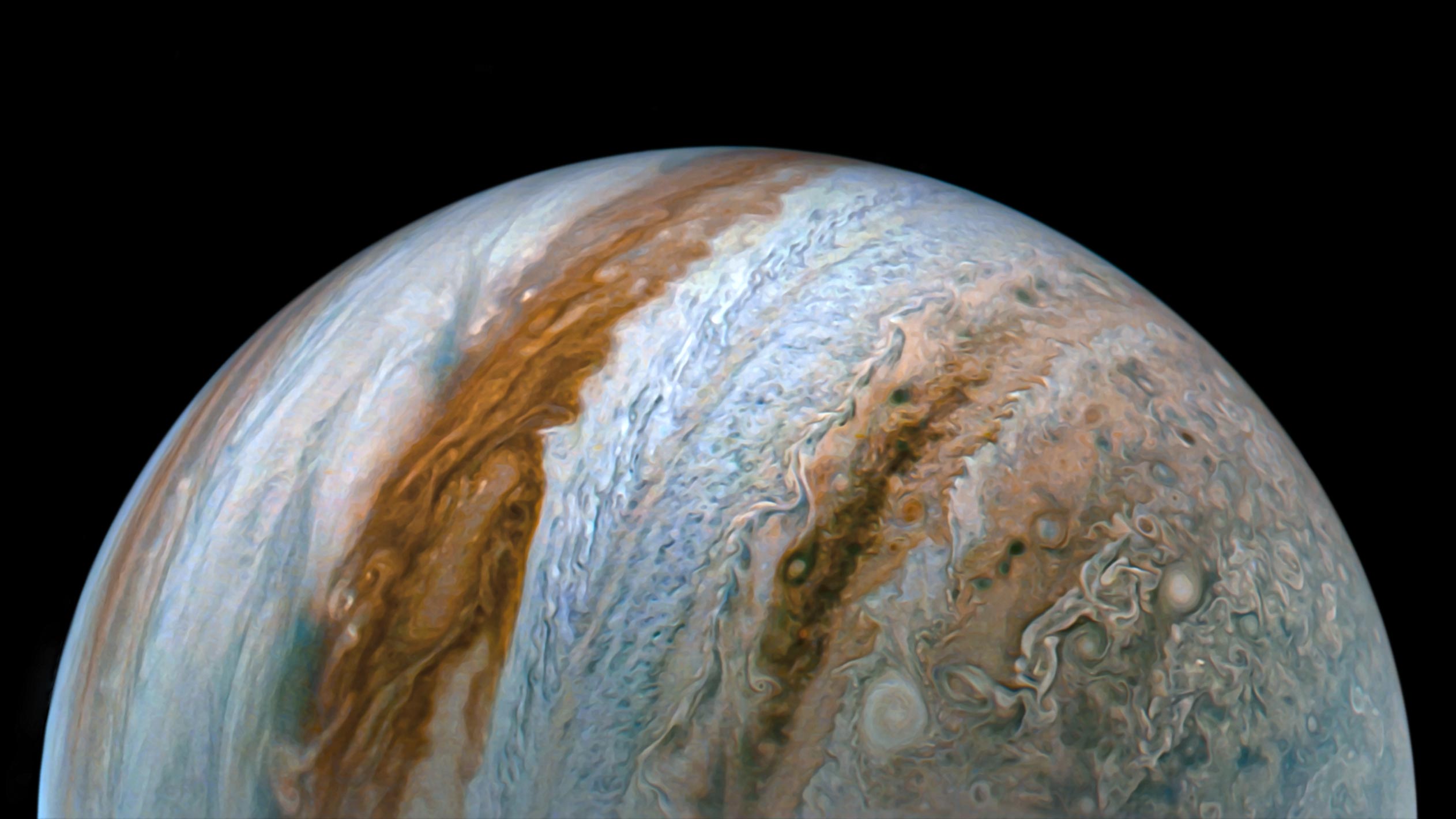
A backyard astronomer helped uncover a planetary mystery — Jupiter’s famous clouds aren’t ammonia ice but a murky mix of chemicals, sitting lower in the atmosphere than expected.
For years, astronomers believed that Jupiter’s upper clouds — responsible for its iconic pale brown belts — were made of frozen ammonia. However, a new study, combining efforts from both amateur and professional astronomers, has revealed that these clouds sit lower in the atmosphere than previously thought and consist of something entirely different: most likely ammonium hydrosulphide mixed with smog.
Citizen Scientists Join the Search
Citizen scientist Steve Hill had already demonstrated that he could map Jupiter’s atmosphere using only specially colored filters and his backyard telescope. His findings suggested that the clouds were too deep within the planet’s warm atmosphere to be made of ammonia ice.
To investigate further, Hill teamed up with Patrick Irwin from Oxford University, whose research group had previously used the advanced MUSE instrument on ESO’s Very Large Telescope (VLT) to analyze the atmospheres of gas giants.
MUSE is capable of scanning the atmosphere of Jupiter at different wavelengths, mapping out the different molecules that make up the planet’s atmosphere. This animated image, based on real MUSE data, shows how the gas giant looks at different wavelengths.
A Layered Cake of Mystery
The new study shows that this new approach with backyard telescopes or VLT/MUSE can map the abundance of ammonia in Jupiter’s atmosphere with surprising accuracy. As for clouds, the team concluded that Jupiter’s atmosphere is much like a layered cake. Clouds of ammonium hydrosulphide cover the upper layers, but sometimes there may be a decoration of ammonia ice clouds, brought to the top by strong vertical convection. The entire cake’s structure, though, is not yet fully known, and the work of citizen scientists will be key to uncovering it. So next time you are looking at Jupiter or Saturn from your backyard, you may also be unraveling the secrets still lying within our Solar System.
Explore Further: Citizen Scientists Reveal Jupiter’s Clouds Are Not What We Thought
Reference: “Clouds and Ammonia in the Atmospheres of Jupiter and Saturn Determined From a Band-Depth Analysis of VLT/MUSE Observations” by Patrick G. J. Irwin, Steven M. Hill, Leigh N. Fletcher, Charlotte Alexander and John H. Rogers, 1 January 2025, Journal of Geophysical Research: Planets.
DOI: 10.1029/2024JE008622
Never miss a breakthrough: Join the SciTechDaily newsletter.
Follow us on Google and Google News.
12 Comments
Okay, okay, okay…forget what we said before…Now we have another idea.
😂🤣
About time!
It is so impressive that a back yard astronomer could find this valuable information. I hope his name goes down in history as the first person to find this information. Blessings Mr. Hill for your brilliance!👏👏👏🫵🏻🥇
🔔❄️
Ahhh…smog. Jupiter should have taken better care of its planet 🤣
We should call it Planet New LA! 😎
Wow that’s awesome
Should be renamed Planet LA! 😎
Jupiter has been Earth’s shield for billions of years, when the arms of the Milky Way galaxy with its stars and very small planets rotate at 600 km/s as they orbit the galactic core, this rotation is counterclockwise, and Jupiter’s rotation is counterclockwise. And this has caused that when the stars of the Milky Way collide with the surface of Jupiter, the speed of Jupiter increases, Jupiter rotates around itself in about 9.5 hours and at a speed of 45 thousand kilometers, because a large number of stars have collided with Jupiter, the number of planets that have been placed around Jupiter from these gas planets is more than other planets. I already said that all the moons of Jupiter and other planets have not existed in the solar system since the formation of this system. These small moons are related to stars that have transformed from the large arms of the Milky Way into solar system objects. The large arms of the galaxy approach the Sun at a speed of 370 km/s. It is more than forty trillion kilometers. The distance between the Sun and these arms, I calculated the speed of the arm to be 600 km/s, but I calculated the speed of the Milky Way objects hitting the solar system at 370 km/s. This is due to the speed of the sun, which is 230 km/s. In fact, the speed of the sun decreases from 600 km, the Milky Way galaxy along with the stars and their small planets pass the sun, several stars collide with the sun and the gas planets place some of the planets that have come to the solar system with their stars, these planets are the 243 moons of the solar system. Saturn doesn’t burn because they are too cold, but Jupiter is closer to the Sun and more stars have collided with Jupiter. Another reason Saturn and Uranus don’t burn is that no new stars have collided with these gas planets in the Milky Way, but Jupiter did 65 to 60 million years ago, when several stars and planets from the Milky Way came into the Solar System, causing stars and planets to collide. The milky way to solar bodies and the sun, the previous life of humans who lived with dinosaurs was destroyed, but the life of creatures that lived in Antarctica under the huge polar ice was not destroyed, and the life of creatures was created again from the same single-celled creatures. If these small creatures had perished in the water, now humans would not be on earth
Jupiter rotates faster than all the planets. What is the reason? Despite its mass and weight, Jupiter should rotate more slowly than all the planets, but Jupiter has such a large magnetic field that the arms of the Milky Way want to orbit the Sun. Jupiter’s orbit around the Sun is shorter than that of Neptune, Uranus and Saturn. Similarly, Neptune, Uranus, and Saturn collided with fewer stars, respectively, so Neptune had a longer orbit. Neptune has the least number of moons among all the gas planets. Those planets that were not in the path of the gas planets came close to the Sun. When Jupiter revolves around the guest planet, the strong gravitational force of Jupiter brings the guest planet closer to the Sun, and with the next rounds, the very strong gravitational force of Jupiter directs the planets of the arm of the galaxy towards the Sun, and finally the guest planet collides with the Sun. And the fragments of these planets caused Venus to reverse and Mercury to slow down its rotation. You can see that after disintegration, they hit the surface of Mercury, Venus, and the Moon, and their core fragments were counter-clockwise when they hit the surface of Mercury and Venus. When two spheres spinning in the same direction spin, if they collide in space, their spin either slows down, stops, or reverses. Venus and Mercury are like this
One of the strong reasons I discovered that the Milky Way, the great arms of the Galaxy, passes through the Solar System and their stars and planets collide with Solar System objects and the Sun is the rapid rotation of gaseous planets. The four gas planets Neptune, Uranus, Saturn and Jupiter rotate faster than Mars and Earth. Consider Mars, which is farther from the Sun than Earth, which causes planets farther from the Sun to have slower orbits and slower day-night cycles. For example, Mars rotates more slowly than Earth, it takes more than 24 hours for Mars to rotate once, 24.39 Jupiter is the next planet that should rotate more slowly than Earth and Mars because of its distance from the Sun, but since the very small stars of the Milky Way collide with Jupiter’s surface, Jupiter rotates in about less than ten hours per day. The rotation of Jupiter was faster than the rotation of Mars. Also, Neptune, which is 4.5 billion kilometers away from the Sun, due to the collision of the stars of the Milky Way with the surface of Neptune, Neptune rotates faster than Earth and Mars. Now you must have noticed that 100% of the stars of the big arm of the Milky Way galaxy, whose stars are much, much smaller than the sun, along with their planets have collided with the objects of the solar system, and most of these collisions of stars were with gas planets and the sun. The distance from the Sun to this arm of the Milky Way galaxy is more than 40 trillion km, and by calculating the speed of the arm of the Milky Way galaxy, which is 600 km/s, this arm will pass through the solar system in about 3600 years. In the solar system, you have already seen the effects of these collisions on the surface of the moon and the planets Venus and Mercury. It doesn’t rain on these planets like on Earth, and you can see the impact of meteorites and the disintegrated elements of the core of the Milky Way planets on the surface of the Moon, Venus, and Mercury, but on the surface of the Earth, during 60 million years of rain, all traces of meteorites have disappeared and no trace of it remains. All these changes in the solar system are due to the collision of the stars and planets of the Milky Way with the objects of the solar system. Scientists should take the collision of Milky Way objects with solar system objects seriously, because the destruction of life on Earth will happen in the near future. I calculated the transit time of the galactic arm through the solar system based on the distance of the star Alpha Centauri from the Sun.
Thanks