
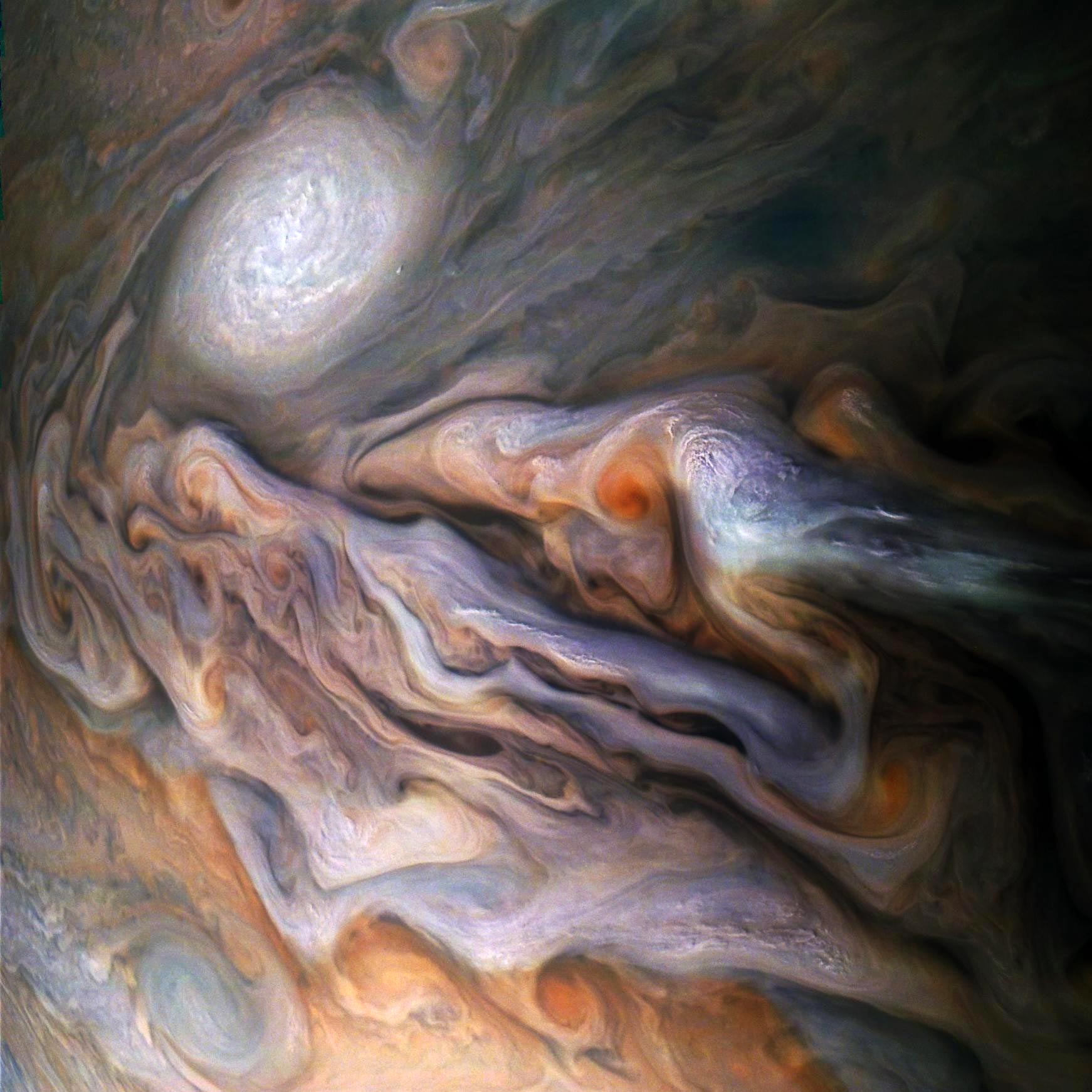
A groundbreaking study combining the efforts of amateur and professional astronomers has redefined our understanding of Jupiter’s atmospheric clouds.
Initially believed to be composed of ammonia ice, new findings suggest they are actually made of ammonium hydrosulphide and smog.
Revolutionary Findings in Jupiter’s Atmospheric Composition
Amateur and professional astronomers have teamed up to resolve a long-standing debate about the makeup of Jupiter’s clouds. Once thought to be made of ammonia ice, these clouds are now believed to consist of ammonium hydrosulphide mixed with smog.
The discovery, published on January 1 in the Journal of Geophysical Research – Planets, was sparked by amateur astronomer Dr. Steven Hill from Colorado. Dr. Hill recently showed that the levels of ammonia and the pressure at Jupiter’s cloud tops could be measured using commercially available telescopes and specialized filters. His findings revealed not only that amateurs could map ammonia in Jupiter’s atmosphere, but also that the clouds are located too deep in the planet’s warm atmosphere to be composed of ammonia ice.
In this new study, Professor Patrick Irwin from the University of Oxford’s Department of Physics applied Dr. Steven Hill’s analytical method to observations of Jupiter made with the Multi Unit Spectroscopic Explorer (MUSE) instrument at the European Southern Observatory’s Very Large Telescope (VLT) in Chile. MUSE uses the power of spectroscopy, where Jupiter’s gases create telltale fingerprints in visible light at different wavelengths, to map the ammonia and cloud heights in the gas giant’s atmosphere.
Rethinking the Clouds of Jupiter
By simulating how the light interacts with the gases and clouds in a computer model, Professor Irwin and his team found that the primary clouds of Jupiter – the ones we can see when looking through backyard telescopes – had to be much deeper than previously thought, in a region of higher pressure and higher temperature. Too warm, in fact, for the condensation of ammonia. Instead, those clouds have to be made of something different: ammonium hydrosulphide.
Previous analyses of MUSE observations had hinted at a similar result. However, since these analyses were made with sophisticated, extremely complex methods that can only be conducted by a few groups around the world, this result was difficult to corroborate. In this new work, Irwin’s team found that Dr. Hill’s method of simply comparing the brightnesses in adjacent, narrow colored filters gave identical results. And since this new method is much faster and very simple, it is far easier to verify. Hence, the team concluded that the clouds of Jupiter really are at deeper pressures than the expected ammonia clouds at 700 mb and so cannot be composed of pure ammonia ice.
Implications for Amateur Contributions and Future Research
Professor Irwin said: “I am astonished that such a simple method is able to probe so deep in the atmosphere and demonstrate so clearly that the main clouds cannot be pure ammonia ice! These results show that an innovative amateur using a modern camera and special filters can open a new window on Jupiter’s atmosphere and contribute to understanding the nature of Jupiter’s long-mysterious clouds and how the atmosphere circulates.”
Dr. Steven Hill, who has a PhD in Astrophysics from the University of Colorado and works in space weather forecasting, said, “I always like to push my observations to see what physical measurements I can make with modest, commercial equipment. The hope is that I can find new ways for amateurs to make useful contributions to professional work. But I certainly did not expect an outcome as productive as this project has been!”
The ammonia maps resulting from this simple analytical technique can be determined at a fraction of the computational cost of more sophisticated methods. This means they could be used by citizen scientists to track ammonia and cloud-top pressure variations across features in Jupiter’s atmosphere including Jupiter’s bands, small storms, and large vortices like the Great Red Spot.
John Rogers (British Astronomical Association), one of the study’s co-authors adds: “A special advantage of this technique is that it could be used frequently by amateurs to link visible weather changes on Jupiter to ammonia variations, which could be important ingredients in the weather.”
Understanding Cloud Formation on Jupiter
So why doesn’t ammonia condense to form a thick cloud? Photochemistry (chemical reactions induced by sunlight) is very active in Jupiter’s atmosphere and Professor Irwin and his colleagues suggest that in regions where moist, ammonia-rich air is raised upwards, the ammonia is destroyed and/or mixed with photochemical products faster than ammonia ice can form. Thus, the main cloud deck may actually be composed of ammonium hydrosulphide mixed with photochemical, smoggy products, which produce the red and brown colors seen in Jupiter images.
In small regions, where convection is especially strong, the updrafts may be fast enough to form fresh ammonia ice, and such regions have occasionally been seen by spacecraft such as NASA’s Galileo, and more recently by NASA’s Juno, where a few small high white clouds have been seen, casting their shadows down on the main cloud deck below.
Professor Irwin and his team also applied the method to VLT/MUSE observations of Saturn and have found similar agreement in the derived ammonia maps with other studies, including one determined from James Webb Space Telescope observations. Similarly, they have found the main level of reflection to be well below the expected ammonia condensation level, suggesting that similar photochemical processes are occurring in Saturn’s atmosphere.
Reference: “Clouds and Ammonia in the Atmospheres of Jupiter and Saturn Determined From a Band-Depth Analysis of VLT/MUSE Observations” by Patrick G. J. Irwin, Steven M. Hill, Leigh N. Fletcher, Charlotte Alexander and John H. Rogers, 1 January 2025, Journal of Geophysical Research: Planets.
DOI: 10.1029/2024JE008622
Never miss a breakthrough: Join the SciTechDaily newsletter.
Follow us on Google and Google News.
26 Comments
Something inside me says that once a person reaches a certain academic level of education they tend to spend too much time flirting with constant weight to have new novel finding than to check their designed academic studies for failures and faults . The books are being rewritten daily over misunderstood theories and closer observations .
Bingo.
Good ideas can come from any source, regardless if there is or isn’t PhD after the name. Though often maligned, the layperson is open to new ideas that professionals sometimes overlook. After all, how many PhD’s does it take to change a lightbulb? { Run with this one…! }
One
…but only after being peer reviewed and receiving a grant.
😂😂😂😂 very good.
Not if it happens in real life homes and labs. This isn’t even funny, since peer review happens in publishing, not lab work.
It’s a joke, dude. Lighten up.
How many trump’s dose it take to screw up science? ONE!
Your obvious hate has over-ridden your sense of humor and creativity. The other replies at least showed some sense of humorous sarcasm. I can’t say the same for you.
I don’t really like Trump, and care even less for Biden. But, I don’t waste my time with witless insults to either.
*does
Better question. How many spelling mistakes does it take to discredit yourself?
I don’t have a PhD in either Astrophysics or Astronomy yet I discovered both a misspelled word and a misplaced possessive apostrophe without even putting on my reading glasses, let alone leaving our planet’s gravitational pull!
One. Sometimes not even that many. LOL
That is an anecdote with zero evidence given, which makes the reference to avoiding faults and “observations” ironic.
Science is an empiric process, that is its strength. Maybe you should study how it works.
Socrates keeps talking to me
I love the UNIVERSE
A finding like this makes me feel like the science community was being lazy and unscientific
But you don’t really believe that do you – they followed up on the lead.
Wow
Could it be that the sulfur in the clouds is largely that emitted from the moon Io, with its sulphurous volcanism?
Jupiter and Io combine to give evidence that sulphur is common in the outer system. But there could be some exchange, how much is perhaps to find out.
Does anyone else find this is odd that they are so specific about part of the composition yet the other part they just throw somewhat generic “smog” title at? Seems sus to me.
The classic London pea-soup smog contained not only sulphurous compounds but also lots of unburnt carbon from the coal-fired household heating (fireplaces) of the day.
Why is the word astonished in “quotes”?
So… instead of the clouds being made of a frosty cleaning product… it is made of sulfur fart spray. Interesting. I’ll be sure to wear a mask when visiting.
This is the second time I find that SciTechDaily seeming copy of a university press release initially differs from other sources and specifically the press release itself. I don’t know if it is a concerted effort to stand out, perhaps regarding ad algorithm incentives, but it worries me that there could be an AI involved – they still “hallucinate” more than people do.
Else, yay for citizen science!