
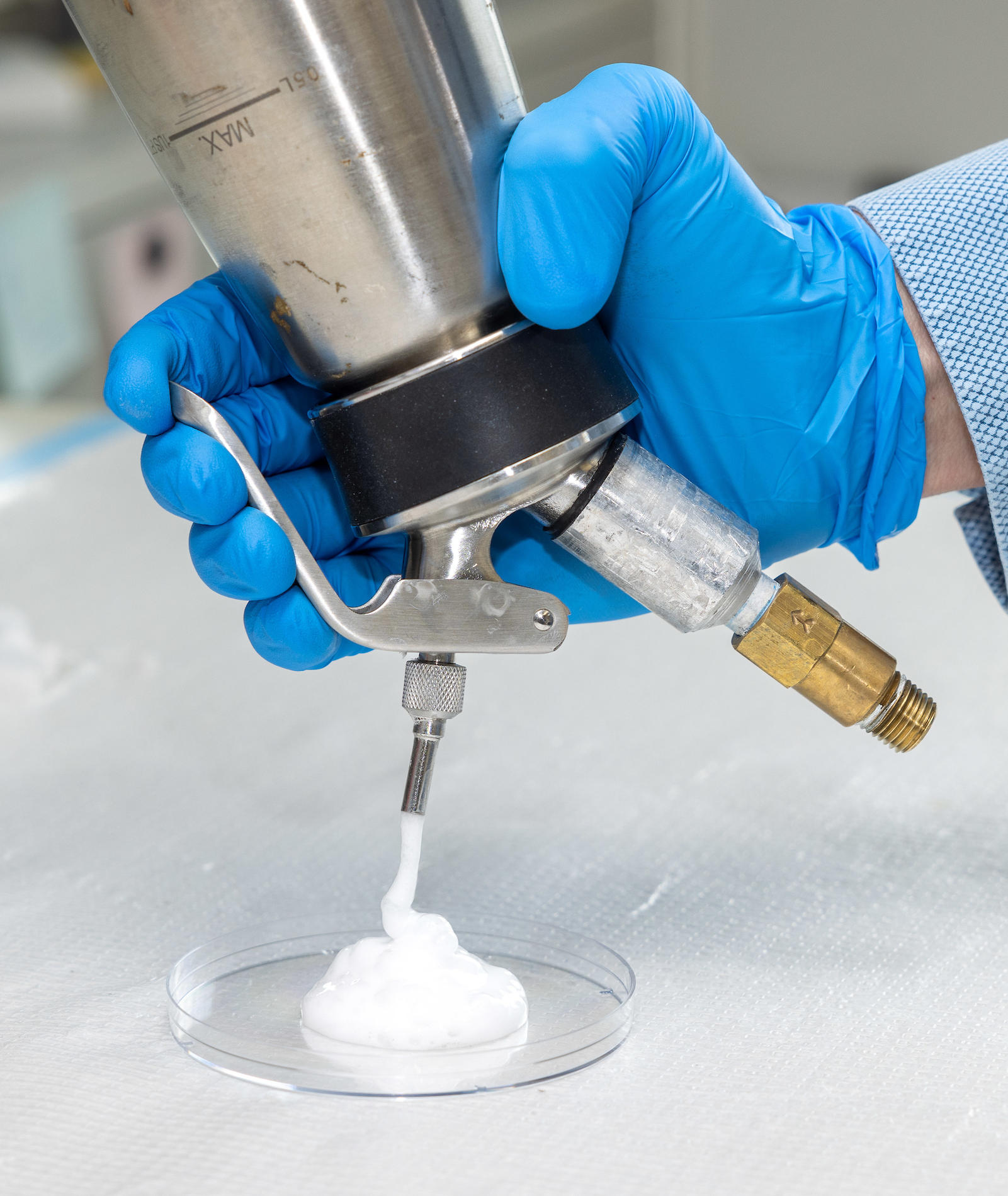
Did smokers do better than non-smokers in a clinical trial for an experimental cancer treatment? That was the intriguing question that led University of Iowa researchers and their colleagues to develop a drinkable, carbon monoxide-infused foam that boosted the effectiveness of the therapy, known as autophagy inhibition, in mice and human cells. The findings were recently published in the journal Advanced Science.
Looking for ways to exploit biological differences between cancer cells and healthy cells is a standard approach for devising new cancer treatments. But it is a painstaking process that requires a deep understanding of complex cancer biology and often a dose of unexpected insight.
The potential of autophagy inhibitors
Researchers have known for several decades that autophagy, which is the cell’s natural recycling system, is increased in cancer cells relative to healthy cells, suggesting that inhibiting autophagy might be a way to target cancer cells. However, results from almost 20 clinical trials testing autophagy inhibitors have been inconclusive.
“Within those clinical trials they found mixed results; there was some benefit, but for many patients, there was no benefit, which really pushed researchers back to the drawing board,” says James Byrne, MD, PhD, UI assistant professor of radiation oncology and biomedical engineering and senior author on the new study.
Searching for insight into why autophagy inhibition only seems to work some of the time, the researchers made the surprising discovery that smokers in two of the previous trials of autophagy inhibitors seemed to do better than non-smokers.
“When we looked at how the smokers did in those trials, we saw an increase in overall response in smokers that received the autophagy inhibitors, compared to (non-smoker) patients, and we also saw a pretty robust decrease in the target lesion size,” Byrne says.
This was an exciting finding for Byrne and his team because smoking is also associated with increased levels of carbon monoxide, a gas molecule that can increase autophagy in cells in a way that researchers think might enhance the anti-cancer effect of autophagy inhibitors.
“We know also that smokers have higher carbon monoxide levels and while we definitely don’t recommend smoking, this suggested that elevated carbon monoxide might improve the effectiveness of autophagy inhibitors. We want to be able to harness that benefit and take it into a therapeutic platform,” says Byrne, who also is a member of University of Iowa Holden Comprehensive Cancer Center.
Carbon monoxide boosts the anti-cancer activity of autophagy inhibition
The team already had just such a “platform” to test their ideas. Byrne specializes in crafting gas-entrapping materials (GEMs)—foams, gels, and solids made from safe, edible substances that can be infused with different gas molecules. For this study, the researchers created a drinkable foam infused with carbon monoxide.
When mice with pancreatic and prostate cancers were fed the carbon monoxide foam and simultaneously treated with an autophagy inhibitor, tumor growth and progression were significantly reduced in the animals. The team also showed that combining carbon monoxide with autophagy inhibitors had a significant anti-cancer effect in human prostate, lung, and pancreatic cancer cells in petri dishes.
Ultimately, Byrne hopes to test this approach in human clinical trials.
“The results from this study support the idea that safe, therapeutic levels of CO, which we can deliver using GEMs, can increase the anti-cancer activity of autophagy inhibitors, opening a promising new approach that might improve therapies for many different cancers,” he says.
Reference: “Oral Carbon Monoxide Enhances Autophagy Modulation in Prostate, Pancreatic, and Lung Cancers” by Jianling Bi, Emily Witt, Megan K. McGovern, Arielle B. Cafi, Lauren L. Rosenstock, Anna B. Pearson, Timothy J. Brown, Thomas B. Karasic, Lucas C. Absler, Srija Machkanti, Hannah Boyce, David Gallo, Sarah L. Becker, Keiko Ishida, Joshua Jenkins, Alison Hayward, Alexandra Scheiflinger, Kellie L. Bodeker, Ritesh Kumar, Scott K. Shaw, Salma K. Jabbour, Vitor A. Lira, Michael D. Henry, Michael S. Tift, Leo E. Otterbein, Giovanni Traverso and James D. Byrne, 12 December 2023, Advanced Science.
DOI: 10.1002/advs.202308346
In addition to Byrne, the research team included UI researchers Jianling Bi, Emily Witt, Megan McGovern, Arielle Cafi, Lauren Rosenstock, Lucas Absler, Srija Machkanti, Kellie Bodeker, Scott Shaw, Vitor Lira, and Michael Henry.
The research team also included scientists from MIT, Harvard Medical School, University of Pennsylvania, Rutgers Cancer Institute of New Jersey, University of North Carolina Wilmington, and Oregon Health and Science University.
The study was funded by the National Cancer Institute, the American Cancer Society, Hope Funds for Cancer Research, the U.S. Department of Defense, the National Science Foundation, and the National Football League Players Association.
Never miss a breakthrough: Join the SciTechDaily newsletter.
Follow us on Google and Google News.