
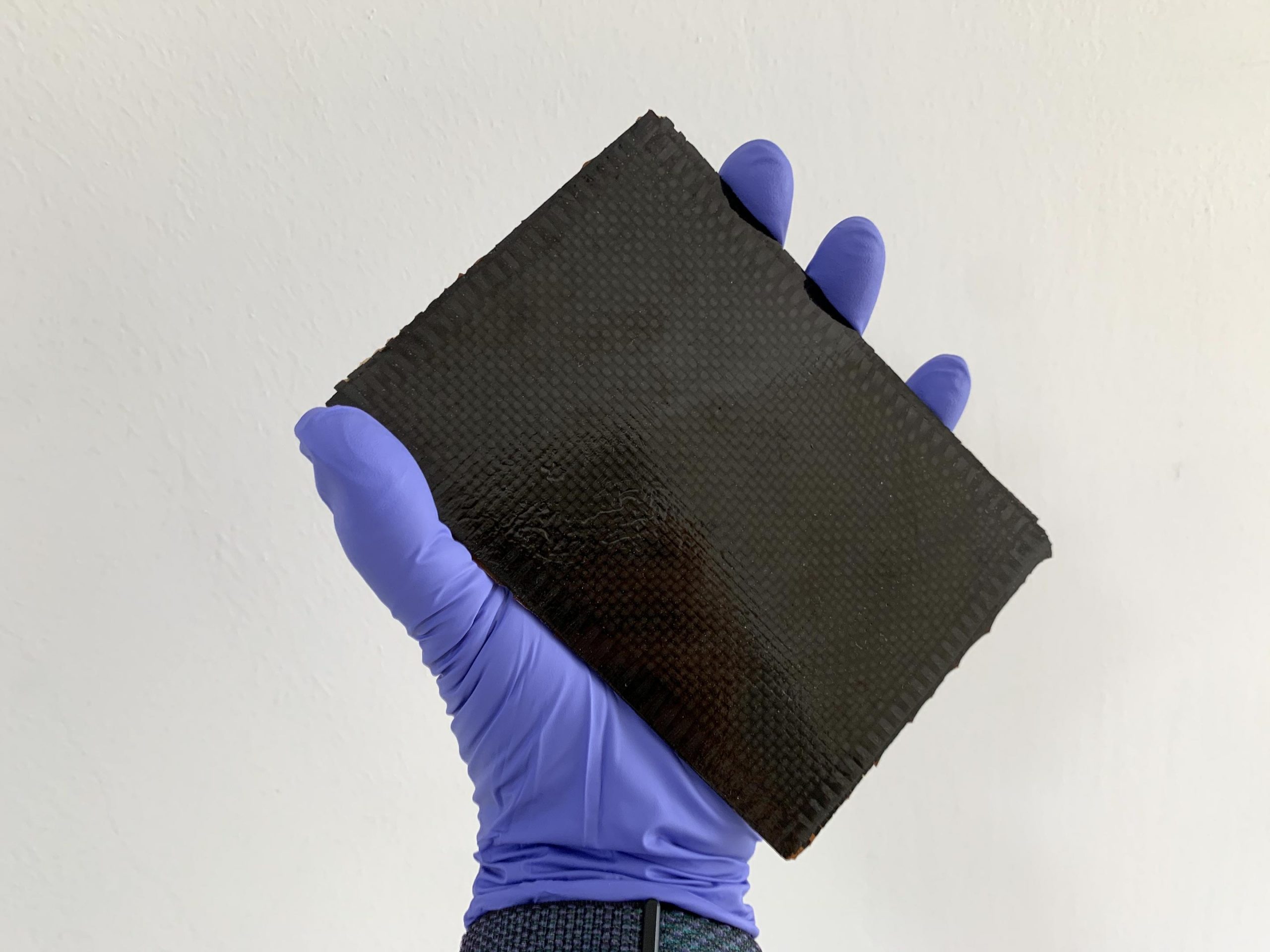
Non-toxic, flame-retardant composite material based on bio-epoxy made from plant-source tannic acid. 99% eco-friendly recycling within tens of minutes merely by dissolving in water.
A flame-retardant carbon-fiber-reinforced composite material has been developed. Korea Institute of Science and Technology (KIST) announced that a research team from its Institute of Advanced Composite Materials, headed by Dr. Yong Chae Jung used plant-originated tannic acid* to develop a flame-retardant carbon fiber-reinforced plastic** (CFRP), and also presented a method for its eco-friendly recycling.
*Tannic acid: A substance that is abundant in nature, tannic acid is a type of polyphenol that is usually synthesized by plants.
**Carbon fiber-reinforced plastic: An advanced lightweight composite material reinforced by carbon fiber, with high rigidity and high elasticity that is suitable for a wide range of applications.

CFRP, a composite material that contains carbon fiber, which is about four times lighter than steel yet 10 times stronger, is widely used in the aerospace, automotive, shipbuilding, and sports equipment industries. Structurally, CFRP is made up of carbon fiber and epoxy resin, which serve functions in this composite material similar to the respective roles that reinforcing rods and cement play in concrete structures. To achieve mechanical rigidity, the binding of carbon fiber and epoxy resin in CFRP must be strong. Moreover, CFRP must be fire-safe as it is used for purposes closely related to everyday life, e.g. use as a construction material. To induce these traits in CFRP, sometimes it is synthesized with additives.
Due to its susceptibility to heat, CFRP had been made fire-safe by adding a halogen flame-retardant***. However, the use of halogen in CFRP was banned worldwide, because it generates toxic substances when incinerated for recycling. As such, the task at hand was to make CFRP flame-retardant with the use of non-toxic, safe material.
***Halogen: Elements that belong to Group 17 on the periodic table, including fluorine, chlorine, bromine, and iodine.

Jung Yong-chae, head researcher at KIST’s Institute of Advanced Composite Materials, sought to improve the mechanical rigidity and flame-retardance of CFRP with tannic acid, an eco-friendly substance. Tannic acid characteristically bonds strongly with carbon fiber. It also turns into charcoal when burned. Charred tannic acid functions as a barrier that blocks the inflow of external oxygen. By manufacturing epoxy resin from tannic acid and mixing it into carbon fiber, the KIST research team successfully developed a CFRP that is strong and flame-retardant.
Unlike conventional epoxy resin that is vulnerable to heat, epoxy resin made from tannic acid is flame-retardant and needs no additives. This means that the toxic substances generated when incinerating CFRP for recycling would no longer be a problem. Also, because conventional CFRP when burned decreased the performance of its epoxy resin, precluding complete recycling, the research team came up with a new recycling method.
By dissolving CFRP in water in a supercritical fluid**** state – i.e. temperature and pressure over a set level – over 99% of the CFRP could be recovered without reduced carbon fiber performance. It was also found that epoxy resin when dissolved produced a substance called carbon dots”*****,” which can be used as an electronic material (Optronics, Sensing, Bioimaging, etc.,). Unlike the method of recycling by incineration, which burns up epoxy resin leaving only the incomplete carbon fiber to be recycled, this new method of recycling enables the recycling of all components of a composite material.
****Supercritical fluid: A substance with a temperature and pressure above the critical level. Related to expandability of gas and dissolvability of liquid. Water and carbon dioxide are substances commonly used as supercritical fluids. Supercritical water can dissolve even gold.
*****Carbon dots: Carbon quantum dots, with carbon as their major element, have the characteristics of photoluminescence and a semiconductor, making them similar to inorganic quantum dots. Due to said characteristics, carbon quantum dots are being widely used in areas such as bio-imaging, sensors, light-emitting diode (LED) lighting, organic solar cells, and photocatalysts.
Head researcher Dr. Jung said, “We have created a composite material with an expanded range of application that is a dramatic improvement over conventional carbon fiber-reinforced plastic in terms of flame-retardancy, mechanical rigidity, and recyclability. These improved traits are significant in that they determine the range of application of said composite material.” He added, “We will be reviewing the structure of this composite material to achieve even further improved properties and to further expand the range of its application.”
Reference: “Recyclable, flame-retardant and smoke-suppressing tannic acid-based carbon-fiber-reinforced plastic” by Young-O Kim, Jaehyun Cho, Young Nam Kim, Kun Won Kim, Byoung Wan Lee, Jae Woo Kim, Minkook Kim and Yong Chae Jung, 22 May 2020, Composites Part B: Engineering.
DOI: 10.1016/j.compositesb.2020.108173
The research, backed by the Ministry of Science and ICT, was conducted as an Institutional Research Program of the Korea Institute of Science and Technology. A journal article explaining the results of the research was published in the latest issue of Composite Part B: Engineering, the top international journal in the field of materials science and composite materials (top 2% of JCR).
Never miss a breakthrough: Join the SciTechDaily newsletter.
Follow us on Google and Google News.
1 Comment
I for one welcome new Szechuan-Seoul hydro-recyclable Coke 3 L. bottles in fun refractive mirror patterns. Not having to wrap them in carbon fiber to have reinforced water-air rockets is just a bonus.