
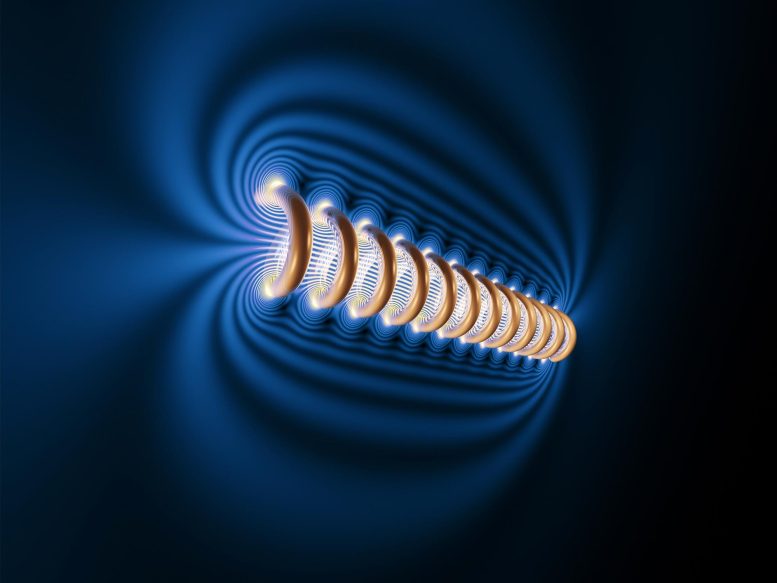
Scientists at the U.S. Department of Energy’s (DOE) Princeton Plasma Physics Laboratory (PPPL) have designed a new type of magnet that could aid devices ranging from doughnut-shaped fusion facilities known as tokamaks to medical machines that create detailed pictures of the human body.
Tokamaks depend on a central electromagnet known as a solenoid to produce electrical currents and magnetic fields that confine plasma — a hot, charged state of matter made up of free electrons and atomic nuclei — so that fusion reactions may take place. However, after being subjected to energetic subatomic particles known as neutrons emitted by the plasma over time, the insulation around the electromagnet’s wires might deteriorate. If they do, the magnet may fail, limiting the tokamak’s ability to harness fusion power.
Metal functions as insulation in this new form of magnet preventing particles from damaging it. Furthermore, it would operate at greater temperatures than existing superconducting electromagnets, making it simpler to maintain. Fusion, the power that powers the sun and stars, combines light elements in the form of plasma to produce huge quantities of energy. Scientists are attempting to replicate fusion on Earth in order to produce a nearly infinite source of power to generate electricity.
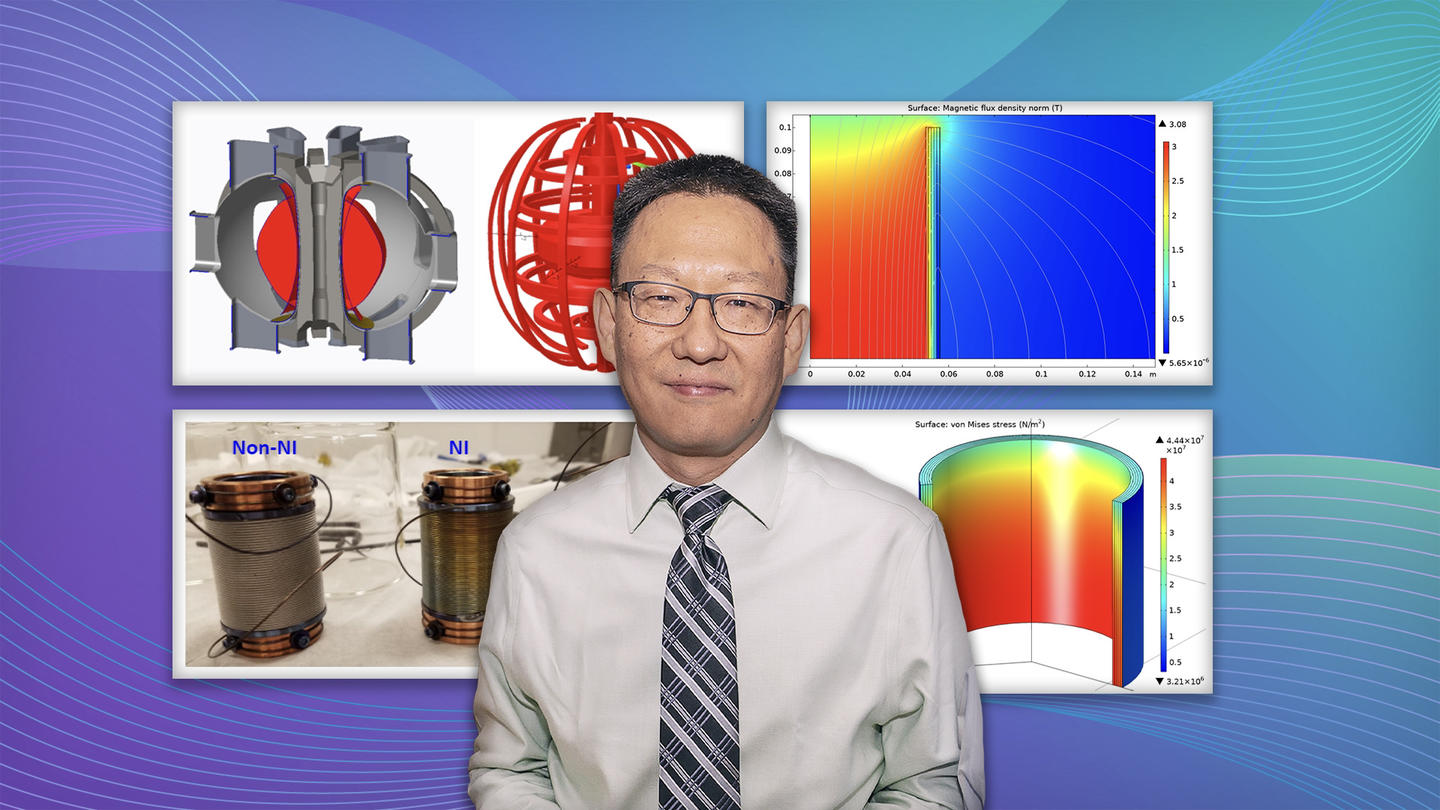
Simplifying Magnet Fabrication and Extending Longevity
“Our innovation both simplifies the fabrication process and makes the magnet more tolerant of the radiation produced by the fusion reactions,” said Yuhu Zhai, a principal engineer at PPPL and lead author of a paper reporting the results in Superconductor Science and Technology.
“If we are designing a power plant that will run continuously for hours or days, then we can’t use current magnets,” Zhai said. “Those facilities will produce more high-energy particles than current experimental facilities do. The magnets in production today would not last long enough for future facilities like commercial fusion power plants.”
Electromagnets differ from the simple permanent magnets that hold artwork to refrigerator doors. Electromagnets consist of a coil of insulated wire carrying an electrical current that generates a magnetic field as it flows. Electromagnets are used in devices ranging from tokamaks to cranes that lift smashed cars in garbage dumps and magnetic-resonance imaging devices that scan the interior of human bodies.
Zhai and others have built a prototype magnet and gotten encouraging results. “During our tests, our magnet produced about 83 percent of the maximum amount of electrical current the wires can carry, a very good amount,” he said. “Scientists typically only use 70 percent of the superconducting wire electrical current capacity when designing and building high-power magnets. And large-scale magnets like those used in ITER, the international fusion facility being constructed in France, often use only 50 percent.”
The Benefits of Niobium-Tin Superconductors
The new magnets have wires constructed out of the elements niobium, sometimes used in jet engines, and tin. When heated in a special way, these elements form a superconductor that allows electrical current to flow through it at extremely low temperatures with no resistance. So there is much less need for insulation to prevent current leakage.
“This new concept is interesting because it allows the magnet to carry a lot of electrical current in a little space, reducing the amount of volume the magnet occupies in a tokamak,” said PPPL Chief Engineer Robert Ellis. “This magnet could also operate at higher current densities and stronger magnetic fields than magnets can today. Both qualities are important and could lead to lower costs.”
All in all, the new development could profoundly benefit the development of fusion energy. “This is a revolutionary change in how you make electromagnets,” said Michael Zarnstorff, PPPL’s Chief Science Officer. “By creating a magnet with just metal and removing the need to use insulation, you get rid of a lot of costly steps and reduce the number of opportunities for the coil to malfunction. This is really important stuff.”
Zhai and collaborators around the country and the world now are working with private industry to further develop an insulation-free prototype. This new type of high-temperature superconductor-based electromagnet that could be a foundational component of a pilot fusion power plant.
Reference: “Design, construction, and testing of no-insulation small subscale solenoids for compact tokamaks” by Yuhu Zhai, Bruce Berlinger, Christian Barth and Carmine Senatore, 31 August 2021, Superconductor Science and Technology.
DOI: 10.1088/1361-6668/ac1d95
Research for this paper was supported by the DOE’s Office of Science (Fusion Energy Sciences) and the Princeton-University of Geneva International Research Partnership Grant. Collaborators include Bruce Berlinger (PPPL), Christian Barth (CERN, the European Organization for Nuclear Research), and Carmine Senatore (the University of Geneva in Switzerland).
PPPL, on Princeton University’s Forrestal Campus in Plainsboro, N.J., is devoted to creating new knowledge about the physics of plasmas — ultra-hot, charged gases — and to developing practical solutions for the creation of fusion energy.
Never miss a breakthrough: Join the SciTechDaily newsletter.
Follow us on Google and Google News.