
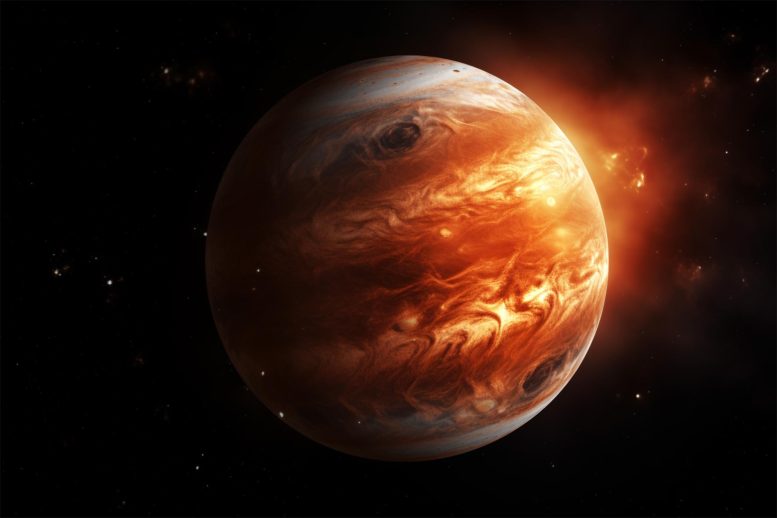
Scientists have identified a Jupiter-sized planet, TOI-4860 b, around a low-mass star, challenging conventional planet formation theories.
An international team of researchers has discovered an unusual Jupiter-sized planet orbiting a low-mass star called TOI-4860, located in the Corvus constellation.
The newly discovered gas giant, named TOI-4860 b, is an unusual planet for two reasons: stars of such low mass are not expected to host planets like Jupiter, and the planet appears to be particularly enriched by heavy elements.
The study, led by University of Birmingham astronomers, was published earlier this month in a letter within the Monthly Notices of the Royal Astronomical Society.
“Under the canonical planet formation model, the less mass a star has, the less massive the disc of material is around that star. Since planets are created from that disc, high-mass planets like Jupiter, were widely expected not to form.”
George Dransfield, PhD student at the University of Birmingham
Tools and Methods Used in the Discovery
The planet was initially identified using NASA’s Transiting Exoplanet Survey Satellite as a drop of brightness while transiting in front of its host star, but that data alone was insufficient to confirm that it was a planet.
The team used the SPECULOOS South Observatory, located in the Atacama Desert in Chile, to measure the planetary signal in several wavelengths and validated the planetary nature. The astronomers also observed the planet just before and after it disappeared behind its host star, noticing that there was no change in light, meaning the planet was not emitting any. Finally, the team collaborated with a Japanese group using the Subaru Telescope in Hawai’i. Together they measured the mass of the planet to fully confirm it.
Following this star and confirming its planet was the initiative of a group of PhD students within the SPECULOOS project.
“A hint of what might have happened is hidden in the planetary properties, which appear particularly enriched in heavy elements. We have detected something similar in the host star too, so it is likely that an abundance of heavy elements catalysed the planet formation process.”
Professor Amaury Triaud, University of Birmingham
Challenging Established Beliefs
George Dransfield, one of those PhD students, who recently submitted her thesis at the University of Birmingham, explains: “Under the canonical planet formation model, the less mass a star has, the less massive is the disc of material around that star.
“Since planets are created from that disc, high-mass planets like Jupiter, were widely expected not to form. However, we were curious about this and wanted to check planetary candidates to see if it was possible. TOI-4860 is our first confirmation and the lowest mass star hosting such a high mass planet.”
Insights on Planet Formation
Amaury Triaud, Professor of Exoplanetology at the University of Birmingham, who led the study said: “I am ever thankful to the bright PhD students of our team for proposing to observe systems like TOI-4860. Their work has really paid off since planets like TOI-4860 are vital to deepening our understanding of planet formation.
“A hint of what might have happened is hidden in the planetary properties, which appear particularly enriched in heavy elements. We have detected something similar in the host star too, so it is likely that an abundance of heavy elements catalyzed the planet formation process.”
Characteristics and Further Studies
The new gas giant takes about 1.52 days to complete a full orbit around its host star, but because its host is a cold low mass star, the planet itself can be referred to as a ‘Warm Jupiter’. This is a subclass of planet that holds particular interest for astronomers looking to build on their initial observations and learn more about how these kinds of planets are formed.
Mathilde Timmermans, another student of the SPECULOOS project, working at the University of Liege in Belgium concludes: “Thanks to its very short orbital period, and to the properties of its host star, the discovery of TOI-4860 b provides a brilliant opportunity to study the atmospheric properties of a warm Jupiter and learn more about how gas giants are formed.”
Recently the team has been awarded telescope time at the Very Large Telescope, in Chile, which they intend to use to confirm several more planets with similar properties.
Reference: “An M dwarf accompanied by a close-in giant orbiter with SPECULOOS” by Amaury H M J Triaud, Georgina Dransfield, Taiki Kagetani, Mathilde Timmermans, Norio Narita, Khalid Barkaoui, Teruyuki Hirano, Benjamin V Rackham, Mayuko Mori, Thomas Baycroft, Zouhair Benkhaldoun, Adam J Burgasser, Douglas A Caldwell, Karen A Collins, Yasmin T Davis, Laetitia Delrez, Brice-Oliver Demory, Elsa Ducrot, Akihiko Fukui, Clàudia Jano Muñoz, Emmanuël Jehin, Lionel J García, Mourad Ghachoui, Michaël Gillon, Yilen Gómez Maqueo Chew, Matthew J Hooton, Masahiro Ikoma, Kiyoe Kawauchi, Takayuki Kotani, Alan M Levine, Enric Pallé, Peter P Pedersen, Francisco J Pozuelos, Didier Queloz, Owen J Scutt, Sara Seager, Daniel Sebastian, Motohide Tamura, Samantha Thompson, Noriharu Watanabe, Julien de Wit, Joshua N Winn and Sebastián Zúñiga-Fernández, 4 August 2023, Monthly Notices of the Royal Astronomical Society: Letters.
DOI: 10.1093/mnrasl/slad097
Never miss a breakthrough: Join the SciTechDaily newsletter.
Follow us on Google and Google News.
1 Comment
Michael Innes. I am God Ouranos. ASTÈR I made the universes