
Close Menu
    Facebook X (Twitter) Instagram
    SciTechDaily
    • Biology
    • Chemistry
    • Earth
    • Health
    • Physics
    • Science
    • Space
    • Technology
    Facebook X (Twitter) Pinterest YouTube RSS
    SciTechDaily
    Home»Physics»New Filter for Blocking High-Pitched Sounds Proposed by Physicists
    Physics

    New Filter for Blocking High-Pitched Sounds Proposed by Physicists

    By University at BuffaloApril 13, 20201 Comment3 Mins Read
    Facebook Twitter Pinterest Telegram LinkedIn WhatsApp Email Reddit
    Share
    Facebook Twitter LinkedIn Pinterest Telegram Email Reddit
    High-Pitched Sound Filter
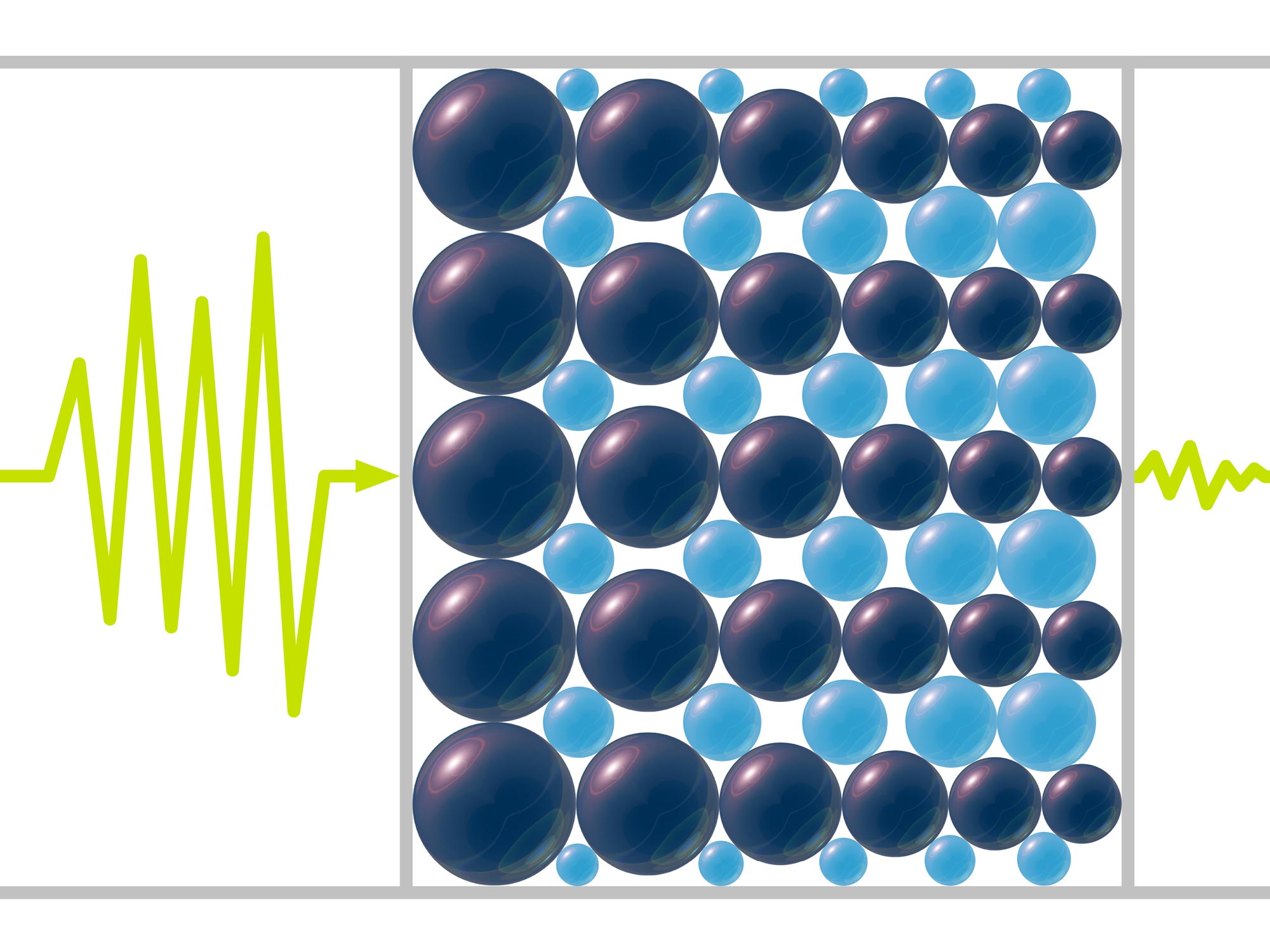
    An artist’s illustration of a system designed to help block high-frequency sounds of up to 20 kilohertz. The system comprises tapered chains of Delrin plastic beads (darker beads) alternating with tapered chains of tungsten carbide beads (lighter beads), surrounded by plastic walls. Credit: Robert Rivera, University at Buffalo; Luis Machado, Federal University of Pará in Brazil

    Need to reduce high-pitched noises? Science may have an answer.

    In a new study, theoretical physicists report that materials made from tapered chains of spherical beads could help dampen sounds that lie at the upper range of human hearing or just beyond.

    The impacts of such noises on health are uncertain. But some research suggests that effects could include nausea, headaches, dizziness, impaired hearing, or other symptoms.

    “There is a fair amount of ultrasonic stuff around us, and much of it has effects that are unknown. In warmer areas, you have pest control systems that are strongly reliant on ultrasonic emissions to drive out the pests. You have ultrasonics from machinery, from drilling. Certain lamps may emit these high-frequency noises,” says Surajit Sen, Ph.D., professor of physics in the University at Buffalo College of Arts and Sciences. “What does it do to our hearing? And in return, what does it do to our brain?

    “Because of these unknowns, we thought it would be of potential value to design a system that kills off high-frequency sound.”

    The new research appears in the February 2020 volume of Granular Matter and was published online in the journal in November 2019.

    Sen co-authored the study with Luís Paulo Silveira Machado, Ph.D., professor of physics at the Federal University of Pará in Brazil. Machado did part of the work as a visiting scholar at UB with the financial support of his home university, and Sen’s research was partially supported by a Fulbright-Nehru Academic and Professional Excellence Fellowship.

    “There is a fair amount of ultrasonic stuff around us, and much of it has effects that are unknown. … Because of these unknowns, we thought it would be of potential value to design a system that kills off high-frequency sound.”
    —  Surajit Sen, Professor of Physics, University at Buffalo

    The study used computational modeling to explore how well various materials would dampen incoming sounds with frequencies up to 20 kilohertz — high enough that only some people can hear these noises.

    Machado and Sen researched a number of materials, all made from spherical beads of varying sizes surrounded by plastic walls.

    The best set-up they found consisted of tapered chains of beads made from a metal called tungsten carbide, alternating with tapered chains of beads made from a plastic called Delrin. In computer simulations, this system effectively helped to filter high-frequency noises of varying loudness, greatly reducing these sounds.

    The scientists have not yet tested the material in the laboratory. But if it works, the noise-filtering system could be used in headphones or other barriers that dampen high-frequency sound, the researchers say.

    “An advantage of the proposed device is its simple configuration: spherical beads properly confined and positioned,” Machado says. “This proposal allows a prototype of easy construction, with low cost and little maintenance. In addition, its configuration is scalable, being adaptable for small or large volumes. Our next step is to redirect the output signals, which is under study.”

    Reference: “Decorated granular crystal as filter of low-frequency ultrasonic signals” by Luís Paulo Silveira Machado and Surajit Sen, 15 November 2019, Granular Matter.
    DOI: 10.1007/s10035-019-0977-4

    Never miss a breakthrough: Join the SciTechDaily newsletter.
    Follow us on Google and Google News.

    Materials Science Public Health University at Buffalo
    Share. Facebook Twitter Pinterest LinkedIn Email Reddit

    Related Articles

    The Experimental Design of a Space-Time Crystal

    Room-Temperature Superconductivity Might Have Been Attained

    Probing the Effects of Light at the Atomic Scale

    New Insights Into How Superconducting Materials Interact With Magnetic Ones

    Path to Magnetic Vortex RAM Might be More Difficult Than Previously Assumed

    Electron-Electron Interactions are Critical to Graphene’s Extraordinary Properties

    SLAC Scientists Complete Terahertz Experiment

    LCLS Low-Energy Test Just Shy of the 284-Electronvolt Carbon Edge

    High-Energy Radiation is Refracted Setting the Stage for Gamma Optics

    1 Comment

    1. Kimberly Edens on October 22, 2022 8:42 am

      An ex-neighbor of mine has been harassing me for over 2 years. He has some kind of instrument or something that is causing extremely high pitched sounds to me. He’s been tormenting me with this thing for a couple of weeks. My head is getting swollen near at the temples & is excruciatingly painful. He turns it on & off at will. Sometimes it gets too high & sometimes its lower. Do you know what electronic device that can cause this? Please help me, this is really going on right now & I need help.

      Reply
    Leave A Reply Cancel Reply

    • Facebook
    • Twitter
    • Pinterest
    • YouTube

    Don't Miss a Discovery

    Subscribe for the Latest in Science & Tech!

    Trending News

    Popular Sugar-Free Sweetener Linked to Liver Disease, Study Warns

    What Is Hantavirus? The Deadly Disease Raising Alarm Worldwide

    Scientists Just Discovered How the Universe Builds Monster Black Holes

    Scientists Unveil New Treatment Strategy That Could Outsmart Cancer

    A Simple Vitamin May Hold the Key to Treating Rare Genetic Diseases

    Scientists Think the Real Fountain of Youth May Be Hiding in Your Gut

    Ravens Don’t Follow Wolves, They Predict Them

    This Common Knee Surgery May Be Doing More Harm Than Good

    Follow SciTechDaily
    • Facebook
    • Twitter
    • YouTube
    • Pinterest
    • Newsletter
    • RSS
    SciTech News
    • Biology News
    • Chemistry News
    • Earth News
    • Health News
    • Physics News
    • Science News
    • Space News
    • Technology News
    Recent Posts
    • You May Have a Dangerous Type of Cholesterol Even if Your Tests Look Normal
    • Study Reveals Dangerous Flaw in AI Symptom Checkers
    • New MRI Breakthrough Captures Stunningly Clear Images of the Eye and Brain
    • Scientists Warn Sitting Too Much Can Harm Your Body in Surprising Ways
    • Your Blood Pressure Reading Could Be Wrong Because of One Simple Mistake
    Copyright © 1998 - 2026 SciTechDaily. All Rights Reserved.
    • Science News
    • About
    • Contact
    • Editorial Board
    • Privacy Policy
    • Terms of Use

    Type above and press Enter to search. Press Esc to cancel.