
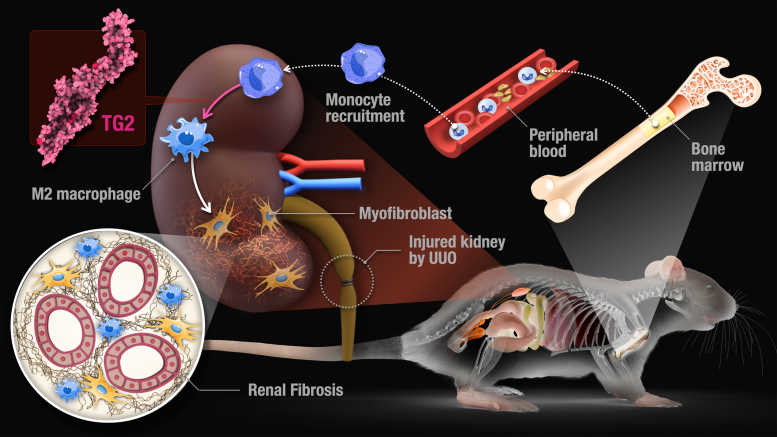
Researchers Identified Enzymes That Contribute to Kidney Fibrosis Through Macrophage Polarization
According to a study published in Cell Death & Disease, scientists at Nagoya University in Japan have discovered two enzymes that play a role in macrophage polarization, a key factor affecting fibrosis. The findings of the study suggest a promising treatment possibility for human patients.
Kidney fibrosis is a deadly inflammatory disease that results in the stiffening and loss of normal function of the kidneys. The disease is associated with a mechanism known as macrophage polarization. Macrophages, which are white blood cells that assist the body in fighting infections and repairing tissues, undergo polarization in response to changes in their microenvironment. This polarization results in two different types of macrophages: M1, which causes inflammation, and M2, which possesses anti-inflammatory and tissue repair capabilities.
Because macrophage polarization is tightly controlled and involves multiple signaling pathways and regulatory networks, imbalances in this process are common in many inflammatory diseases. In patients with kidney fibrosis, there is an imbalance between M1 and M2 macrophages. In this situation, M2 macrophages, which normally suppress inflammation, proliferate excessively and secrete factors that promote fibrosis.
Although these imbalances may be therapeutic targets, this is hampered by the fact that the mechanism of macrophage polarization involved in kidney fibrosis is still poorly understood. Furthermore, the molecular mechanisms of macrophage polarization have little in common between mice and humans, making it difficult to translate research results obtained in mice to human diseases.
Discovery of TG2 and ALOX15 in Kidney Fibrosis
A Nagoya University research group led by Assistant Professor Hideki Tatsukawa, graduate student Yoshiki Shinoda, and Professor Hitomi Kiyotaka of the Graduate School of Pharmaceutical Sciences, in collaboration with Professor Takayoshi Suganami and Lecturer Miyako Tanaka of the Research Institute of Environmental Medicine, has identified an enzyme associated with kidney fibrosis in both mice and human models called protein cross-linking enzyme transglutaminase (TG2). Their discovery opens the possibility of translating findings in mouse models into therapies for human patients.
As its name suggests, TG2 is involved in the cross-linking of amino acid residues in proteins. In fibrosis models, TG2 induces another enzyme, arachidonic acid oxidase (ALOX15), through the cross-linking process. Since previous studies have reported that ALOX15 is involved in M2 macrophage induction, the group’s findings suggest that TG2 activity exacerbates kidney fibrosis by polarizing M2 macrophages using ALOX15.
“Macrophage polarization, which promotes fibrosis through cross-linking enzymes, has a similar induction mechanism in both humans and mice,” Tatsukawa said. “By targeting the regulation of macrophage function, we hope to develop treatments for various diseases caused by an imbalance between the promotion and suppression of inflammation, such as fibrosis, cancer, and atherosclerosis.”
Their research also suggests that drugs developed for celiac disease, that inhibit TG2, could be repurposed to treat fibrosis. “TG2 also converts wheat gluten into gliadin, which is known to cause gluten sensitivity (celiac disease),” Tatsukawa said. “A TG2 inhibitor has been developed for the treatment of this celiac disease and is currently in clinical trials. We believe that this inhibitor could be used in the treatment of fibrosis because researchers, including our group, have found that the administration of TG2 inhibitors suppresses the pathogenesis of fibrosis models in the kidney, liver, and lung.”
Reference: “Tissue transglutaminase exacerbates renal fibrosis via alternative activation of monocyte-derived macrophages” by Yoshiki Shinoda, Hideki Tatsukawa, Atsushi Yonaga, Ryosuke Wakita, Taishu Takeuchi, Tokuji Tsuji, Miyako Tanaka, Takayoshi Suganami and Kiyotaka Hitomi, 2 March 2023, Cell Death & Disease.
DOI: 10.1038/s41419-023-05622-5
Never miss a breakthrough: Join the SciTechDaily newsletter.
Follow us on Google and Google News.