
Close Menu
    Facebook X (Twitter) Instagram
    SciTechDaily
    • Biology
    • Chemistry
    • Earth
    • Health
    • Physics
    • Science
    • Space
    • Technology
    Facebook X (Twitter) Pinterest YouTube RSS
    SciTechDaily
    Home»Space»Cosmic Tentacles: The Unexpected Star Factory in Jellyfish Galaxies
    Space

    Cosmic Tentacles: The Unexpected Star Factory in Jellyfish Galaxies

    By ESA/HubbleApril 9, 20231 Comment4 Mins Read
    Facebook Twitter Pinterest Telegram LinkedIn WhatsApp Email Reddit
    Share
    Facebook Twitter LinkedIn Pinterest Telegram Email Reddit
    Hubble JO204
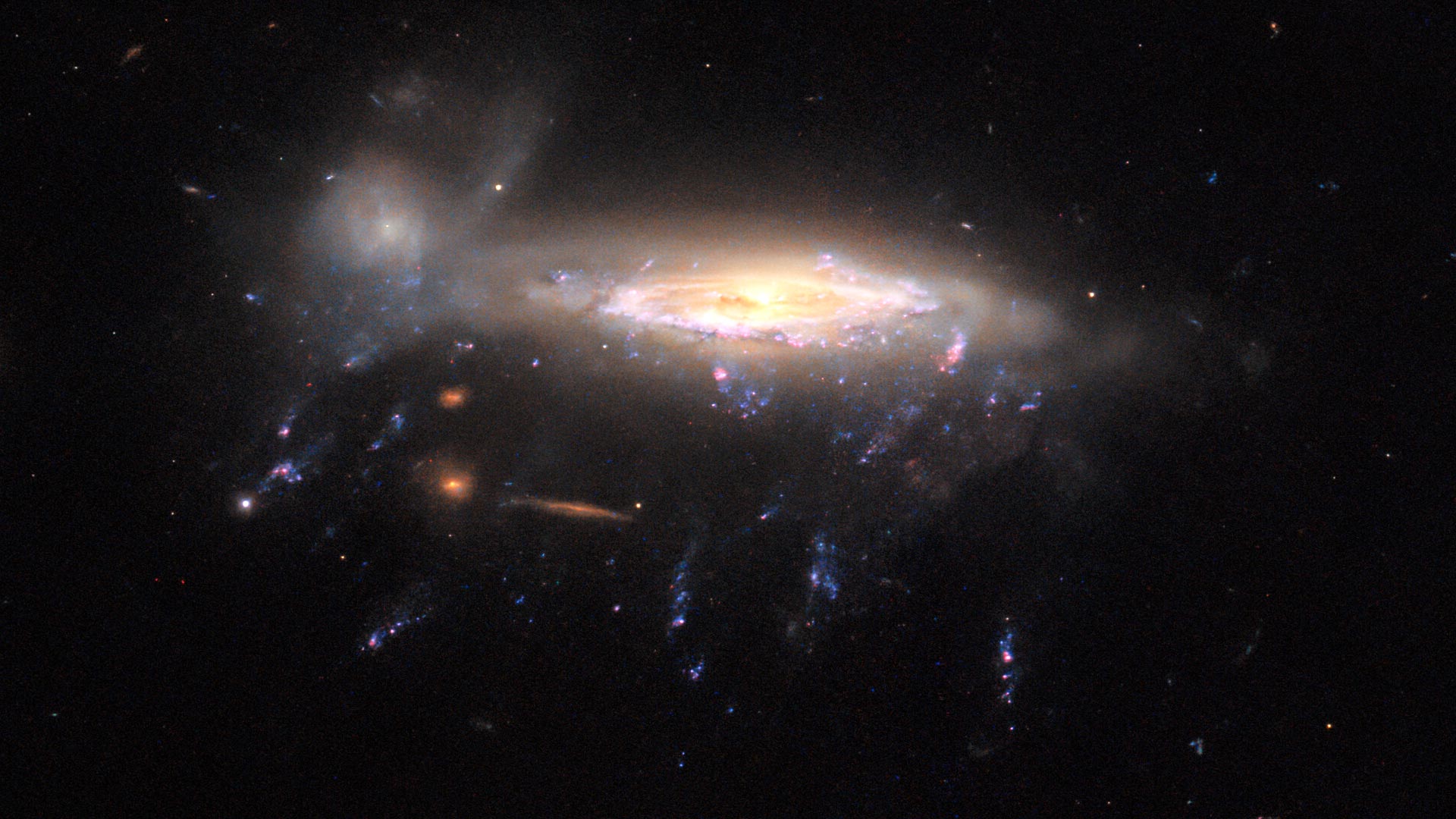
    JO204, a “jellyfish galaxy” situated 600 million light-years away in the constellation Sextans, features bright tendrils of gas that look like jellyfish tentacles. Captured by the Hubble Space Telescope, this image is part of a series of Pictures of the Week highlighting jellyfish galaxies. These galaxies are crucibles for star formation due to an astronomical process called ram pressure stripping. As the galaxies move against the intergalactic medium, their loosely bound gas is stripped away, causing the colder and denser gas to collapse and form new stars in the galaxy’s tendrils. (Cropped view. See full image below.) Credit: ESA/Hubble & NASA, M. Gullieuszik and the GASP team

    The Hubble Space Telescope captured an image of JO204, a “jellyfish galaxy” characterized by bright gas tendrils resembling jellyfish tentacles. These galaxies experience ram pressure stripping, which causes their loosely bound gas to collapse and form new stars in their tendrils.

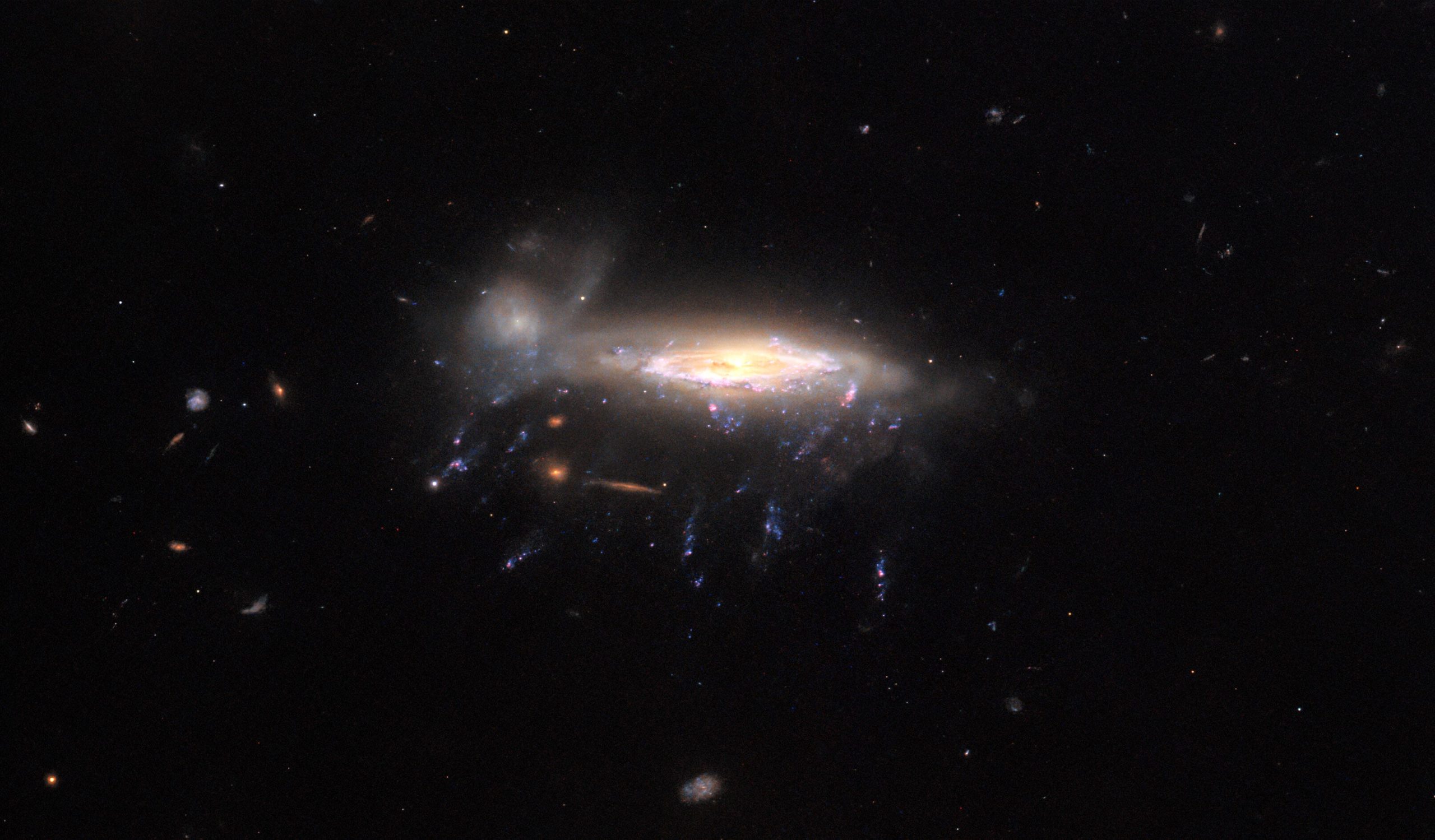
    Here we see JO204, a ‘jellyfish galaxy’ so named for the bright tendrils of gas that appear in this image to be drifting lazily below JO204’s bright central bulk. The galaxy lies almost 600 million light-years away in the constellation Sextans. This image was captured by the NASA/ESA Hubble Space Telescope, and it is the third of a series of Pictures of the Week featuring jellyfish galaxies. This series of images is possible thanks to a survey in which observations were made of six of these fascinating galaxies, including JO204. This survey was performed with the intention of better understanding star formation under extreme conditions.
    Hubble JO204
    Hubble Space Telescope image of ‘jellyfish galaxy’ JO204. Credit: ESA/Hubble & NASA, M. Gullieuszik and the GASP team

    Given the dreamy appearance of this image, it would be understandable to wonder why jellyfish galaxies should be such a crucible for star formation. The answer is that — as is often the case with astronomy — first appearances can be deceiving. Whilst the delicate ribbons of gas beneath JO204 may look like floating jellyfish tentacles, they are in fact the outcome of an intense astronomical process known as ram pressure stripping.

    Ram pressure is a particular type of pressure exerted on a body when it moves relative to a fluid. An intuitive example is the sensation of pressure you experience when you are standing in an intense gust of wind — the wind is a moving fluid, and your body feels pressure from it. An extension of this analogy is that your body will remain whole and coherent, but the more loosely bound things — like your hair and your clothes — will flap in the wind. The same is true for jellyfish galaxies. They experience ram pressure because of their movement against the intergalactic medium that fills the spaces between galaxies in a galaxy cluster. The galaxies experience intense pressure from that movement, and as a result their more loosely bound gas is stripped away. This gas is mostly the colder and denser gas in the galaxy — gas which, when stirred and compressed by the ram pressure, collapses and forms new stars in the jellyfish’s beautiful tendrils.

    References:

    “UV and Hα HST observations of 6 GASP jellyfish galaxies” by Marco Gullieuszik, Eric Giunchi, Bianca M. Poggianti, Alessia Moretti, Claudia Scarlata, Daniela Calzetti, Ariel Werle, Anita Zanella, Mario Radovich, Callum Bellhouse, Daniela Bettoni, Andrea Franchetto, Jacopo Fritz, Yara L. Jaffé, Sean McGee, Matilde Mingozzi, Alessando Omizzolo, Stephanie Tonnesen, Marc Verheijen and Benedetta Vulcani, 7 March 2023, The Astrophysical Journal.
    DOI: 10.3847/1538-4357/acb59b

    “HST imaging of star-forming clumps in 6 GASP ram-pressure stripped galaxies” by Eric Giunchi, Marco Gullieuszik, Bianca M. Poggianti, Alessia Moretti, Ariel Werle, Claudia Scarlata, Anita Zanella, Benedetta Vulcani and Daniela Calzetti, The Astrophysical Journal.
    arXiv:2302.10615

    Never miss a breakthrough: Join the SciTechDaily newsletter.
    Follow us on Google and Google News.

    Astronomy European Space Agency Hubble Space Telescope
    Share. Facebook Twitter Pinterest LinkedIn Email Reddit

    Related Articles

    A Diamond Necklace of Cosmic Proportions

    Hubble Snaps a Stunning Close-Up of a Magnificent Spiral Galaxy

    Extraordinary Hubble Image: Light Bends From the Beyond

    Hubble Space Telescope Sees Volcanic Activity Reforming the Atmosphere on a Rocky Exoplanet

    Hubble Spies a Luminous Heart With Dark Tendrils

    Spectacular Return to the Veil Nebula

    Hubble Spots a Peculiar Sight: Unusual Spiral Galaxy With a Heavy Arm

    A Flash of Life: Hubble Spies an Unusual Planetary Nebula

    Through the Cosmic Clouds: Hubble Spots a Beautiful Stellar Nursery

    1 Comment

    1. haneri1121 on April 10, 2023 1:08 am

      Earn Dollars In Your Free Time…>> rb.gy/hxdfe

      Reply
    Leave A Reply Cancel Reply

    • Facebook
    • Twitter
    • Pinterest
    • YouTube

    Don't Miss a Discovery

    Subscribe for the Latest in Science & Tech!

    Trending News

    Monster Storms on Jupiter Unleash Lightning Beyond Anything on Earth

    Scientists Create “Liquid Gears” That Spin Without Touching

    The Simple Habit That Could Help Prevent Cancer

    Millions Take These IBS Drugs, But a New Study Finds Serious Risks

    Scientists Unlock Hidden Secrets of 2,300-Year-Old Mummies Using Cutting-Edge CT Scanner

    Bread Might Be Making You Gain Weight Even Without Eating More Calories

    Scientists Discover Massive Magma Reservoir Beneath Tuscany

    Europe’s Most Active Volcano Just Got Stranger – Here’s Why Scientists Are Rethinking It

    Follow SciTechDaily
    • Facebook
    • Twitter
    • YouTube
    • Pinterest
    • Newsletter
    • RSS
    SciTech News
    • Biology News
    • Chemistry News
    • Earth News
    • Health News
    • Physics News
    • Science News
    • Space News
    • Technology News
    Recent Posts
    • Simple Blood Test May Predict Alzheimer’s Years Before Brain Scans Show Signs
    • Scientists Say Adding This Unusual Seafood to Your Diet Could Reverse Signs of Aging
    • U.S. Waste Holds $5.7 Billion Worth of Crop Nutrients
    • Scientists Say a Hidden Structure May Exist Inside Earth’s Core
    • Doctors Surprised by the Power of a Simple Drug Against Colon Cancer
    Copyright © 1998 - 2026 SciTechDaily. All Rights Reserved.
    • Science News
    • About
    • Contact
    • Editorial Board
    • Privacy Policy
    • Terms of Use

    Type above and press Enter to search. Press Esc to cancel.