
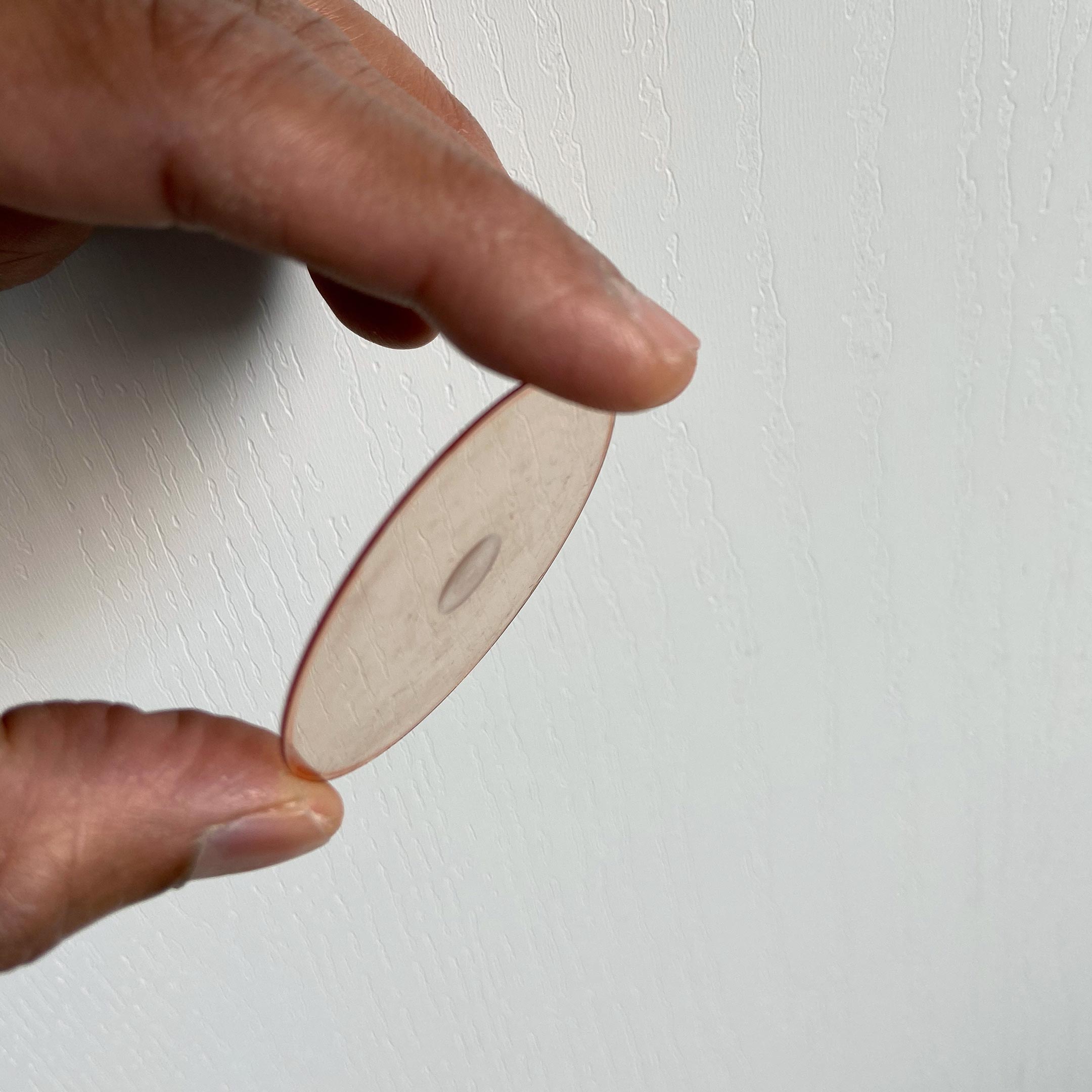
New technology poised to drastically reduce weight, complexity and cost of cameras while increasing functionality.
Using a single lens that is about one-thousandth of an inch thick, researchers have created a camera that does not require focusing. The technology offers considerable benefits over traditional cameras such as the ones in most smartphones, which require multiple lenses to form high-quality, in-focus images.
“Our flat lenses can drastically reduce the weight, complexity, and cost of cameras and other imaging systems, while increasing their functionality,” said research team leader Rajesh Menon from the University of Utah. “Such optics could enable thinner smartphone cameras, improved and smaller cameras for biomedical imaging such as endoscopy, and more compact cameras for automobiles.”
In Optica, The Optical Society’s (OSA) journal for high-impact research, Menon and colleagues describe their new flat lens and show that it can maintain focus for objects that are about 6 meters apart from each other. Flat lenses use nanostructures patterned on a flat surface rather than bulky glass or plastic to achieve the important optical properties that control the way light travels.
“This new lens could have many interesting applications outside photography such as creating highly efficient illumination for LIDAR that is critical for many autonomous systems, including self-driving cars,” said Menon.
The researchers say the design approach they used could be expanded to create optical components with any number of properties such as extreme bandwidth, easier manufacturability, or lower cost.
Questioning the textbook
Conventional cameras, whether used in smartphones or for microscopy, require focusing to ensure that the details of an object are sharp. If there are multiple objects at different distances from the camera, each object must be focused separately.
“The new lens eliminates the need for focusing and allows any camera to keep all the objects in focus simultaneously,” said Menon. “Conventional cameras also use multiple lenses to keep different colors of light in focus simultaneously. Since our design is very general, we can also use it to create a single flat lens that focuses all colors of light, drastically simplifying cameras even further.”
To focus light, traditional lenses transform parallel light waves into spherical waves that converge into a focal spot. In an important breakthrough, the researchers realized that waves with other shapes could produce a similar effect, vastly increasing the number of possible lens designs.
“In stark contrast to what is taught in optics textbooks, our research has shown that there is more than one way that light transmission is affected by an ideal lens – a concept known as pupil function,” said Menon. “This opened essentially infinite possibilities for the lens pupil function, and we searched through these possibilities for one that achieved an extreme depth of focus.”
Experimental confirmation
After choosing the best lens design for depth of focus, the researchers used nanofabrication techniques to make a prototype lens. Experiments confirmed that the new lens performed as expected and achieved a depth of focus several orders of magnitude larger than that of an equivalent conventional lens.
The researchers demonstrated the new lens using infrared light and relatively low numerical aperture — a number that characterizes the range of angles over which the lens can accept or emit light. They plan to extend the lens to larger numerical apertures and to use it with the full visible light spectrum. Work to ensure that the lenses could be mass manufactured is also needed before they could be commercialized.
“This research is a good example of how abandoning traditional notions can enable devices previously considered impossible,” said Menon. “It serves as a good reminder to question dictates from the past.”
Reference: “Extreme depth-of-focus imaging with a flat lens” by Sourangsu Banerji, Monjurul Meem, Apratim Majumder, Berardi Sensale-Rodriguez and Rajesh Menon, 12 March 2020, Optica.
DOI:
Never miss a breakthrough: Join the SciTechDaily newsletter.
Follow us on Google and Google News.
2 Comments
As I read this, I couldn’t stop thinking about how this could improve vision in people who need a infra-ocular implant to replace their cataract. Imagine, a implant that let’s you see well near & far, without glasses, something today’s implants can’t do
I wonder what it’s image looks like?
Not to be a smarty-pants, but can we not use these lens for eyeglasses?!?!
Why should computers get all the good stuff???