
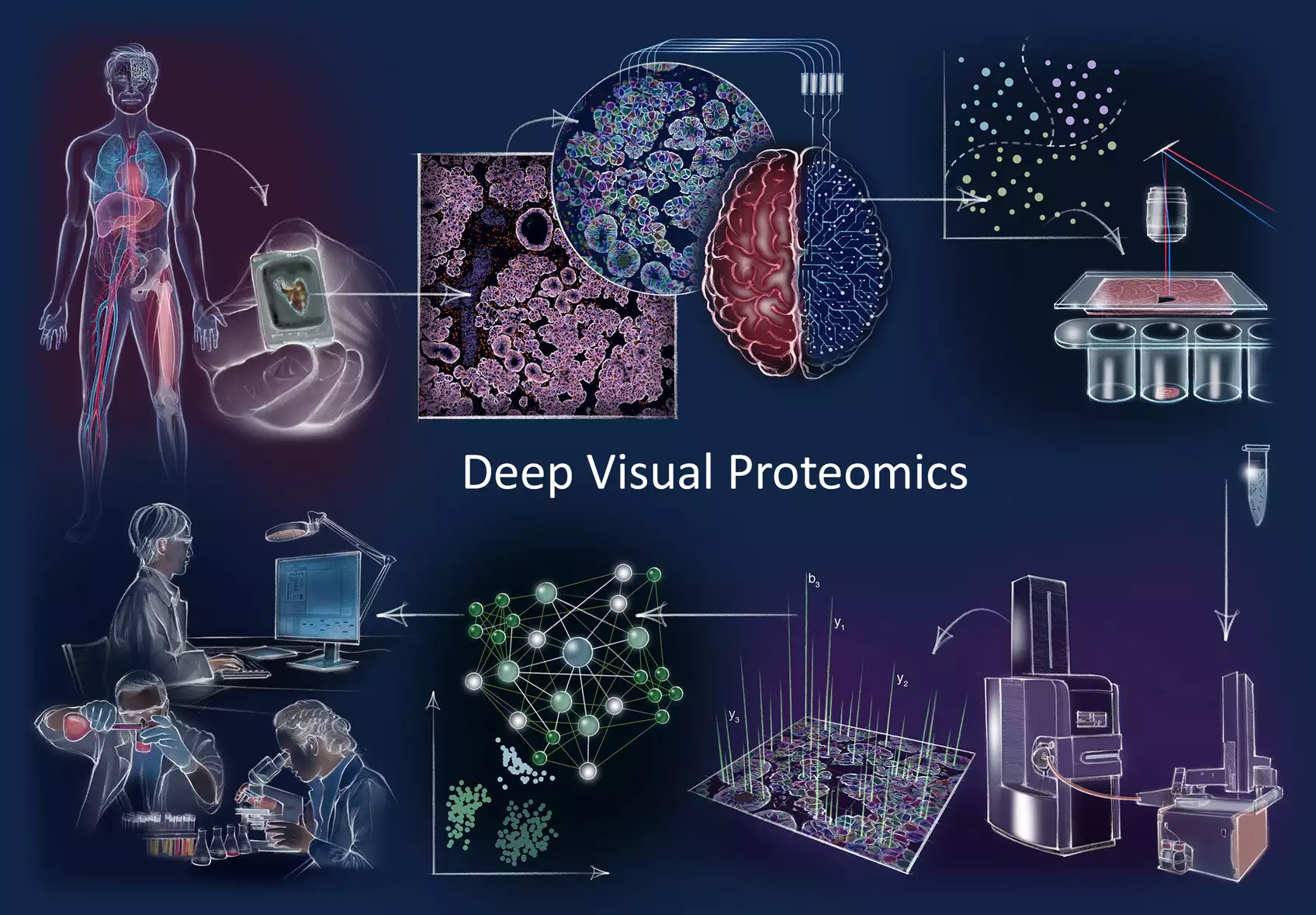
How do some patients develop resistance to cancer treatment? The new method known as “Deep Visual Proteomics” may be able to help doctors get closer to an answer and identify cancer tumor vulnerabilities.
It is never easy for doctors to figure out why certain illnesses develop in our bodies. Old age, risky habits such as smoking, and genetics can all play a role.
However, the exact, specific causes of serious diseases such as cancer remain unknown.
Now, a groundbreaking method known as “Deep Visual Proteomics” may be able to help change that. An international team of researchers led by Copenhagen University created the technique, which was recently applied to cancer cells in a new study published in the top scientific journal Nature Biotechnology.
“Our new concept, Deep Visual Proteomics, could become a game-changer for molecular pathology in the hospitals. With this method, we can identify thousands of proteins and determine how many of them are there,” explains Andreas Mund, first author of the new study.
“We do this by taking a tissue sample and analyzing just the tumor cells in it. This ‘list’ of proteins is called proteome. These proteomes reveal the mechanisms that drive tumor development and directly expose new therapeutic targets from a single tissue slice of a cancer patient biopsy. It exposes a cosmos of molecules inside these cancer cells,” says Andreas Mund, Associate Professor at the Novo Nordisk Foundation Center for Protein Research (CPR) and part of Professor Matthias Mann’s team that spearheaded this development at CPR and the Max Planck Institute for Biochemistry.
Important to Pathology Departments
The reason why the researchers are so interested in proteins is that they actually are some of the most important pieces of the puzzle for almost all diseases. Proteins are commonly referred to as the ‘workhorses of the cell’.
“When something goes wrong inside our cells and we become sick, you can be sure that proteins are involved in a wide range of different ways. Because of this, mapping the protein landscape can help us determine why a tumor could develop in a particular patient, what vulnerabilities that tumor has, and also what treatment strategy might prove the most beneficial,” says Matthias Mann, professor.
In the new study, the researchers applied “Deep Visual Proteomics” to cells from patients with acinic cell carcinoma and melanoma. This was done in collaboration with researchers at the Zealand University Hospital, Roskilde.
“This unique method combines tissue architecture with the expression of thousands of proteins specific for selected cells. It enables researchers to investigate interactions between cancer cells and their surrounding cells with major implications for future clinical cancer treatment. Recently, we diagnosed a highly complex clinical case with 2 different components, and the results from DVP analysis,” says Lise Mette Rahbek Gjerdrum, consultant and clinical research associate professor at the Department of Pathology, Zealand University Hospital and Department of Clinical Medicine, University of Copenhagen.
Digital Pathology, Deep Learning, Microscopy, and Mass Spectrometry
Deep Visual Proteomics integrates advances from four different technologies into a single workflow. Firstly, advanced microscopy generates high-resolution tissue maps. Afterward, machine learning algorithms are used to classify cells accurately before laser microdissections and single-cell collection. Then just the normal or diseased cells of a particular type are analyzed by mass spectroscopy, mapping the protein landscape, and understanding the mechanisms of health and disease.
“Using this technology, we can effectively connect the physiological characteristics of cells seen under microscopes with the functions of proteins. This was not previously possible and we are very convinced that this method can be applied to other diseases, not just cancer,” says Andreas Mund.
Reference: “Deep Visual Proteomics defines single-cell identity and heterogeneity” by Andreas Mund, Fabian Coscia, András Kriston, Réka Hollandi, Ferenc Kovács, Andreas-David Brunner, Ede Migh, Lisa Schweizer, Alberto Santos, Michael Bzorek, Soraya Naimy, Lise Mette Rahbek-Gjerdrum, Beatrice Dyring-Andersen, Jutta Bulkescher, Claudia Lukas, Mark Adam Eckert, Ernst Lengyel, Christian Gnann, Emma Lundberg, Peter Horvath and Matthias Mann, 19 May 2022, Nature Biotechnology.
DOI: 10.1038/s41587-022-01302-5
Never miss a breakthrough: Join the SciTechDaily newsletter.
Follow us on Google and Google News.