
Close Menu
    Facebook X (Twitter) Instagram
    SciTechDaily
    • Biology
    • Chemistry
    • Earth
    • Health
    • Physics
    • Science
    • Space
    • Technology
    Facebook X (Twitter) Pinterest YouTube RSS
    SciTechDaily
    Home»Space»New Horizons Reveals Charon’s Surprising, Youthful and Varied Terrain
    Space

    New Horizons Reveals Charon’s Surprising, Youthful and Varied Terrain

    By SciTechDailyJuly 15, 2015No Comments2 Mins Read
    Facebook Twitter Pinterest Telegram LinkedIn WhatsApp Email Reddit
    Share
    Facebook Twitter LinkedIn Pinterest Telegram Email Reddit
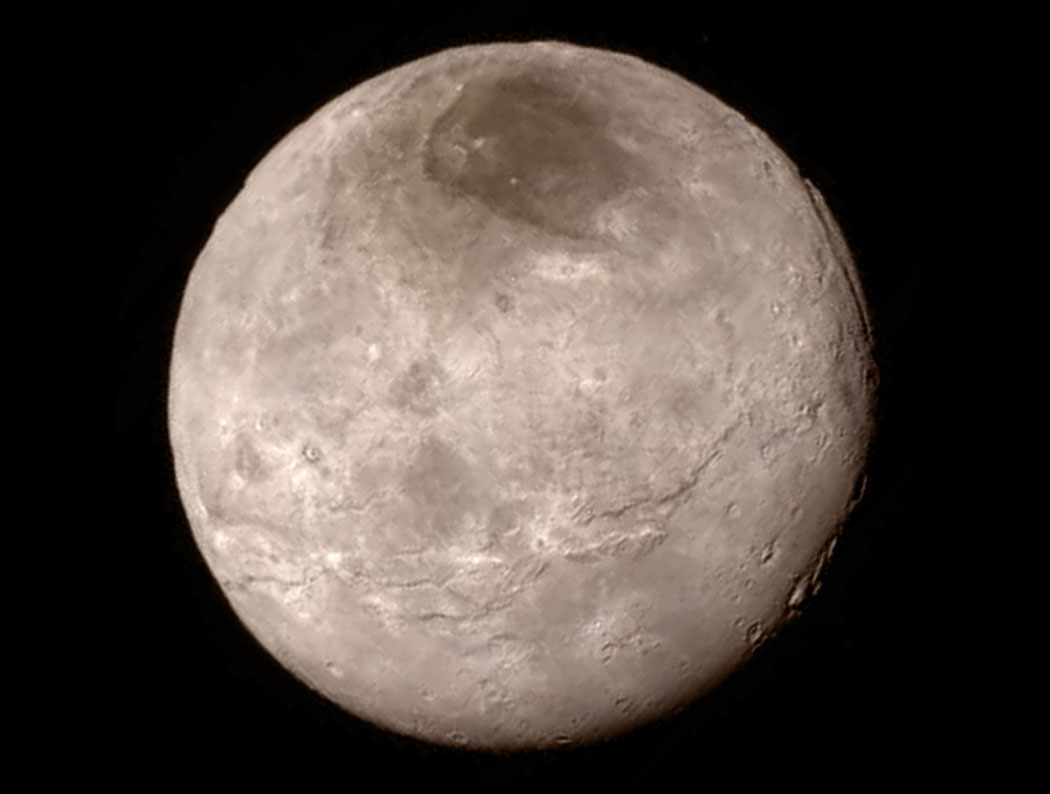
    New Image Reveals Details of Pluto’s Moon Charon
    Pluto’s largest moon Charon. Credit: NASA-JHUAPL-SwRI

    This new image from New Horizons’ Long Range Reconnaissance Imager reveals new details of Pluto’s largest moon Charon. The image was taken on July 13, 2015,  from a distance of 289,000 miles (466,000 kilometers).

    A swath of cliffs and troughs stretches about 600 miles (1,000 kilometers) from left to right, suggesting widespread fracturing of Charon’s crust, likely a result of internal processes. At the upper right, along the moon’s curving edge, is a canyon estimated to be 4 to 6 miles (7 to 9 kilometers) deep.

    Mission scientists are surprised by the apparent lack of craters on Charon. South of the moon’s equator, at the bottom of this image, the terrain is lit by the slanting rays of the sun, creating shadows that make it easier to distinguish topography. Even here, however, relatively few craters are visible, indicating a relatively young surface that has been reshaped by geologic activity.

    In Charon’s north polar region, a dark marking prominent in New Horizons’ approach images is now seen to have a diffuse boundary, suggesting it is a thin deposit of dark material. Underlying it is a distinct, sharply bounded, angular feature; higher resolution images still to come are expected to shed more light on this enigmatic region.

    The image has been compressed to reduce its file size for transmission to Earth. In high-contrast areas of the image, features as small as 3 miles (5 kilometers) across can be seen. Some lower-contrast detail is obscured by the compression of the image, which may make some areas appear smoother than they really are. The uncompressed version still resides in New Horizons’ computer memory and is scheduled to be transmitted at a later date.

    The image has been combined with color information obtained by New Horizons’ Ralph instrument on July 13.

    New Horizons traveled more than three billion miles over nine-and-a-half years to reach the Pluto system.

    Never miss a breakthrough: Join the SciTechDaily newsletter.
    Follow us on Google and Google News.

    Astronomy Charon NASA New Horizons
    Share. Facebook Twitter Pinterest LinkedIn Email Reddit

    Related Articles

    New Horizons Reveals a Possible Ancient Ocean on Charon

    New Horizons Views Pluto and Charon’s Daily Rotation

    New Horizons Reveals Charon’s Colorful and Violent History

    Latest New Horizons Portrait of Pluto and Charon

    New Horizons Measures Size of Pluto, Settles Decades-Long Debate

    Hubble Finds Three Potential Kuiper Belt Targets for New Horizons

    New ScienceCast Video Previews What New Horizons May See on Pluto

    Hubble Searches for a New Horizons Mission Target Beyond Pluto

    New ScienceCast Video – Countdown to Pluto

    Leave A Reply Cancel Reply

    • Facebook
    • Twitter
    • Pinterest
    • YouTube

    Don't Miss a Discovery

    Subscribe for the Latest in Science & Tech!

    Trending News

    Study Finds a Surprising Link Between Gut Microbes and Aging

    Frequent Cannabis Users Wake Up With More “Stress Hormone”

    Scientists Reveal Hidden DNA Traces in the Shroud of Turin

    Giant Alien World Found Hiding in Plain Sight for 11 Years

    Scientists Link Heavy TV Watching to Brain Changes Decades Later

    Did T. rex Leave These Mysterious Marks on Dinosaur Bones?

    Quantum Computers Could Freeze Like Ordinary PCs

    Scientists Reversed Autism-Like Symptoms in Adult Mice Within Two Hours

    Follow SciTechDaily
    • Facebook
    • Twitter
    • YouTube
    • Pinterest
    • Newsletter
    • RSS
    SciTech News
    • Biology News
    • Chemistry News
    • Earth News
    • Health News
    • Physics News
    • Science News
    • Space News
    • Technology News
    Recent Posts
    • These “Good” Immune Cells Could Hold the Key to Spinal Cord Regeneration
    • New Research Questions Decades of Low-Fat Dairy Advice
    • Researchers Solve Mystery Behind Contradictory Weight-Loss Drug Paradox
    • Forgotten Autobiography Rewrites the Story of a War of 1812 Soldier
    • Ancient Egyptian Princesses Were Trained Warriors, Their Bones Reveal
    Copyright © 1998 - 2026 SciTechDaily. All Rights Reserved.
    • Science News
    • About
    • Contact
    • Editorial Board
    • Privacy Policy
    • Terms of Use

    Type above and press Enter to search. Press Esc to cancel.