
A lens-free system produces sharp mid-infrared images even in low light and over long distances, creating new opportunities for improved night vision, industrial inspections, and environmental monitoring.
Drawing on the centuries-old principle of pinhole imaging, researchers have developed a high-performance mid-infrared imaging system that operates without lenses. This new camera is capable of producing exceptionally sharp images across a wide range of distances and under low-light conditions, making it suitable for environments where conventional cameras often struggle.
“Many useful signals are in the mid-infrared, such as heat and molecular fingerprints, but cameras working at these wavelengths are often noisy, expensive, or require cooling,” said research team leader Heping Zeng from East China Normal University. “Moreover, traditional lens-based setups have a limited depth of field and need careful design to minimize optical distortions. We developed a high-sensitivity, lens-free approach that delivers a much larger depth of field and field of view than other systems.”
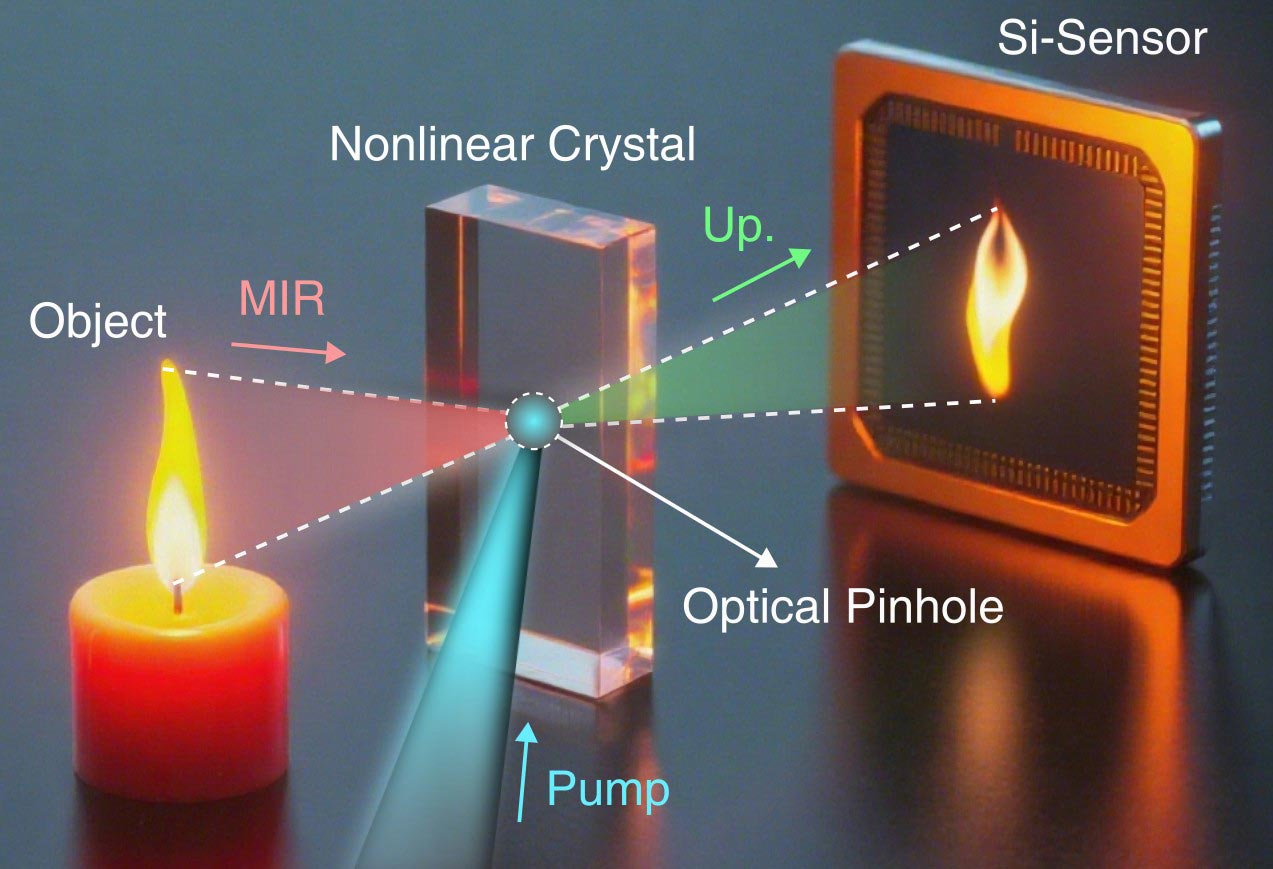
In a paper published in the journal Optica, the team outlines how they use light to create a tiny “optical pinhole” inside a nonlinear crystal. This crystal also converts the infrared image into a visible one. With this technique, they produced clear mid-infrared images featuring a depth of field greater than 35 cm and a field of view exceeding 6 cm. The same setup also allowed them to capture 3D images.
“This approach can enhance night-time safety, industrial quality control, and environmental monitoring,” said research team member Kun Huang from East China Normal University. “And because it uses simpler optics and standard silicon sensors, it could eventually make infrared imaging systems more affordable, portable, and energy efficient. It can even be applied with other spectral bands such as the far-infrared or terahertz wavelengths, where lenses are hard to make or perform poorly.”
Pinhole imaging reimagined
Pinhole imaging is one of the earliest known methods for creating images, first described by the Chinese philosopher Mozi in the 4th century BC. In a traditional pinhole camera, light enters through a tiny opening in a sealed box and projects an inverted image of the outside scene onto the inner surface opposite the hole. Unlike systems that rely on lenses, pinhole imaging does not suffer from distortion, offers unlimited depth of field, and functions across a broad spectrum of wavelengths.
To adapt these benefits for modern infrared imaging, the research team used a powerful laser to generate an “optical hole,” or artificial aperture, within a nonlinear crystal. Thanks to the crystal’s unique optical properties, the infrared image is converted into visible light, enabling it to be captured by a conventional silicon camera.
The video shows the mid-infrared imaging system capturing clear images of a resolution test target as it is moved 9 cm away, demonstrating the large depth-of-field capability of the lensless configuration. Credit: Kun Huang, East China Normal University
According to the researchers, a specially engineered crystal with a chirped-period structure—capable of accepting light from many different angles—was crucial to creating a wide field of view. In addition, the upconversion detection method naturally reduces noise, allowing the system to perform effectively even under very low light conditions.
“Lensless nonlinear pinhole imaging is a practical way to achieve distortion-free, large-depth, wide-field-of-view mid-infrared imaging with high sensitivity,” said Huang. “The ultrashort synchronized laser pulses also provide a built-in ultrafast optical time gate that can be used for sensitive, time-of-flight depth imaging, even with very few photons.”
After figuring out that an optical pinhole radius of about 0.20 mm produced sharp, well-defined details, the researchers used this aperture size to image targets that were 11 cm, 15 cm, and 19 cm away. They achieved sharp imaging at the mid-infrared wavelength of 3.07 μm, across all the distances, confirming a large depth range. They were also able to keep images sharp for objects placed up to 35 cm away, demonstrating a large depth of field.
3D imaging without lenses
The investigators then used their setup for two types of 3D imaging. For 3D time-of-flight imaging, they imaged a matte ceramic rabbit by using synchronized ultrafast pulses as an optical gate and were able to reconstruct the 3D shape with micron-level axial precision. Even when the input was reduced to about 1.5 photons per pulse — simulating very low-light conditions — the method still produced 3D images after correlation-based denoising.
They also performed two-snapshot depth imaging by taking two pictures of a stacked “ECNU” target at slightly different object distances and using those to calculate the true sizes and depths. With this method, they were able to measure the depth of the objects over a range of about 6 centimeters, without using complex pulsed timing techniques.
The researchers note that the mid-infrared nonlinear pinhole imaging system is still a proof-of-concept that requires a relatively complex and bulky laser setup. However, as new nonlinear materials and integrated light sources are developed, the technology should become far more compact and easier to deploy.
They are now working to make the system faster, more sensitive, and adaptable to different imaging scenarios. Their plans include boosting conversion efficiency, adding dynamic control to reshape the optical pinhole for different scenes, and extending the camera’s operation across a wider mid-infrared range.
Reference: “Mid-infrared nonlinear pinhole imaging” by Zhuohang Wei, Yanan Li, Heping Zeng, Kun Huang and Jianan Fang, 19 September 2025, Optica.
DOI: 10.1364/OPTICA.566042
Never miss a breakthrough: Join the SciTechDaily newsletter.
Follow us on Google and Google News.