

Researchers have developed a groundbreaking thin infrared filter for night vision that can be integrated into everyday eyewear, allowing simultaneous viewing of the infrared and visible light spectra. This innovation promises to transform night vision technology by making it lighter and more practical for everyday use, potentially improving safety in low-light conditions.
Scientists from TMOS, the ARC Centre of Excellence for Transformative Meta-Optical Systems, have made significant progress in their journey to deliver a new approach to night vision technology, creating an infrared filter that is thinner than a piece of cling wrap, and that could one day be placed on everyday eyewear, allowing the user to view the infrared and visible light spectrum at the same time.
Night vision devices have primarily been used by the military, hunting enthusiasts willing to lug around multipurpose binoculars, or photographers happy to carry around heavy lenses. This is due to the weight and bulk of the technology. The average person is not going for a night-time run with an additional kilo strapped to their forehead.

Advancing Everyday Night Vision
Miniaturizing night vision could lead to widespread adoption. Creating night vision filters that weigh less than a gram and can sit as a film across a pair of traditional spectacles opens up new, everyday applications. Consumer night vision glasses that allow the user to see the visible and infrared spectrum at the same time could result in safer driving in the dark, safer nighttime walks, and less hassle working in low-light conditions that currently require bulky and often uncomfortable headlamps.
In research published in Advanced Materials, TMOS researchers from the Australian National University demonstrate enhanced infrared vision non-linear upconversion technology using a non-local lithium niobate metasurface.
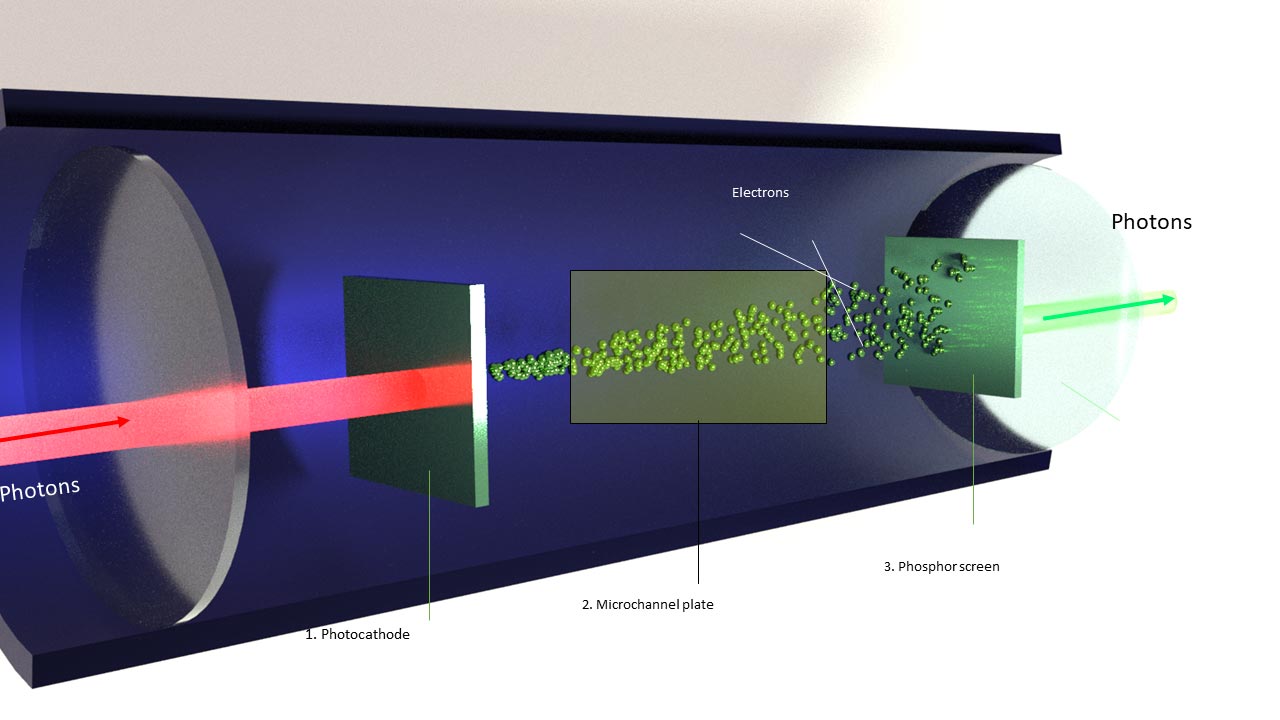
Streamlining the Night Vision Process
Traditional night vision technology requires infrared photons to pass through a lens, then encounter a photocathode that transforms these photons into electrons, which then go through a microchannel plate to increase the number of electrons generated. These electrons which travel through a phosphor screen to be reconverted back to photons, producing an intensified visible image that can be seen by eye (figure 1.1). These elements require cryogenic cooling to prevent thermal noise from also being intensified. A high-quality night vision system, like the one described above, is heavy and bulky. In addition, these systems often block the visible light.
The metasurface-based upconversion technology requires fewer elements, drastically reducing its footprint. Photons pass through a single resonant metasurface where they are mixed with a pump beam (figure 1.2). The resonant metasurface enhances the energy of the photons, drawing them into the visible light spectrum—no conversion of electrons needed. It also works at room temperature, eliminating the need for bulky and heavy cooling systems.
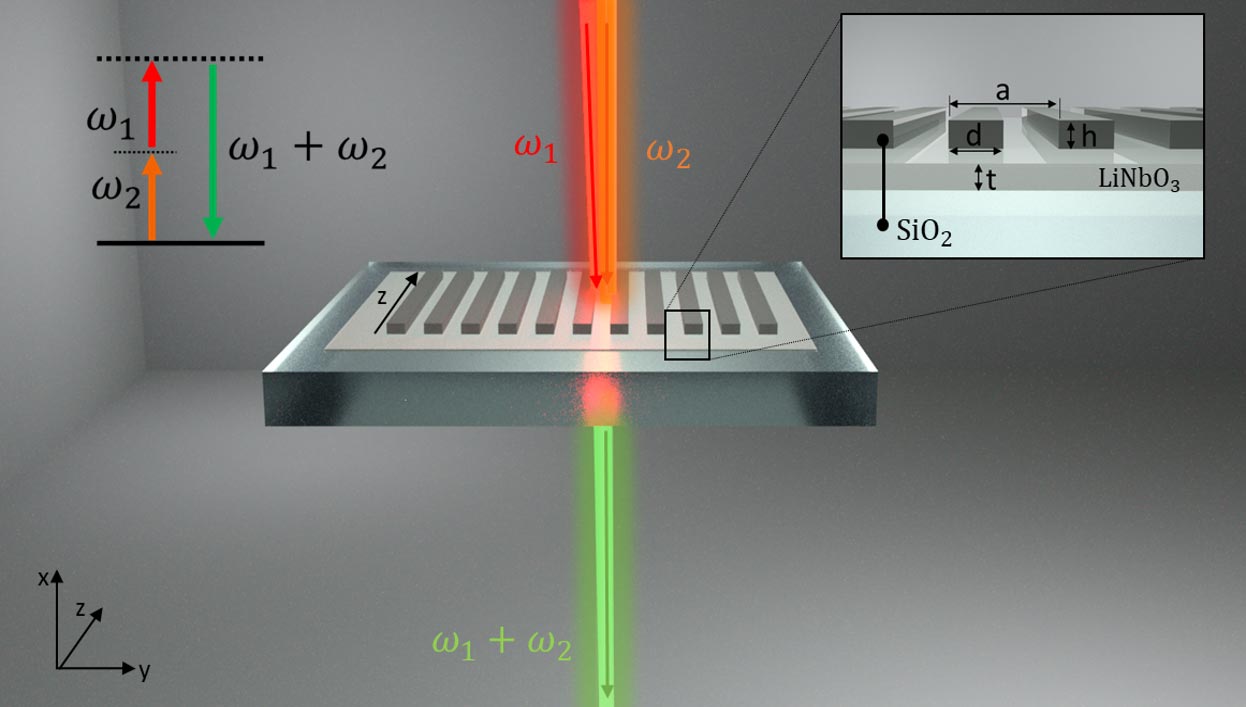
Enhancements in Imaging Technology
In addition, traditional infrared and visible imaging systems cannot produce identical images, as they capture images from each spectrum side-by-side. By using up-conversion technology, imaging systems can capture both the visible and non-visible in one image.
The work is an improvement on the researchers’ original technology, which featured a gallium arsenide metasurface. Their new metasurface is made from lithium niobate, which is fully transparent in the visible range, making it far more efficient. In addition, the photon beam is spread over a wider surface area, limiting angular loss of data.
Perspectives on Upconversion Efficiency
Lead author Laura Valencia Molina says, “People have said that high-efficiency up-conversion of infrared to visible is impossible because of the amount of information not collected due to the angular loss that is inherent in non-local metasurfaces. We overcome these limitations and experimentally demonstrate high-efficiency image up-conversion.”
Author Rocio Camacho Morales says, “This is the first demonstration of high-resolution up-conversion imaging from 1550 nm infrared to visible 550 nm light in a non-local metasurface. We choose these wavelengths because 1550 nm, an infrared light, is commonly used for telecommunications, and 550 nm is visible light to which human eyes are highly sensitive. Future research will include expanding the range of wavelengths the device is sensitive to, aiming to obtain broadband IR imaging, as well as exploring image processing, including edge detection.”
Future Implications and Applications
Chief Investigator Dragomir Neshev says, “These results promise significant opportunities for the surveillance, autonomous navigation, and biological imaging industries, amongst others. Decreasing the size weight and power requirements of night vision technology is an example of how meta-optics, and the work TMOS is doing, is crucial to Industry 4.0 and the future extreme miniaturization of technology.”
Reference: “Enhanced Infrared Vision by Nonlinear Up-Conversion in Nonlocal Metasurfaces” by Laura Valencia Molina, Rocio Camacho Morales, Jihua Zhang, Roland Schiek, Isabelle Staude, Andrey A. Sukhorukov and Dragomir N. Neshev, 23 May 2024, Advanced Materials.
DOI: 10.1002/adma.202402777
Never miss a breakthrough: Join the SciTechDaily newsletter.
Follow us on Google and Google News.
2 Comments
Thank you for this excellent article It was very helpful and informative.
Thank you for this excellent article It was very helpful and informative.