
Close Menu
    Facebook X (Twitter) Instagram
    SciTechDaily
    • Biology
    • Chemistry
    • Earth
    • Health
    • Physics
    • Science
    • Space
    • Technology
    Facebook X (Twitter) Pinterest YouTube RSS
    SciTechDaily
    Home»Space»New Measurements Show Sun’s Shape Unaffected by Solar Cycle Variability
    Space

    New Measurements Show Sun’s Shape Unaffected by Solar Cycle Variability

    By University of Hawaii Institute for AstronomyAugust 17, 20121 Comment3 Mins Read
    Facebook Twitter Pinterest Telegram LinkedIn WhatsApp Email Reddit
    Share
    Facebook Twitter LinkedIn Pinterest Telegram Email Reddit
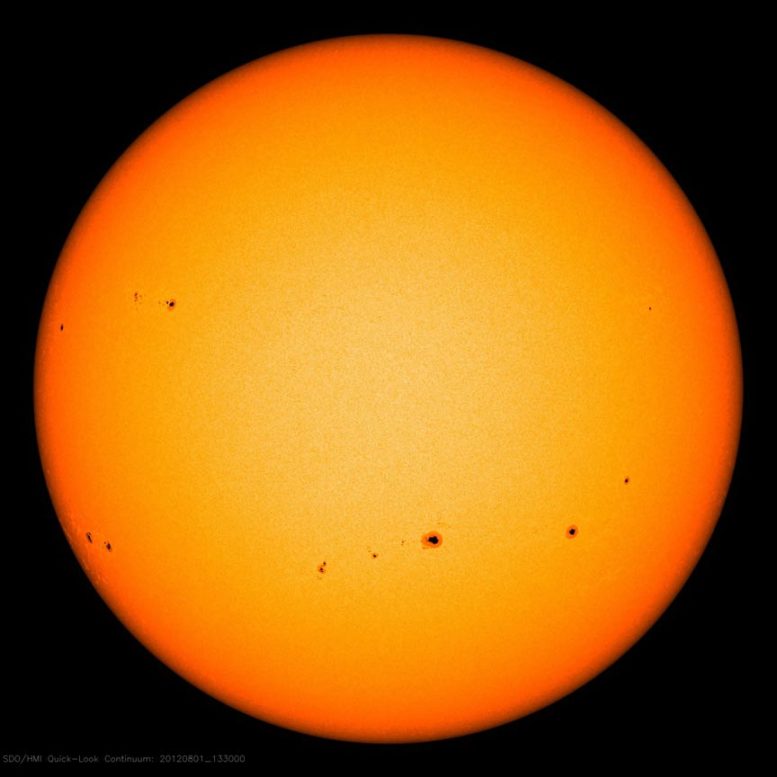
    Sun Peppered With Groups of Sunspots
    Image of the sun taken by the Solar Dynamics Observatory. Credit: NASA

    Using the Helioseismic and Magnetic Imager onboard the Solar Dynamics Observatory satellite, a team of scientists measured the shape of the Sun with unprecedented accuracy, finding that Sun’s oblate shape is remarkably constant and almost completely unaffected by the solar cycle variability seen on its surface.

    The sun is nearly the roundest object ever measured. If scaled to the size of a beach ball, it would be so round that the difference between the widest and narrow diameters would be much less than the width of a human hair.

    The sun rotates every 28 days, and because it doesn’t have a solid surface, it should be slightly flattened. This tiny flattening has been studied with many instruments for almost 50 years to learn about the sun’s rotation, especially the rotation below its surface, which we can’t see directly.

    Now Jeff Kuhn and Isabelle Scholl (Institute for Astronomy, University of Hawaii at Manoa), Rock Bush (Stanford University), and Marcelo Emilio (Universidade Estadual de Ponta Grossa, Brazil) have used the Helioseismic and Magnetic Imager (HMI) onboard the Solar Dynamics Observatory satellite to obtain what they believe is the definitive–and baffling–answer.

    Because there is no atmosphere in space to distort the solar image, they were able to use HMI’s exquisite image sensitivity to measure the solar shape with unprecedented accuracy. The results indicate that if the Sun were shrunk to a ball one meter in diameter, its equatorial diameter would be only 17 millionths of a meter larger than the diameter through its North-South pole, which is its rotation axis.

    They also found that the solar flattening is remarkably constant over time and too small to agree with that predicted from its surface rotation. This suggests that other subsurface forces, like solar magnetism or turbulence, may be a more powerful influence than expected.

    Kuhn, the team leader and first author of an article published in Science Express, said, “For years we’ve believed our fluctuating measurements were telling us that the sun varies, but these new results say something different. While just about everything else in the sun changes along with its 11-year sunspot cycle, the shape doesn’t.”

    Reference: “The Precise Solar Shape and Its Variability” by J. R. Kuhn, R. Bush, M. Emilio and I. F. Scholl, 16 August 2012, Science Express.
    DOI: 10.1126/science.1223231

    This work was supported by NASA grants to Stanford University and the University of Hawaii.

    Never miss a breakthrough: Join the SciTechDaily newsletter.
    Follow us on Google and Google News.

    Astronomy NASA SDO Sun University of Hawaii Institute for Astronomy
    Share. Facebook Twitter Pinterest LinkedIn Email Reddit

    Related Articles

    New Technique Provides Near Real-Time Mapping of the Sun’s Interior

    NASA’s Solar Dynamics Observatory Views Two New Solar Flares

    Hi-C Captures the Highest-Resolution Images Ever of the Sun’s Corona

    NASA’s Solar Dynamics Observatory Captures Filament Explosion

    Unexpectedly Slow Plasma Flow Measured Below the Sun’s Surface

    First Images From Project 1640

    The Sun Celebrates Independence Day With Solar Flare

    Ultrafine Loops of Solar Material Scattered on the Sun’s Surface

    NASA’s NuSTAR is One Step Closer to Launching

    1 Comment

    1. emansnas on August 19, 2012 5:14 am

      I wonder if the inclination of the Sun’s axis of rotation relative the SDO during time of observation was taken into account. Depending on what time of year the observations were made, this could substantially affect results.

      Reply
    Leave A Reply Cancel Reply

    • Facebook
    • Twitter
    • Pinterest
    • YouTube

    Don't Miss a Discovery

    Subscribe for the Latest in Science & Tech!

    Trending News

    Artificial Sweeteners May Harm Future Generations, Study Suggests

    Splashdown! NASA Artemis II Returns From Record-Breaking Moon Mission

    What If Consciousness Exists Beyond Your Brain

    Scientists Finally Crack the 100-Million-Year Evolutionary Mystery of Squid and Cuttlefish

    Beyond “Safe Levels”: Study Challenges What We Know About Pesticides and Cancer

    Researchers Have Found a Dietary Compound That Increases Longevity

    Scientists Baffled by Bizarre “Living Fossil” From 275 Million Years Ago

    Your IQ at 23 Could Predict Your Wealth at 27, Study Finds

    Follow SciTechDaily
    • Facebook
    • Twitter
    • YouTube
    • Pinterest
    • Newsletter
    • RSS
    SciTech News
    • Biology News
    • Chemistry News
    • Earth News
    • Health News
    • Physics News
    • Science News
    • Space News
    • Technology News
    Recent Posts
    • Scientists Break Optical Limits With Quantum Dot-Powered Nanoscopy
    • Scientists Shrink a Lab Spectrometer to the Size of a Grain of Sand
    • Quantum Reality Gets Stranger: Physicists Put a Lump of Metal in Two Places at Once
    • 34-Million-Year-Old Snake Found in Wyoming Rewrites Our Understanding of Evolution
    • Prehistoric “Vomit Fossil” Reveals Never-Before-Seen Flying Reptile
    Copyright © 1998 - 2026 SciTechDaily. All Rights Reserved.
    • Science News
    • About
    • Contact
    • Editorial Board
    • Privacy Policy
    • Terms of Use

    Type above and press Enter to search. Press Esc to cancel.