
Close Menu
    Facebook X (Twitter) Instagram
    SciTechDaily
    • Biology
    • Chemistry
    • Earth
    • Health
    • Physics
    • Science
    • Space
    • Technology
    Facebook X (Twitter) Pinterest YouTube RSS
    SciTechDaily
    Home»Physics»New Microscopy Technique Reaches Deeper Into the Living Brain
    Physics

    New Microscopy Technique Reaches Deeper Into the Living Brain

    By The Optical SocietyMay 31, 2021No Comments4 Mins Read
    Facebook Twitter Pinterest Telegram LinkedIn WhatsApp Email Reddit
    Share
    Facebook Twitter LinkedIn Pinterest Telegram Email Reddit
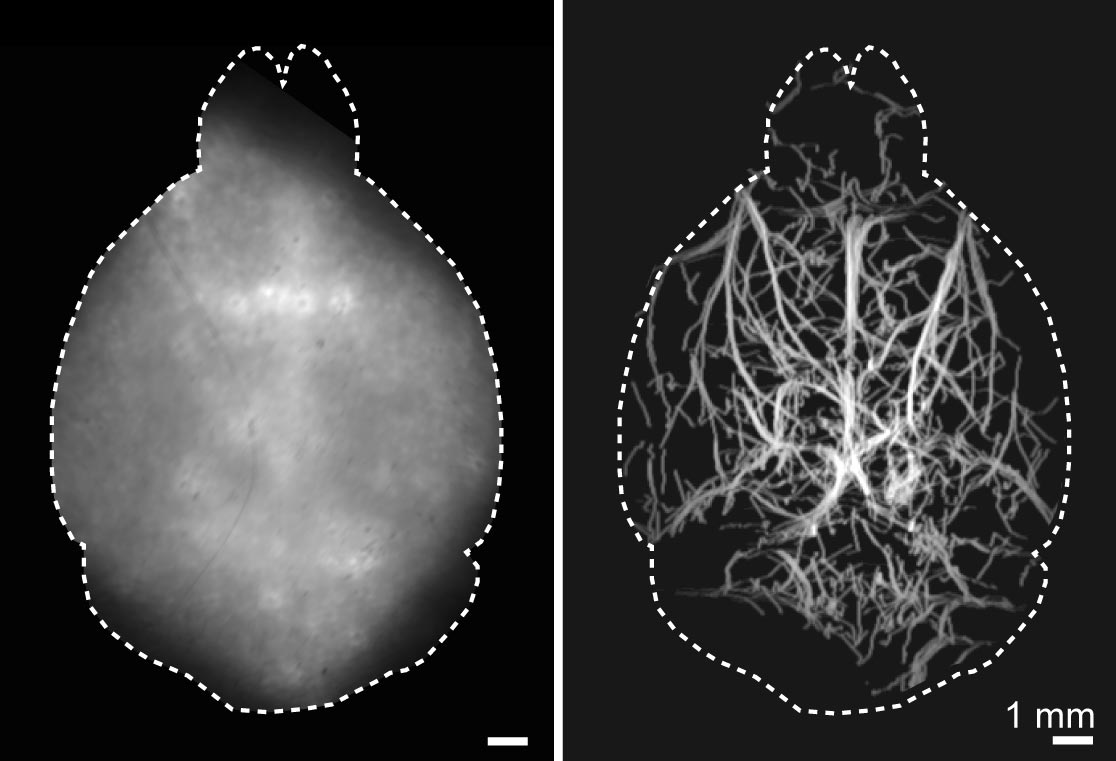
    Vasculature Deep in Brain
    A new imaging method can capture images of vasculature deep in the brains of mice. A conventional widefield fluorescence image of the mouse brain taken non-invasively in the visible light spectrum is shown on the left, while the non-invasive localization-based DOLI approach operating in the NIR-II spectral window is shown on the right. Credit: Daniel Razansky, University and ETH Zurich

    Imaging method poised to bring new insight into how the brain works in health and disease.

    Scientists have developed a new technique that allows microscopic fluorescence imaging at four times the depth limit imposed by light diffusion. Fluorescence microscopy is often used to image molecular and cellular details of the brain in animal models of various diseases but, until now, has been limited to small volumes and highly invasive procedures due to intense light scattering by the skin and skull.

    “Visualization of biological dynamics in an unperturbed environment, deep in a living organism, is essential for understanding the complex biology of living organisms and progression of diseases,” said research team leader Daniel Razansky from the University of Zurich and ETH Zurich, both in Switzerland. “Our study represents the first time that 3D fluorescence microscopy has been performed fully noninvasively at capillary level resolution in an adult mouse brain, effectively covering a field of view of about 1 centimeter.”

    Diffuse Optical Localization Imaging (DOLI)
    The new technique called diffuse optical localization imaging (DOLI) takes advantage of the NIR-II spectral window from 1000 to 1700 nanometers, which exhibits less scattering. First author Quanyu Zhou is shown with the imaging setup. Credit: Daniel Razansky, University of Zurich and ETH Zurich

    In Optica, The Optical Society’s (OSA) journal for high impact research, the researchers describe their new technique, which is called diffuse optical localization imaging (DOLI). It takes advantage of what is known as the second near-infrared (NIR-II) spectral window from 1000 to 1700 nanometers, which exhibits less scattering.

    “Enabling high-resolution optical observations in deep living tissues represents a long-standing goal in the biomedical imaging field,” said Razansky. “DOLI’s superb resolution for deep-tissue optical observations can provide functional insights into the brain, making it a promising platform for studying neural activity, microcirculation, neurovascular coupling and neurodegeneration.”

    Achieving Greater Depth

    For the new technique, the researchers intravenously inject a living mouse with fluorescent microdroplets at a concentration that creates a sparse distribution in the blood stream. Tracking these flowing targets enables reconstruction of a high-resolution map of the deep cerebral microvasculature in the mouse brain.

    Tissue Phantom
    The researchers tested the new technique in tissue phantoms that mimic average brain tissue properties, demonstrating that they could acquire microscopic resolution images at depths of up to 4 millimeters in optically opaque tissues. Credit: Daniel Razansky, University of Zurich and ETH Zurich

    “The method eliminates background light scattering and is performed with the scalp and skull intact,” said Razansky. “Interestingly, we also observed strong dependence of the spot size recorded by the camera on microdroplet’s depth in the brain, which enabled depth-resolved imaging.”

    The new approach benefits from the recent introduction of highly efficient short-wave infrared cameras based on InGaAs sensors. Another key building block was the use of novel contrast agents exhibiting strong fluorescence responses in the NIR-II window, such as lead sulfide (PbS)-based quantum dots.

    Crisp and Clear Imaging

    The researchers first tested the new technique in synthetic models of tissue known as tissue phantoms that mimic average brain tissue properties, demonstrating that they could acquire microscopic resolution images at depths of up to 4 millimeters in optically opaque tissues. They then performed DOLI in living mice where cerebral microvasculature as well as blood flow velocity and direction could be visualized entirely noninvasively.

    The researchers are working to optimize precision in all three dimensions to improve DOLI’s resolution. They are also developing improved fluorescent agents that are smaller, have stronger fluorescence intensity and are more stable in vivo. This will significantly boost DOLI’s performance in terms of the achievable signal to noise and imaging depth.

    “We expect that DOLI will emerge as a powerful approach for fluorescence imaging of living organisms at previously inaccessible depth and resolution regimes,” said Razansky. “This will greatly enhance the in vivo applicability of fluorescence microscopy and tomography techniques.”

    Reference: “Diffuse optical localization imaging for noninvasive deep brain microangiography in the NIR-II window” by Quanyu Zhou, Zhenyue Chen, Justine Robin, Xosé-Luís Deán-Ben and Daniel Razansky, 27 May 2021, Optica.
    DOI: 10.1364/OPTICA.420378

    Never miss a breakthrough: Join the SciTechDaily newsletter.
    Follow us on Google and Google News.

    Brain Medical Imaging Optics The Optical Society
    Share. Facebook Twitter Pinterest LinkedIn Email Reddit

    Related Articles

    Switchable Mirrors Created From Liquid Metal

    Scientists Develop System for Visualizing Breath to Provide Insights Into COVID-19 Transmission

    Simple New Way to Capture High Quality 3D Images of Live Cells and Organisms

    Optical Matter Machine: Nanoscale Machines Convert Light Into Work

    Precision Deformable Mirrors to Detect New Sources of Gravitational Waves From Deep Space

    New Photon-Counting Camera With Record Speed and Resolution for 3D Image Capture

    Combining Quantum Physics and Biology to Improve Enzyme Activity Measurements

    New Ghost Imaging Nanoscopy Approach Captures the Details of Processes Occurring in Living Cells

    Gamma Ray Lens Created Using Amplifying Effect of Virtual Electron-Positron Pairs

    Leave A Reply Cancel Reply

    • Facebook
    • Twitter
    • Pinterest
    • YouTube

    Don't Miss a Discovery

    Subscribe for the Latest in Science & Tech!

    Trending News

    Enormous Prehistoric Insects Puzzle Scientists

    Scientists Develop Bioengineered Chewing Gum That Could Help Fight Oral Cancer

    After 37 Years, the World’s Longest-Running Soil Warming Experiment Uncovers a Startling Climate Secret

    NASA Satellite Captures First-Ever High-Res View of Massive Pacific Tsunami

    ADHD Isn’t Just a Deficit: Study Reveals Powerful Hidden Strengths

    Scientists Discover Stem Cells That Could Regrow Teeth and Bone

    Early Cannabis Use May Stall Key Brain Skills in Teens

    Popular Vitamin D Supplement Has “Previously Unknown” Negative Effect, Study Finds

    Follow SciTechDaily
    • Facebook
    • Twitter
    • YouTube
    • Pinterest
    • Newsletter
    • RSS
    SciTech News
    • Biology News
    • Chemistry News
    • Earth News
    • Health News
    • Physics News
    • Science News
    • Space News
    • Technology News
    Recent Posts
    • First-of-Its-Kind Discovery: Homer’s Iliad Found Embedded in a 1,600-Year-Old Egyptian Mummy
    • Beyond Inflammation: Scientists Uncover New Cause of Persistent Rheumatoid Arthritis
    • Cancer-Like Mutations Found in the Brain May Be Driving Alzheimer’s Disease
    • A Simple Molecule Could Unlock Safer, Easier Weight Loss
    • Stretching Diamonds Unlocks Powerful New Quantum Sensing Abilities
    Copyright © 1998 - 2026 SciTechDaily. All Rights Reserved.
    • Science News
    • About
    • Contact
    • Editorial Board
    • Privacy Policy
    • Terms of Use

    Type above and press Enter to search. Press Esc to cancel.