
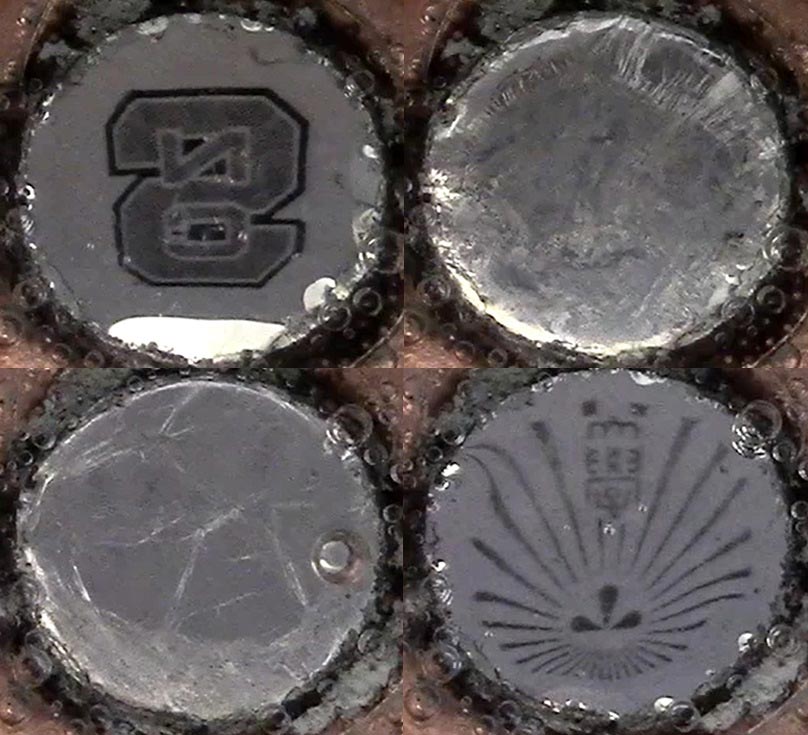
Approach could be used to create electrically controlled mirrors for art or advanced devices.
Researchers have developed a way to dynamically switch the surface of liquid metal between reflective and scattering states. This technology could one day be used to create electrically controllable mirrors or illumination devices.
Liquid metals combine the electrical, thermal and optical properties of metals with the fluidity of a liquid. The new approach uses an electrically driven chemical reaction to create switchable reflective surfaces on a liquid metal. No optical coatings nor polishing steps, which are typically required to make reflective optical components, are necessary to make the liquid metal highly reflective.
In the Optical Society (OSA) journal Optical Materials Express, researchers led by Yuji Oki of Kyushu University in Japan show that switching between reflective and scattering states can be achieved with just 1.4 V, about the same voltage used to light a typical LED. The researchers collaborated with Michael D. Dickey’s research team at North Carolina State University to develop the new method, which can be implemented at ambient temperature and pressures.
Researchers can dynamically switch the surface of liquid metal between reflective and scattering states by applying electricity. The video shows how this is accomplished. Credit: Keisuke Nakakubo, Kyushu University
“In the immediate future this technology could be used to create tools for entertainment and artistic expression that have never been available before,” said Oki. “With more development, it might be possible to expand this technology into something that works much like 3D printing for producing electronically controlled optics made of liquid metals. This could allow the optics used in light-based health testing devices to be easily and inexpensively fabricated in areas of the world that lack medical laboratory facilities.”
Creating an Optical Surface
In the new work, the researchers created a reservoir using an embedded flow-channel. They then used a “push-pull method” to form optical surfaces by either pumping gallium-based liquid metal into or sucking it out of the reservoir. This process formed convex, flat, or concave surfaces; each with different optical properties.
Then, by applying electricity, the researchers initiated a chemical reaction that reversibly oxidizes the liquid metal. The oxidation changes the liquid’s volume in a way that creates many small scratches on the surface that cause light to scatter. When electricity is applied in the opposite direction, the liquid metal returns to its original state. The liquid metal’s surface tension causes the scratches to disappear, restoring the surface to a clean reflective mirror state.
The researchers discovered the new technique serendipitously while experimenting with a liquid metal to see if it could be used to make molds to use with a silicone elastomer. “Our intention was to use oxidation to change the surface tension and reinforce the surface of the liquid metal,” said Oki. “However, we found that, under certain conditions, the surface would spontaneously change into a scattering surface. Instead of considering this a failure, we optimized the conditions and verified the phenomenon.”
Characterizing the Phenomenon
The researchers electrochemically and optically characterized the different surfaces that were created by applying electricity. They found that changing the voltage on the surface from -800 mV to +800 mV would decrease the light intensity as the surface changed from reflective to scattering. The electrochemical measurements revealed that a voltage change of 1.4 V was sufficient to create redox reactions with good reproducibility.
“We also found that under certain conditions the surface can be slightly oxidized and still maintain a smooth reflective surface,” said Oki. “By controlling this, it might be possible to create even more diverse optical surfaces using this approach that could lead to applications in advanced devices such as biochemical chips or be used to make 3D printed optical elements.”
Reference: “Dynamic control of reflective/diffusive optical surfaces on EGaIn liquid metal” by Keisuke Nakakubo, Hiroaki Yoshioka, Kinichi Morita, Ryoichi Ishimatsu, Abolfazl Kiani, Hans Hallen, Michael D. Dickey and Yuji Oki, 14 June 2021, Optical Materials Express.
DOI: 10.1364/OME.425432
Never miss a breakthrough: Join the SciTechDaily newsletter.
Follow us on Google and Google News.