

Close Menu
    Facebook X (Twitter) Instagram
    SciTechDaily
    • Biology
    • Chemistry
    • Earth
    • Health
    • Physics
    • Science
    • Space
    • Technology
    Facebook X (Twitter) Pinterest YouTube RSS
    SciTechDaily
    Home»Health»New “Molecular Glue” Gel Could Help Treat Permanent Voice Loss
    Health

    New “Molecular Glue” Gel Could Help Treat Permanent Voice Loss

    By Keila DePape, McGill UniversityDecember 17, 2025No Comments3 Mins Read
    Facebook Twitter Pinterest Telegram LinkedIn WhatsApp Email Reddit
    Share
    Facebook Twitter LinkedIn Pinterest Telegram Email Reddit
    Man Mouth Singing Speaking
    A newly engineered hydrogel shows early promise for treating vocal cord injuries by persisting longer than existing injectable materials. Credit: Shutterstock

    A newly engineered hydrogel could offer a longer-lasting, minimally invasive way to treat vocal cord injuries.

    Researchers at McGill University have developed a new hydrogel that could one day help repair damaged vocal cords. Early results suggest the material may offer a longer-lasting treatment option for people who lose their voice after injury.

    When vocal cords become scarred, voice loss is often permanent. Existing injectable therapies tend to degrade quickly inside the body, which can require repeated injections. These additional procedures may further harm the fragile tissue they are meant to heal.

    A Longer-Lasting Injectable Gel

    In a preclinical study published in the journal Biomaterials, the research team found that the newly designed gel remained intact for several weeks in laboratory and animal tests. It lasted longer than currently used injectable materials, potentially giving injured vocal cords more time to recover.

    The hydrogel is produced from naturally occurring tissue proteins that are processed into a powder and then formed into a gel. To improve its durability, the researchers applied a technique known as click chemistry.

    “This process is what makes our approach unique,” said co-senior author Maryam Tabrizian, professor in McGill’s Department of Biomedical Engineering and Canada Research Chair (Tier 1) in Nanomedicine and Regenerative Medicine.

    It acts like a molecular glue, locking the material together so it doesn’t fall apart too quickly once injected.”

    Causes and prevalence of voice loss

    Vocal cord injuries are particularly common in older adults with acid reflux or a history of smoking, as well as in people who rely heavily on their voices for work, including singers, teachers and radio hosts.

    Roughly one in 13 adults experiences a voice disorder each year, according to the U.S. National Institutes of Health.
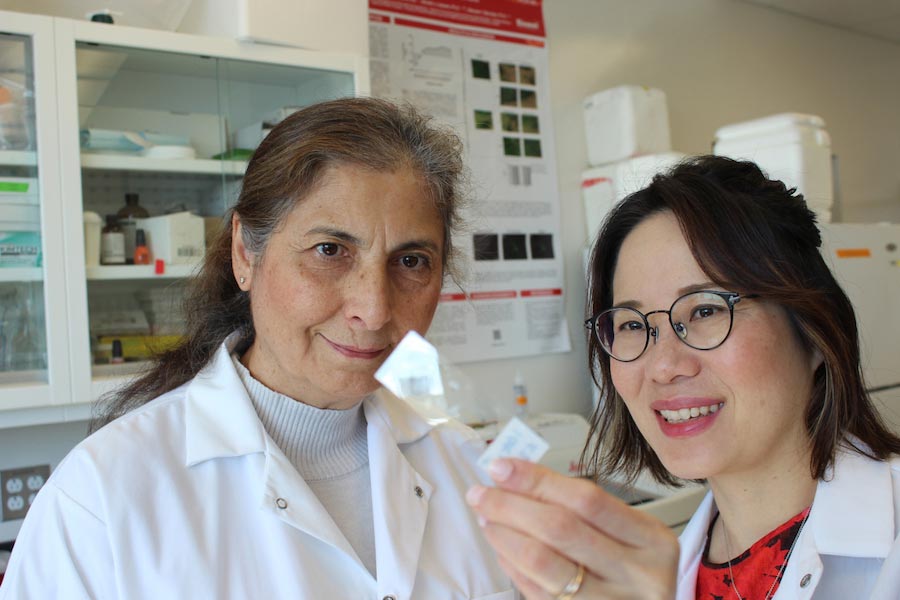
    Maryam Tabrizian and Nicole Li Jessen
    McGill professors Maryam Tabrizian (left) and Nicole Li-Jessen examine tissue samples used to confirm the safety of the gel developed in the study. Credit: McGill University

    Senior author Nicole Li-Jessen, a clinician-scientist as well as a pianist who works with singers, has seen first-hand how devastating voice loss can be for performers.

    “People take their voices for granted but losing it can deeply affect mental health and quality of life, especially for those whose livelihoods depend on it,” said Li-Jessen, associate professor in McGill’s School of Communication Sciences and Disorders and Canada Research Chair (Tier 2) in Personalized Medicine of Upper Airway Health and Diseases.

    Next steps

    The researchers are now looking to test the gel in computer simulations that mimic how it behaves in the body. Once those results are validated, they hope to move toward human trials. If successful, the work could pave the way for a minimally invasive, longer-lasting treatment for voice loss.

    Reference: “Clicktetrazine dECM–alginate hydrogels for injectable, mechanically mimetic, and biologically active vocal fold biomaterials” by Mika Brown, Hideaki Okuyama, Ling Li, Zhen Yang, Jianyu Li, Maryam Tabrizian and Nicole Y.K. Li-Jessen, 5 August 2025, Biomaterials.
    DOI: 10.1016/j.biomaterials.2025.123590

    The research was supported by the Natural Sciences and Engineering Research Council of Canada and Canada Research Chair research stipends.

    Never miss a breakthrough: Join the SciTechDaily newsletter.
    Follow us on Google and Google News.

    Biomaterials Biomedical Engineering Hydrogel McGill University Regenerative Medicine
    Share. Facebook Twitter Pinterest LinkedIn Email Reddit

    Related Articles

    This Jelly-Like Implant Could Help Broken Bones Heal Themselves

    Breakthrough “Bactogel” Offers New Hope for Muscle Repair

    From Corneas to Hearts: Revolutionary Jelly-Like Material Promises To Mend Human Organs

    Science’s Valentine: New Hydrogel Promises To Mend Broken Hearts

    Healing Power of Light: Biomimetic Materials Pulsed With Low-Energy Blue Light Can Reshape Damaged Corneas

    Groundbreaking Biomaterial Heals Tissues From the Inside Out

    New Synthetic Biomaterial Can Repair Hearts, Muscles, and Vocal Cords

    Next-Generation Surgical Sutures Inspired by Human Tendons Can Deliver Drugs, Prevent Infections, and Monitor Wounds

    New Hydrogel Material Could Aid Body’s Cellular Repair Process

    Leave A Reply Cancel Reply

    • Facebook
    • Twitter
    • Pinterest
    • YouTube

    Don't Miss a Discovery

    Subscribe for the Latest in Science & Tech!

    Trending News

    Breakthrough Bowel Cancer Trial Leaves Patients Cancer-Free for Nearly 3 Years

    Natural Compound Shows Powerful Potential Against Rheumatoid Arthritis

    100,000-Year-Old Neanderthal Fossils in Poland Reveal Unexpected Genetic Connections

    Simple “Gut Reset” May Prevent Weight Gain After Ozempic or Wegovy

    2.8 Days to Disaster: Scientists Warn Low Earth Orbit Could Suddenly Collapse

    Common Food Compound Shows Surprising Power Against Superbugs

    5 Simple Ways To Remember More and Forget Less

    The Atomic Gap That Could Cost the Semiconductor Industry Billions

    Follow SciTechDaily
    • Facebook
    • Twitter
    • YouTube
    • Pinterest
    • Newsletter
    • RSS
    SciTech News
    • Biology News
    • Chemistry News
    • Earth News
    • Health News
    • Physics News
    • Science News
    • Space News
    • Technology News
    Recent Posts
    • After 37 Years, the World’s Longest-Running Soil Warming Experiment Uncovers a Startling Climate Secret
    • NASA Satellite Captures First-Ever High-Res View of Massive Pacific Tsunami
    • ADHD Isn’t Just a Deficit: Study Reveals Powerful Hidden Strengths
    • Scientists Uncover “Astonishing” Hidden Property of Light
    • Scientists Discover Stem Cells That Could Regrow Teeth and Bone
    Copyright © 1998 - 2026 SciTechDaily. All Rights Reserved.
    • Science News
    • About
    • Contact
    • Editorial Board
    • Privacy Policy
    • Terms of Use

    Type above and press Enter to search. Press Esc to cancel.