
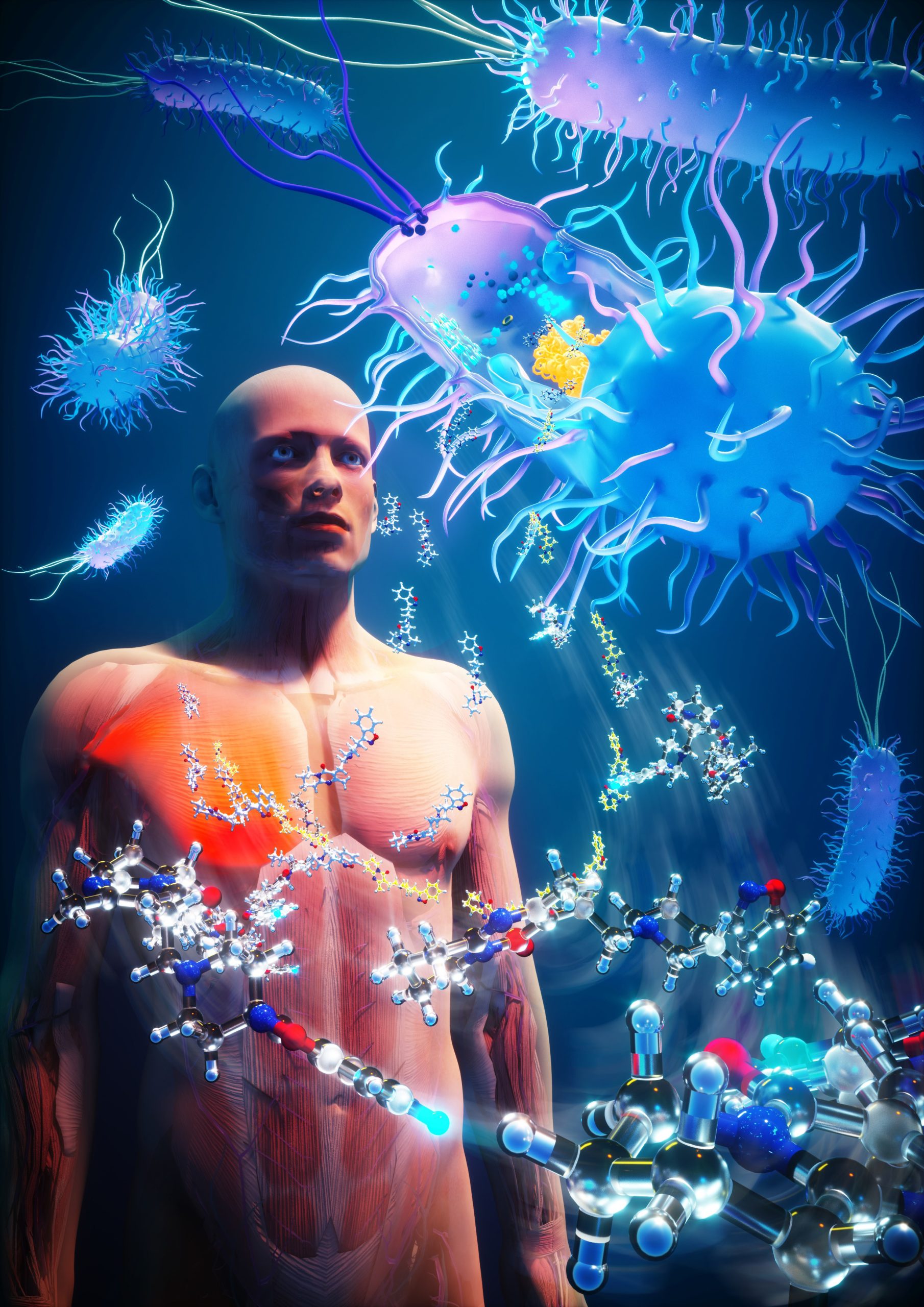
Researchers at DTU are harnessing the power of bacteria to heal tissues.
Researchers have created a new bacteria-derived biopolymer, PAMA, which has been used in a hydrogel for effectively regenerating muscle tissue in rats, with potential implications for treating musculoskeletal injuries across different populations.
A research team at the Technical University of Denmark, led by Alireza Dolatshahi-Pirouz, has recently made significant advancements in tissue engineering and cell therapy by leveraging the healing properties of bacteria.
The group harnessed the native bioproduction facilities in bacteria to synthesize a new biopolymer with tissue-healing properties. They used this polymer to manufacture a durable, resilient, and elastic hydrogel for muscle tissue regeneration. The study is published in the journal Bioactive Materials and details a new biopolymer – Pantoan Methacrylate, PAMA for short -with muscle regeneration properties derived from bacteria.
Promising Results in Muscle Injury Treatment
They have implemented this new hydrogel – or “bactogel” – to treat muscle injuries in rats with promising results. The in vivo study showed a significant increase in muscle tissue formation and reduced fibrous tissue. With nearly 100% mechanical recovery, good biocompatibility, and healing capacity, the PAMA bactogel presents a new path in the field.
“This combination of feats is rarely encountered in the field, as most bioactive hydrogels display subpar mechanical properties that do not fit the mechanically demanding milieu of musculoskeletal tissues, such as muscles, says Associate Professor Alireza Dolatshahi-Pirouz from DTU Health Tech.
“I believe that our new results could foster better therapies against musculoskeletal injuries in athletes, the elderly, as well as in wounded soldiers or others involved in accidents giving rise to traumatic muscle injuries,”
With PAMA, the team has shown that they can achieve tissue regeneration in rats without using cells, and they expect much better healing by combining their bactogels with either muscle progenitor cells or stem cells.
“I imagine a future where bacteria-derived polymers or put simply “bactomers” revolutionize the field of regenerative medicine. A future where bacteria in so-called regenerative bacto-baths secrete regenerative bactomers on demand to heal injured tissues in patients,” says Alireza Dolatshahi-Pirouz.
Reference: “Enhancing volumetric muscle loss (VML) recovery in a rat model using super durable hydrogels derived from bacteria” by Seyyed Vahid Niknezhad, Mehdi Mehrali, Farinaz Riyahi Khorasgani, Reza Heidari, Firoz Babu Kadumudi, Nasim Golafshan, Miguel Castilho, Cristian Pablo Pennisi, Masoud Hasany, Mohammadjavad Jahanshahi, Mohammad Mehrali, Younes Ghasemi, Negar Azarpira, Thomas L. Andresen and Alireza Dolatshahi-Pirouz, 1 June 2024, Bioactive Materials.
DOI: 10.1016/j.bioactmat.2024.04.006
Funding: Danmarks Frie Forskningsfond, Novo Nordisk Foundation, VIDI research programme, Horizon 2020 Framework Programme, Horizon 2020, Marie Skłodowska-Curie grant
Never miss a breakthrough: Join the SciTechDaily newsletter.
Follow us on Google and Google News.
1 Comment
In this study, rats experienced pain for 1 to 3 weeks after their leg muscle was severely cut away, which is “volumetric muscle loss”. I can see the importance in developing technology that helps heal muscle injuries like this, which can happen during war or other causes of trauma. However, there are so many people who currently have this problem due to wars currently raging, that this could be done in humans who ask for it, instead of helpless rats.
I realize that people are conditioned by the culture to dislike rats. But rats are highly intelligent, social creatures who feel pain and distress like humans do. They are used in research because they are similar to humans, and there are few regulations protecting animals from abuse. Other animals used include dogs, cats, monkeys, pigs, and other sentient creatures. For those who care about ethics, this creates a problem.
What are the consequences of institutionalizing animal cruelty in biomedical research, and rationalizing that cruelty based on potential information gain?
Animal research is accepted as ethical by the current medical system because our culture does not recognize the equivalence between humans and non-humans in ethical terms, even though it exploits this equivalence in biology, psychology, and even social behavior research. Researchers consider animals to be just like humans, without the ethical protections give to humans.
There is a slippery slope created by this unethical treatment of non-humans. And it affects you and your healthcare. See my article, Animal Research: The Rot at the Core of Medicine. https://www.academia.edu/123055005/Animal_Research_The_Rot_at_the_Core_of_Medicine