
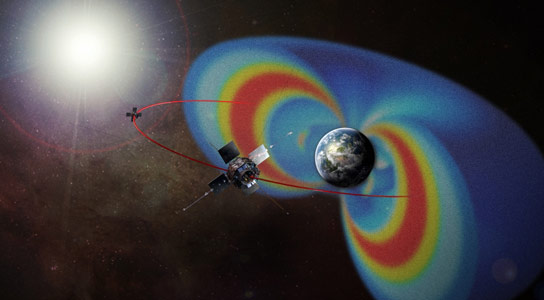
Using new data from the Van Allen Probes, a newly published study reveals the first direct observation of two processes that, in a chain, cause the acceleration of electrons in Earth’s outer radiation belt.
One of the great, unanswered questions for space weather scientists is just what creates two gigantic donuts of radiation surrounding Earth, called the Van Allen radiation belts. Recent data from the Van Allen Probes — two nearly identical spacecraft that launched in 2012 — address this question.
The inner Van Allen radiation belt is fairly stable, but the outer one changes shape, size, and composition in ways that scientists don’t yet perfectly understand. Some of the particles within this belt zoom along at close to light speed, but just what accelerates these particles up to such velocities? Recent data from the Van Allen Probes suggests that it is a two-fold process: One mechanism gives the particles an initial boost and then a kind of electromagnetic wave called Whistlers does the final job to kick them up to such intense speeds.
“It is important to understand how this process happens,” said Forrest Mozer, a space scientist at the University of California in Berkeley and the first author of the paper on these results that appeared online in Physical Review Letters on July 15, 2014, in conjunction with the July 18 print edition. “Not only do we think a similar process happens on the sun and around other planets, but these fast particles can damage the electronics in spacecraft and affect astronauts in space.”
Over the last few decades, numerous theories about where these extremely energetic particles come from have been developed. They have largely fallen into two different possibilities. The first theory is that the particles drift in from much further out, some 400,000 miles (640,000 kilometers) or more, gathering energy along the way. The second theory is that some mechanism speeds up particles already inhabiting that area of space. After two years in space, the Van Allen Probes data has largely pointed to the latter.
Additionally, it has been shown that once particles attain reasonably large energies of 100 keV, they are moving at speeds in synch with giant electromagnetic waves that can speed the particles up even more – the same way a well-timed push on a swing can keep it moving higher and higher.
“This paper incorporates the Whistler waves theory previously embraced,” said Shri Kanekal, the deputy mission scientist for the Van Allen Probes at NASA’s Goddard Space Flight Center in Greenbelt, Maryland. “But it provides a new explanation for how the particles get their initial push of energy.”
This first mechanism is based on something called time domain structures, which Mozer and his colleagues have identified previously in the belts. They are very short-duration pulses of electric field that run parallel to the magnetic fields that thread through the radiation belts. These magnetic field lines guide the movement of all the charged particles in the belts: The particles move along and gyrate around the lines as if they were tracing out the shape of a spring. During this early phase, the electric pulses push the particles faster forward in the direction parallel to the magnetic fields. This mechanism can increase the energies somewhat – though not as high as traditionally thought to be needed for the Whistler waves to have any effect. However, Mozer and his team showed, through both data from the Van Allen Probes and from simulations, that Whistlers can indeed affect particles at these lower energies.
Together the one-two punch is a mechanism that can effectively accelerate particles up to the intense speeds, which have for so long mysteriously appeared in the Van Allen belts.
“The Van Allen Probes have been able to monitor this acceleration process better than any other spacecraft because it was designed and placed in a special orbit for that purpose,” said Mozer. “The mission has provided the first really strong confirmation of what’s happening. This is the first time we can truly explain how the electrons are accelerated up to nearly the speed of light.”
Such knowledge helps with the job of understanding the belts well enough to protect nearby spacecraft and astronauts.
Reference: “Direct Observation of Radiation-Belt Electron Acceleration from Electron-Volt Energies to Megavolts by Nonlinear Whistlers” by F. S. Mozer, O. Agapitov, V. Krasnoselskikh, S. Lejosne, G. D. Reeves and I. Roth, 14 July 2014, Physical Review Letters.
DOI: 10.1103/PhysRevLett.113.035001
The Johns Hopkins Applied Physics Laboratory in Laurel, Maryland, built and operates the Van Allen Probes for NASA’s Science Mission Directorate. The mission is the second mission in NASA’s Living With a Star program, managed by NASA’s Goddard Space Flight Center in Greenbelt, Maryland.
Never miss a breakthrough: Join the SciTechDaily newsletter.
Follow us on Google and Google News.