
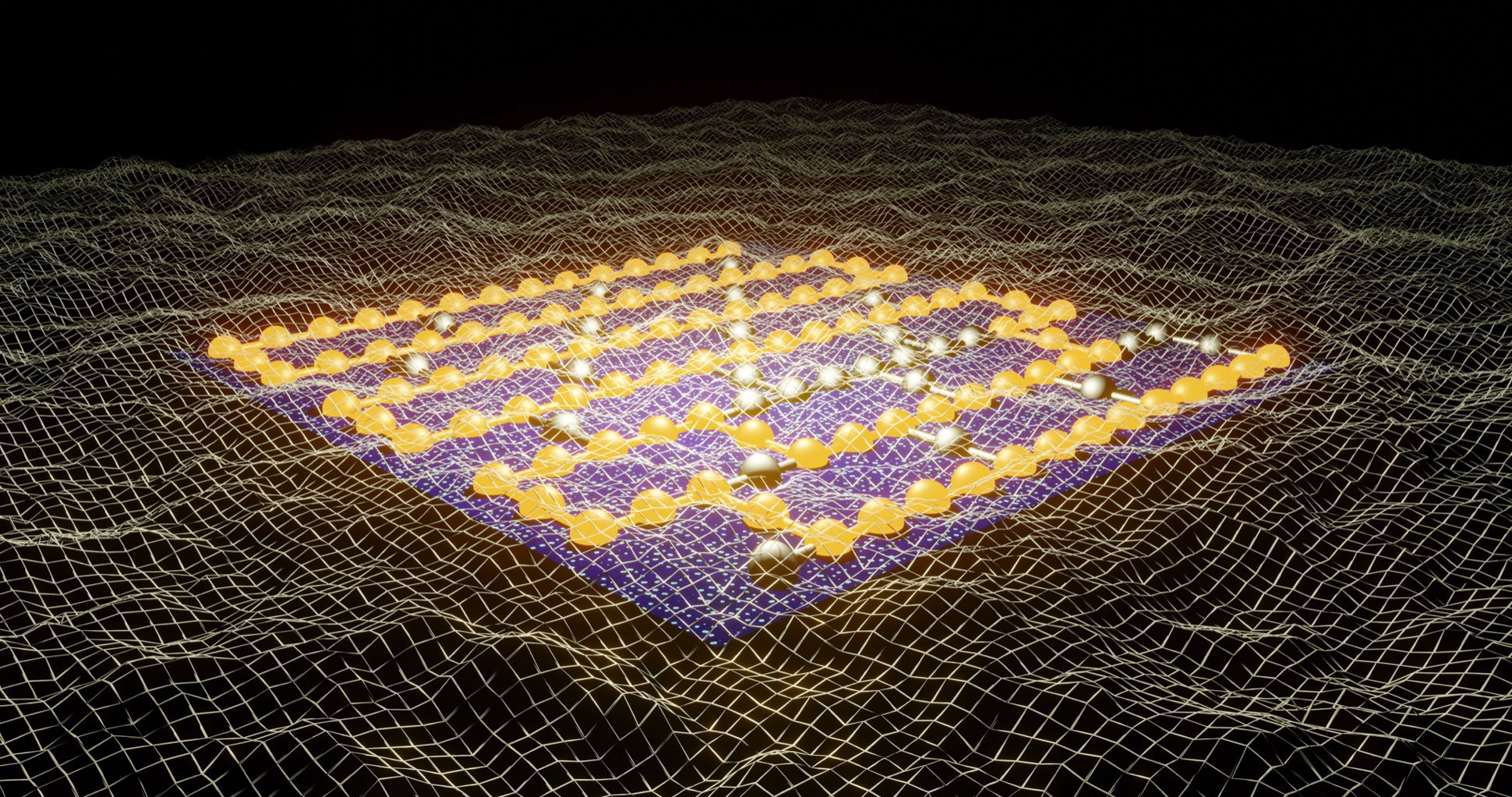
Researchers used IBM’s quantum computers to create scalable quantum circuits that simulate matter under extreme conditions, offering new insight into fundamental forces and the origins of the universe.
Simulating how matter behaves under extreme conditions is essential for exploring some of the deepest questions about the universe. The Standard Model of particle physics describes how fundamental particles interact and provides equations that help scientists explain these natural phenomena.
Yet, when systems become highly dynamic or reach extremely dense states, the Standard Model’s equations become nearly impossible to solve, even using the most advanced classical supercomputers. Quantum computing may offer a powerful new way to model these complex systems with far greater efficiency.
One of the biggest challenges in quantum simulations is preparing the correct initial state of matter on a quantum computer’s qubits. In a major breakthrough, scientists have now developed scalable quantum circuits capable of generating the starting state of a particle collision similar to those produced in a particle accelerator. This work focuses on the strong interactions described within the Standard Model, which govern the behavior of quarks and gluons inside atomic nuclei.
The team first designed and tested these circuits for small-scale systems using classical computers. They then used the circuits’ scalable structure to extend the approach to much larger systems simulated directly on a quantum computer. Using IBM’s quantum processors, the researchers successfully modeled key features of nuclear physics on more than 100 qubits, marking a significant step toward practical quantum simulations.
A Path Toward Complex Quantum Simulations
These scalable quantum algorithms represent a promising path for tackling some of the most complex problems in physics. They can be applied to model the vacuum state before a particle collision, study matter at extremely high densities, and simulate beams of hadrons. Scientists anticipate that as these methods evolve, quantum simulations based on scalable circuits will eventually outperform classical computing, offering new insights into the fundamental workings of matter and the universe.
These simulations will provide insights into the mechanisms that govern the dynamics of fundamental particles and our universe. They may help answer why there is more matter than antimatter, how supernovae produce heavy elements, and the properties of matter at ultra-high densities. These quantum circuits should also help simulate other complex systems, including exotic types of materials.
Nuclear physicists performed the largest digital quantum simulation to date using IBM’s quantum computers. Symmetries and hierarchies in length scales of physical systems aided in the discovery of scalable quantum circuits for preparing states with localized correlations on a quantum computer. The researchers demonstrated the utility of this algorithm by preparing the vacuum and hadrons of quantum electrodynamics in one spatial dimension.
Scaling Up Quantum Simulations
The team performed simulations using classical computers for small systems to determine the scalable quantum circuit elements, and to demonstrate that the states are systematically improvable. The researchers scaled up the circuits to system sizes of more than 100 qubits and implemented the circuits on IBM’s quantum computers. The team used the results from the quantum computer to determine properties of the vacuum with percent-level accuracy.
In addition, they used scalable circuits to prepare pulses of hadrons, which were time evolved to observe their propagation. These developments provide a promising way to eventually perform dynamical simulations of matter in extreme conditions that are beyond the capabilities of classical computing alone.
References:
“Scalable Circuits for Preparing Ground States on Digital Quantum Computers: The Schwinger Model Vacuum on 100 Qubits” by Roland C. Farrell, Marc Illa, Anthony N. Ciavarella and Martin J. Savage, 18 April 2024, PRX Quantum.
DOI: 10.1103/PRXQuantum.5.020315
“Quantum simulations of hadron dynamics in the Schwinger model using 112 qubits” by Roland C. Farrell, Marc Illa, Anthony N. Ciavarella and Martin J. Savage, 10 June 2024, Physical Review D.
DOI: 10.1103/PhysRevD.109.114510
This research was supported in part by the Department of Energy (DOE) Office of Science, Office of Nuclear Physics, InQubator for Quantum Simulation (IQuS) through the Quantum Horizons: QIS Research and Innovation for Nuclear Science Initiative; the Quantum Science Center (QSC), a DOE and University of Washington National Quantum Information Science Research Center. This research used resources of the Oak Ridge Leadership Computing Facility, a DOE Office of Science User Facility. This work was enabled, in part, by the use of advanced computational, storage and networking infrastructure provided by the Hyak supercomputer system at the University of Washington. The researchers acknowledge the use of IBM Quantum services for this work.
Never miss a breakthrough: Join the SciTechDaily newsletter.
Follow us on Google and Google News.
10 Comments
Of course.
Space time collapses on itself to form hydrogen atoms, thus the impossibility of there being nothing at all.
As if spacetime itself was nothing?
Hey Virtual particles and anti particles remember? Coming into and out of existence by annihilating each other. Creating our fabric of spacetime… Which…. Makes….. Total sense? Right?
…. Well… It fits the math at least right?… No?… Kinda? ….. Well F***.
But then there would be hydrogen atoms everywhere and space-time would disappear or would it constantly create hydrogen atoms? It’s more likely that it’s nothing.
I bet those persuing quantum computing do not understand quantum mechanics.
A-n-d – the standard model is wrong. 200 years of good effort chasing bad concepts that a child should see through.
All to describe atoms said to be particles spinning around their nucleus like the planets spin around the Sun. And from mustachioed pipe smoking tweed coats of the nineteenth century you all have danced.
Let invent a new particle, the dumb particle. Where do we see that everywhere?
The contents of an atom are not like a planetary system. That is just a simplified visual representation.
Oh great! You got another model for us?! Finally! Well, Let’s hear it. 😉 …. No?
Well, I think yr right about that dumb particle.
…It’s closer than you think.
Let’s call it ‘stupidium’.