
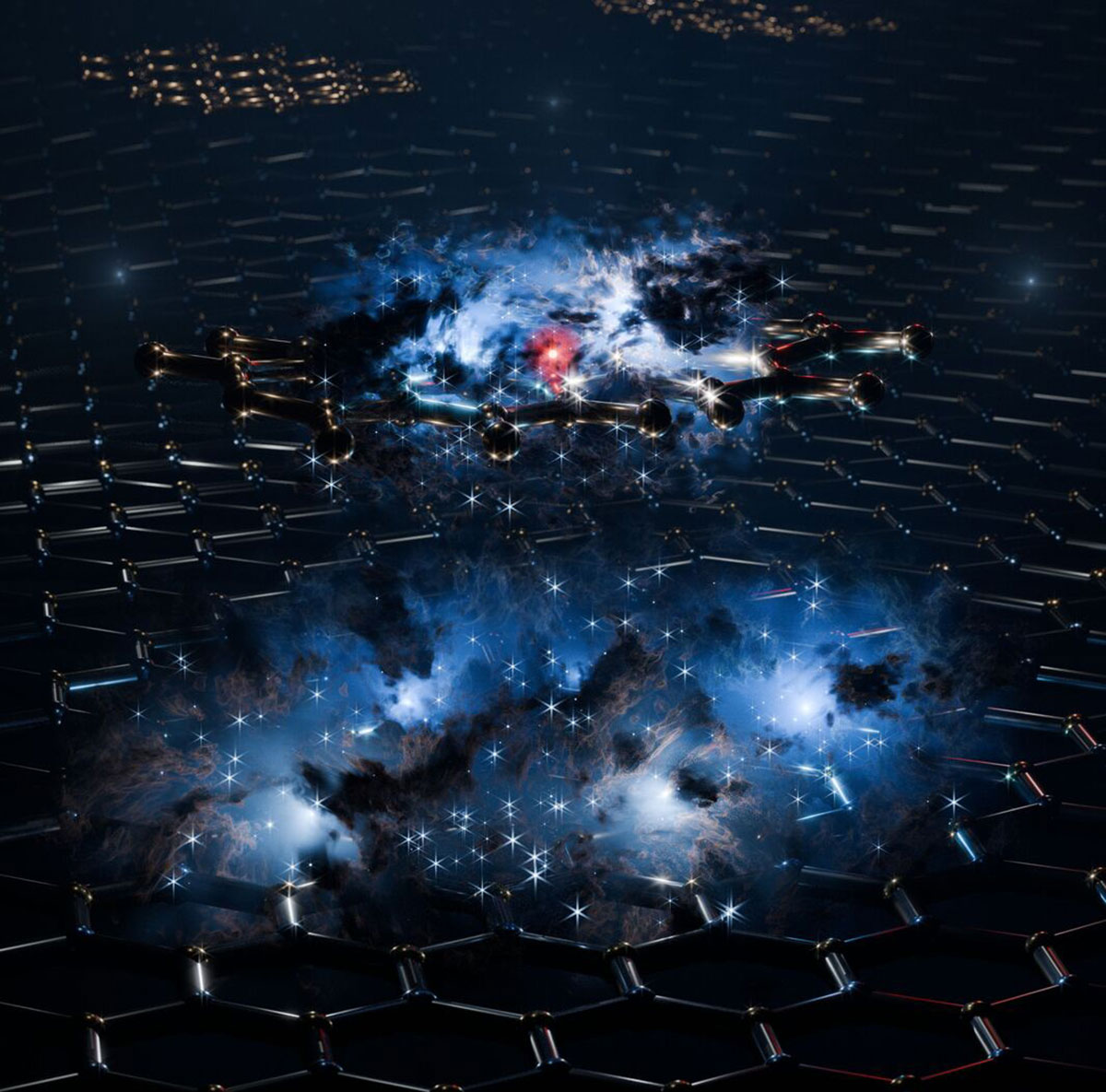
A research team has discovered a unique quantum state at the interface between organic materials and two-dimensional semiconductors.
Faster, more efficient, and more adaptable technologies are widely seen as essential for the future of energy generation and information processing. Achieving those goals, however, requires new ways of understanding how materials behave at the smallest scales. An international research team from the Universities of Göttingen, Marburg, Humboldt University of Berlin in Germany, and the University of Graz in Austria has now reported a significant advance in this area.
The researchers brought together two classes of materials that have attracted intense interest in recent years: organic semiconductors and two-dimensional semiconductors. By examining how this combined system responds to light, using photoelectron spectroscopy together with many-body perturbation theory, they were able to probe ultrafast processes at the boundary between the two materials. These measurements capture events that unfold within one quadrillionth of a second, offering a direct view of microscopic energy transfer.
This unique blend of material properties could open the door to new technologies, including more efficient solar cells. The findings were published in Nature Physics.
Watching Excitons in Motion
To carry out the study, the team relied on a specialized technique known as momentum microscopy, an advanced form of photoelectron spectroscopy. This method allowed them to track changes in the electronic structure of the materials as light interacts with them in real time.
The data can be viewed as a “movie” that reveals how excitons (quantum-mechanical particles consisting of an electron bound to an electron-hole) are created by light and then evolve into different types of exciton states.
By identifying the distinct spectroscopic signatures associated with each exciton type and comparing them with detailed theoretical models of the exciton landscape, the researchers were able to follow how energy moves across the 2D-organic interface. One key result showed that when a photon is absorbed by the two-dimensional material, energy can be transferred to the organic layer in less than one ten-trillionth (10-13) of a second.
“The key to this ultrafast energy transfer is the formation of ‘hybrid excitons’, for which we have now found a tell-tale experimental signature,” explains Professor Stefan Mathias, University of Göttingen.
Hybrid Excitons
But what exactly are “hybrid excitons”?
Excitons are created by light absorption in semiconductors and thus play a central role in optoelectronic devices such as solar cells and light-emitting diodes.
Depending on the material, excitons exhibit very different properties: in organic semiconductors, excitons are typically immobile – they are very much stuck in one place – whereas excitons in two-dimensional semiconductors are extremely mobile, freely floating all over the material.
At the interface of an organic and a 2D semiconductor, however, both the material properties and those of excitons might hybridize, potentially leading to the formation of new, hybrid, excitons.
Observing Hybrid Excitons Directly
This is exactly what the researchers observed at the interface of the 2D material WSe2 and the organic semiconductor PTCDA.
“Our results allow us to better understand and efficiently harness the fundamental processes behind energy and charge transfer in semiconductor nanostructures. This is a crucial step towards the development of efficient solar cells, ultrafast optoelectronic components, and novel applications in quantum technology,” explains Wiebke Bennecke, University of Göttingen and first author of the study, before adding, “As we mark the 100th Anniversary of the development of quantum mechanics, our findings powerfully illustrate its relevance today for the technology of the future.”
Reference: “Hybrid Frenkel–Wannier excitons facilitate ultrafast energy transfer at a 2D–organic interface” by Wiebke Bennecke, Ignacio Gonzalez Oliva, Jan Philipp Bange, Paul Werner, David Schmitt, Marco Merboldt, Anna M. Seiler, Kenji Watanabe, Takashi Taniguchi, Daniel Steil, R. Thomas Weitz, Peter Puschnig, Claudia Draxl, G. S. Matthijs Jansen, Marcel Reutzel and Stefan Mathias, 29 October 2025, Nature Physics.
DOI: 10.1038/s41567-025-03075-5
The research was supported by the German Research Foundation (DFG) Collaborative Research Centres (CRC) “Control of Energy Conversion on Atomic Scales”, “Mathematics of Experimentation”, “Pushing Electrons with Protons” in Göttingen, the DFG CRC “Hybrid Inorganic/Organic Systems for Opto-Electronics” in Berlin, the Austrian Science Fund, and the European Research Council.
Never miss a breakthrough: Join the SciTechDaily newsletter.
Follow us on Google and Google News.
4 Comments
As we mark the 100th Anniversary of the development of quantum mechanics, our findings powerfully illustrate its relevance today for the technology of the future.
Is that really the case?
Please ask the researchers to think deeply:
Is quantum mechanics algebra or physical reality? Is physical reality geometric, topological, or algebraic?
Topology is reshaping physics and the future of science. The core idea of Topological Vortex Theory (TVT)—space is physical, and matter is its topological excitation—already provides a solid and elegant scientific path for understanding the origin of all things.
——Excerpted from https://t.pineal.cn/blogs/6255/A-Mathematical-and-Physical-Analysis-On-the-Origin-of-Objects.
I still don’t know what is a hybrid exciton. Did you forget to finish the story?
SciTech coverage of physics rocks.
Hopefully, there will be a lot more breakthroughs to come and to cover.
VERY GOOD.
When we pursue the ultimate truth of all things, the space in which our bodies and all things exist may itself be the final and deepest puzzle we need to explore. This is not only the pursuit of physics, but also the most magnificent exploration of the origin of the universe by human reason.
Based on the Topological Vortex Theory (TVT), space is an uniformly incompressible physical entity. Topological vortices are the point defects in space. Point defects do not only impact the thermodynamic properties, but are also central to kinetic processes.
In today’s physics, some so-called peer-reviewed journals—including Physical Review Letters, Nature, Science, and others—stubbornly insist on and promote the following:
1. Even though θ and τ particles exhibit differences in experiments, physics can claim they are the same particle. This is science.
2. Even though topological vortices and antivortices have identical structures and opposite rotational directions, physics can define their structures and directions as entirely different. This is science.
3. Even though two sets of cobalt-60 rotate in opposite directions and experiments reveal asymmetry, physics can still define them as mirror images of each other. This is science.
4. Even though vortex structures are ubiquitous—from cosmic accretion disks to particle spins—physics must insist that vortex structures do not exist and require verification. Only the particles that like God, Demonic, or Angelic are the most fundamental structures of the universe. This is science.
5. Even though everything occupies space and maintains its existence in time, physics must still debate and insist on whether space exists and whether time is a figment of the human mind. This is science.
6. Even though space, with its non-stick, incompressible, and isotropic characteristics, provides a solid foundation for the development of physics, physics must still insist that the ideal fluid properties of space do not exist. This is science.
And go on. Is this the counterintuitive science they widely promote?
Under the topological vortex architecture, it is highly challenging for even two hydrogen atoms or two quarks to be perfectly symmetrical, let alone counter-rotating two sets of cobalt-60. Contemporary physics and so-called peer-reviewed publications (including Physical Review Letters, Science, Nature, etc.) stubbornly believe that two sets of counter rotating cobalt-60 are two mirror images of each other, constructing a more shocking pseudoscientific theoretical framework in the history of science than the “geocentric model”. This pseudo scientific framework and system have seriously hindered scientific progress and social development.
For nearly a century, physics has been manipulated by this pseudo scientific theoretical system and the interest groups behind it, wasting a lot of manpower, funds, and time. A large amount of pseudo scientific research has been conducted, and countless pseudo scientific papers have been published, causing serious negative impacts on scientific and social progress, as well as humanistic development.
The development of the Topological Vortex Theory (TVT) reflects a progression from concrete physical phenomena to abstract mathematical modeling and, ultimately, to interdisciplinary unification. Its core innovation lies in forging the continuous spacetime geometry of general relativity with the discrete interactions of quantum field theory within the same topological dynamical system. The core idea of TVT — space is physical, and matter is its topological excitation—already provides a solid and elegant scientific path for understanding the origin of all things.
——Excerpted from https://scitechdaily.com/microscope-spacecrafts-most-precise-test-of-key-component-of-the-theory-of-general-relativity/#comment-909171 and https://t.pineal.cn/blogs/6255/A-Mathematical-and-Physical-Analysis-On-the-Origin-of-Objects.