

Close Menu
    Facebook X (Twitter) Instagram
    SciTechDaily
    • Biology
    • Chemistry
    • Earth
    • Health
    • Physics
    • Science
    • Space
    • Technology
    Facebook X (Twitter) Pinterest YouTube RSS
    SciTechDaily
    Home»Health»New RAS Gene Discovery Unveils Hidden Pathway Driving Cancer Growth
    Health

    New RAS Gene Discovery Unveils Hidden Pathway Driving Cancer Growth

    By National Cancer InstituteNovember 14, 2024No Comments4 Mins Read
    Facebook Twitter Pinterest Telegram LinkedIn WhatsApp Email Reddit
    Share
    Facebook Twitter LinkedIn Pinterest Telegram Email Reddit
    Cancer Cell Biology Illustration
    NIH researchers found that mutant RAS genes can promote cancer through a novel mechanism, leading to enhanced tumor growth. This discovery suggests new combined drug approaches may be more effective for treating RAS-driven cancers.

    These findings could pave the way for new treatment approaches for cancers driven by RAS mutations.

    Researchers at the National Institutes of Health (NIH) and their collaborators have uncovered a novel mechanism by which RAS genes—commonly mutated in cancers—can promote tumor growth, extending beyond their established function in cell surface signaling.

    Mutant RAS, they found, helps to kick off a series of events involving the transport of specific nuclear proteins that lead to uncontrolled tumor growth, according to a study published November 11, 2024, in Nature Cancer.

    RAS genes are the second most frequently mutated genes in cancer, and mutant RAS proteins are key drivers of some of the deadliest cancers, including nearly all pancreatic cancers, half of colorectal cancers, and one-third of lung cancers. Decades of research have shown that mutant RAS proteins promote the development and growth of tumors by activating specific proteins at the cell surface, creating a constant stream of signals telling cells to grow.

    A Breakthrough in Understanding RAS Function

    “This is the first study to show that mutated RAS genes can promote cancer in an entirely new way,” said study author Douglas Lowy, M.D., deputy director of NIH’s National Cancer Institute (NCI). “The finding of the additional role for RAS proteins has exciting implications for improving treatment.”
    RAS Schematic
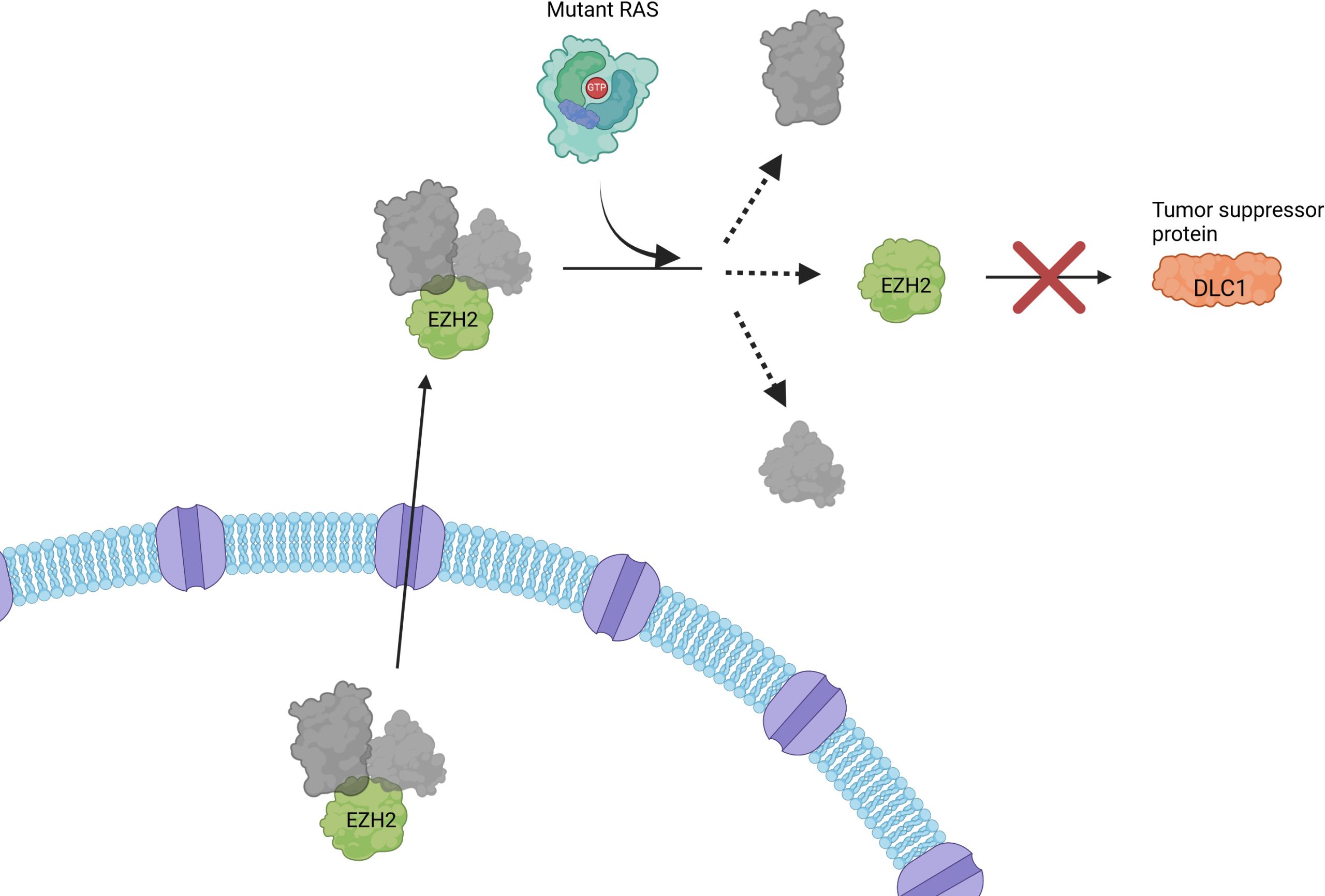
    Mutant RAS helps release EZH2 from a protein complex transported from the nucleus to the cytoplasm. Once released, EZH2 facilitates the breakdown of the DLC1 tumor suppressor protein, leading to uncontrolled tumor growth. Credit: Created by Linda Wang with Biorender.com

    Drugs that block mutant RAS proteins have been available as cancer treatments for only a few years and have been approved by the Food and Drug Administration to treat lung cancer and sarcoma. Although their development was a major scientific success, RAS inhibitors have thus far had a limited impact on patient outcomes, improving survival by only a few months in most people.

    The Mechanism: How Mutant RAS Interferes with Tumor Suppression

    Over 35 years ago, a group led by Dr. Lowy contributed to the early studies that identified RAS as a cancer-causing gene and helped explain how it promotes tumor growth. In this new study, the research team found that mutant RAS is directly involved in the process of releasing a nuclear protein called EZH2 from a complex transported from the nucleus to the cytoplasm. Once released, EZH2 facilitates the breakdown of a tumor suppressor protein called DLC1. Blocking mutant RAS stopped EZH2 from being released, restoring the activity of DLC1.

    In experiments in human lung cancer cell lines and mouse models of lung cancer, the researchers found that combining RAS inhibitors with different targeted cancer drugs that reactivate DLC1’s tumor suppressor activity had potent activity against cancer—more potent than that of RAS inhibitors alone.

    The study also found evidence that mutant RAS proteins perform this same function in other cancer types, suggesting that this mechanism may be a general feature of cancers with mutated RAS genes.

    The researchers believe their findings may have potential applications for the treatment of RAS-fueled cancers. They have started to look at how this function for RAS works in pancreatic cancer in particular because there are so few effective treatments for this type of cancer.

    “New treatment combinations could one day be developed that take this new role for RAS into consideration,” Dr. Lowy said.

    Reference: “The pro-oncogenic noncanonical activity of a RAS•GTP:RanGAP1 complex facilitates nuclear protein export” by Brajendra K. Tripathi, Nicole H. Hirsh, Xiaolan Qian, Marian E. Durkin, Dunrui Wang, Alex G. Papageorge, Ross Lake, Yvonne A. Evrard, Adam I. Marcus, Suresh S. Ramalingam, Mary Dasso, Karen H. Vousden, James H. Doroshow, Kylie J. Walters and Douglas R. Lowy, 11 November 2024, Nature Cancer.
    DOI: 10.1038/s43018-024-00847-5

    Never miss a breakthrough: Join the SciTechDaily newsletter.
    Follow us on Google and Google News.

    Cancer Genetics National Institutes of Health Oncology
    Share. Facebook Twitter Pinterest LinkedIn Email Reddit

    Related Articles

    Young Adults See Alarming Spike in 14 Types of Cancer, NIH Report Reveals

    Scientists May Have Found a Secret Weapon To Stop Pancreatic Cancer Before It Starts

    New Research Overturns Decades-Old Beliefs About How Cancer Grows and Spreads

    Breaking the Laws of Biology: Scientists Expose Cancer’s “Secret Weapon”

    Stanford Scientists Overturn Mendel’s Law With Shocking Cancer Discovery

    Startling Discovery: Cancer Can Arise Without Genetic Mutations

    Personalized Immunotherapy Could Potentially Be Used To Treat Metastatic Breast Cancer

    Genetic Analysis Illuminates Origins of Lung Cancer in People With No History of Smoking

    Many People Want Secondary Genomic Findings After Initially Refusing

    Leave A Reply Cancel Reply

    • Facebook
    • Twitter
    • Pinterest
    • YouTube

    Don't Miss a Discovery

    Subscribe for the Latest in Science & Tech!

    Trending News

    289-Million-Year-Old Reptile Mummy Reveals Origin of Human Breathing System

    New Brain Discovery Challenges Long-Held Theory of Teenage Brain Development

    Scientists Discover Plants “Scream” – We Just Couldn’t Hear Them Until Now

    Scientists Discover a Surprising Reason Intermittent Fasting Extends Life

    This Simple Fruit Wash Could Make Produce Safer and Last Days Longer

    Scientists Say Adding This Unusual Seafood to Your Diet Could Reverse Signs of Aging

    Scientists Say a Hidden Structure May Exist Inside Earth’s Core

    Doctors Surprised by the Power of a Simple Drug Against Colon Cancer

    Follow SciTechDaily
    • Facebook
    • Twitter
    • YouTube
    • Pinterest
    • Newsletter
    • RSS
    SciTech News
    • Biology News
    • Chemistry News
    • Earth News
    • Health News
    • Physics News
    • Science News
    • Space News
    • Technology News
    Recent Posts
    • Breakthrough Bowel Cancer Trial Leaves Patients Cancer-Free for Nearly 3 Years
    • New Immune Pathway Could Supercharge mRNA Cancer Vaccines
    • Natural Compound Shows Powerful Potential Against Rheumatoid Arthritis
    • 100,000-Year-Old Neanderthal Fossils in Poland Reveal Unexpected Genetic Connections
    • Unexpected Hormone Discovery Could Change How We Treat Arthritis
    Copyright © 1998 - 2026 SciTechDaily. All Rights Reserved.
    • Science News
    • About
    • Contact
    • Editorial Board
    • Privacy Policy
    • Terms of Use

    Type above and press Enter to search. Press Esc to cancel.