
New research suggests that artificial intelligence may be most powerful not as a tool for automation, but as a creative collaborator.
Artificial intelligence (AI) is commonly associated with automation and the replacement of human effort. However, new findings from Swansea University suggest a different role for the technology, showing that AI can support creativity by engaging and inspiring people rather than simply taking over tasks.
Researchers from the University’s Computer Science Department carried out one of the largest studies so far on how people work alongside AI in creative design. The online experiment involved more than 800 participants, who used an AI-powered system to help them create virtual car designs.
Encouraging Exploration Through Design Diversity
Many AI design tools quietly optimise outcomes without involving users in the process. In contrast, the system used in this study relied on a method known as MAP-Elites to present participants with a wide variety of visual design options. The resulting galleries showcased everything from highly effective designs to unconventional concepts and intentionally flawed examples, encouraging users to explore a broader range of possibilities.
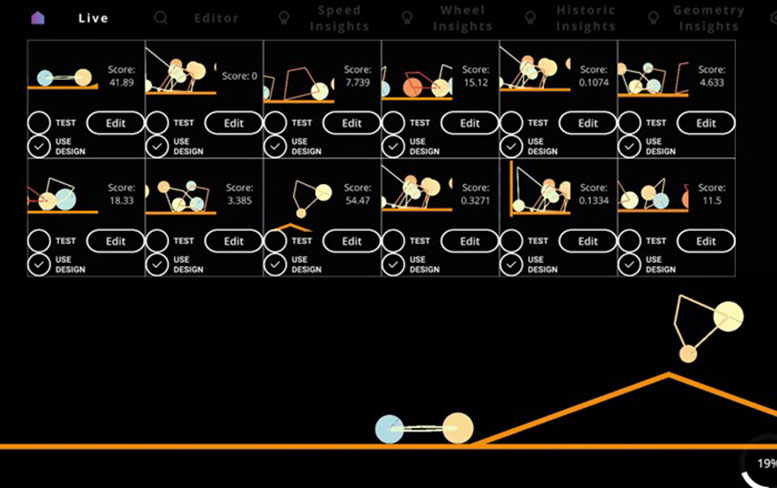
Turing Fellow Dr. Sean Walton, Associate Professor of Computer Science and lead author of the study, explained: “People often think of AI as something that speeds up tasks or improves efficiency, but our findings suggest something far more interesting. When people were shown AI-generated design suggestions, they spent more time on the task, produced better designs, and felt more involved. It was not just about efficiency. It was about creativity and collaboration.”
Rethinking How AI Design Tools Are Evaluated
A key insight from the study, published in the ACM journal Transactions on Interactive Intelligent Systems, is that traditional ways of evaluating AI design tools may be too narrow. Metrics such as how often users click or copy suggestions fail to capture the emotional, cognitive, and behavioral dimensions of engagement. The Swansea team argues for more holistic evaluation methods that consider how AI systems influence how people feel, think, and explore.
Dr. Walton added, “Our study highlights the importance of diversity in AI output. Participants responded most positively to galleries that included a wide variety of ideas, including bad ones! These helped them move beyond their initial assumptions and explore a broader design space. This structured diversity prevented early fixation and encouraged creative risk-taking.
“As AI becomes increasingly embedded in creative fields, from engineering and architecture to music and game design, understanding how humans and intelligent systems work together is essential. As the technology evolves, the question is not only what AI can do but how it can help us think, create, and collaborate more effectively.”
Reference: “From Metrics to Meaning: Time to Rethink Evaluation in Human–AI Collaborative Design” by Sean P. Walton, Ben J. Evans, Alma A. M. Rahat, James Stovold and Jakub Vincalek, 7 March 2024, ACM Transactions on Interactive Intelligent Systems.
DOI: 10.1145/3773292
Never miss a breakthrough: Join the SciTechDaily newsletter.
Follow us on Google and Google News.
3 Comments
thanks for this
The more AI helps us think and create, the less we will be able to think and create on our own. It also seems counter-intuitive for AI to be deliberately giving bad designs in that study. AI already gives bad information. This doesn’t necessarily increase human creativity. It undermines trust in AI, which is warranted. And some people will not see the AI error, which can lead people in the wrong direction.
I am a medical anthropologist breast cancer researcher and have issues with AI that inform my comment above. See my article, AI BS and the Big C. https://www.academia.edu/145481904/AI_BS_and_the_Big_C
That’s lovely! But the powers-that-be-will use AI for their own ends, not for the benefit of the rest of us. That’s the evil in human nature. Power begets power.