
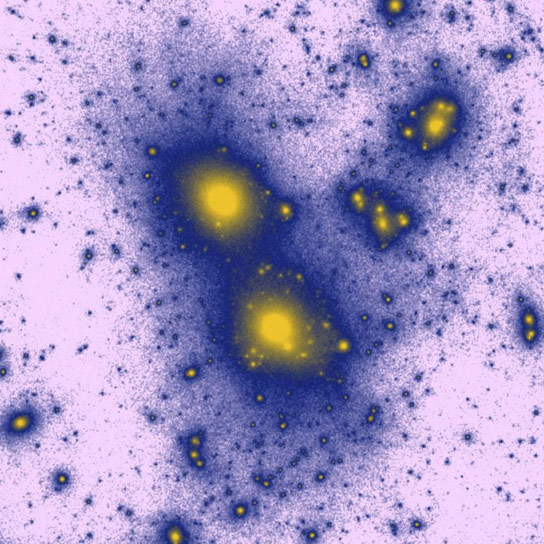
New breakthrough research on dark matter explores dark matter candidates as quantum flavor-mixed particles and demonstrates that the two-component dark matter model agrees with observational data at all scales.
Astrophysicists believe that about 80 percent of the substance of our universe is made up of mysterious “dark matter” that can’t be perceived by human senses or scientific instruments.
“Dark matter has not yet been detected in a lab. We infer about it from astronomical observations,” said Mikhail Medvedev, professor of physics and astronomy at the University of Kansas, who has just published breakthrough research on dark matter that merited the cover of Physical Review Letters, the world’s most prestigious journal of physics research.
Medvedev proposes a novel model of dark matter, dubbed “flavor-mixed multicomponent dark matter.”
“Dark matter is some unknown matter, most likely a new elementary particle or particles beyond the Standard Model,” Medvedev said. “It has never been observed directly, but it reveals itself via gravity it produces in the universe. There are numerous experiments around the world aimed at finding it directly.”
Medvedev’s theory rests on the behavior of elementary particles that have been observed or hypothesized. According to today’s prevalent Standard Model theory of particle physics, elementary particles — categorized as varieties of quarks, leptons and gauge bosons — are the building blocks of an atom. The properties, or “flavors,” of quarks and leptons are prone to change back and forth, because they can combine with each other in a phenomenon called flavor-mixing.
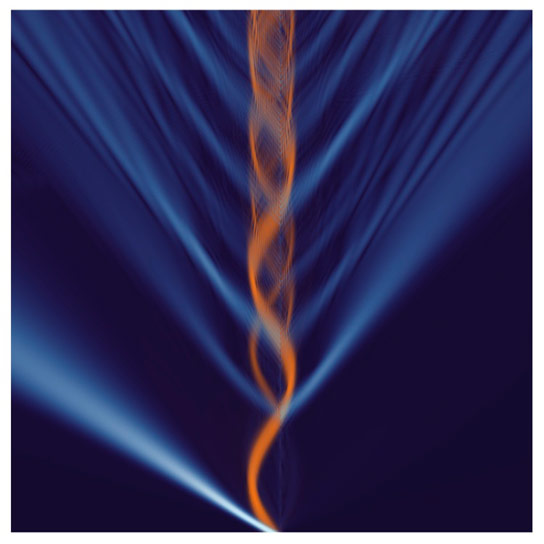
“In everyday life we’ve become used to the fact that each and every particle or an atom has a certain mass,” Medvedev said. “A flavor-mixed particle is weird — it has several masses simultaneously — and this leads to fascinating and unusual effects.”
Medvedev compared flavor-mixing to white light that contains several colors and can generate a rainbow.
“If white was a particular flavor, then red, green and blue would be different masses — masses one, two and three — that mix up together to create white,” he said. “By changing proportions of red, green and blue in the mix, one can make different colors, or flavors, other than white.”
Medvedev said that dark matter candidates are also theorized to be flavor-mixed — such as neutralinos, axions and sterile neutrinos.
“These are, in fact, the most preferred candidates people speak about all the time,” Medvedev said.
“Previously we discovered that flavor-mixed particles can ‘quantum evaporate’ from a gravitational well if they are ‘shaken’ — meaning they collide with another particle,” he said. “That’s a remarkable result, as if a spacecraft made of flavor-mixed matter and hauled along a bumpy road puts itself into space without a rocket or any other means or effort by us.”
Medvedev included the physics process of quantum evaporation in a “cosmological numerical code” and performed simulations using supercomputers.
“Each simulation utilized over a 1,000 cores and ran for a week or so,” he said. “This yearlong project consumed about 2 million computer hours in total, which is equal to 230 years.”
Medvedev said that dark matter may interact with normal matter extremely weakly, which is why it hasn’t been revealed already in numerous ongoing direct detection experiments around the world. So physicists have devised a working model of completely collisionless (noninteracting), cold (that is, having very low thermal velocities) dark matter with a cosmological constant (the perplexing energy density found in the void of outer space), which they term the “Lambda-CDM model.”
But the model has hasn’t always agreed with observational data, until Medvedev’s paper solved the theory’s long-standing and troublesome puzzles.
“Our results demonstrated that the flavor-mixed, two-component dark matter model resolved all the most pressing Lambda-CDM problems simultaneously,” said the KU researcher.
Reference: “Cosmological Simulations of Multicomponent Cold Dark Matter” by Mikhail V. Medvedev, 15 August 2014, Physical Review Letters.
DOI: 10.1103/PhysRevLett.113.071303
Medvedev performed the simulations using XSEDE high-performance computation facilities, primarily Trestles at the San Diego Supercomputer Center and Ranger at the Texas Advanced Computing Center.
Never miss a breakthrough: Join the SciTechDaily newsletter.
Follow us on Google and Google News.