
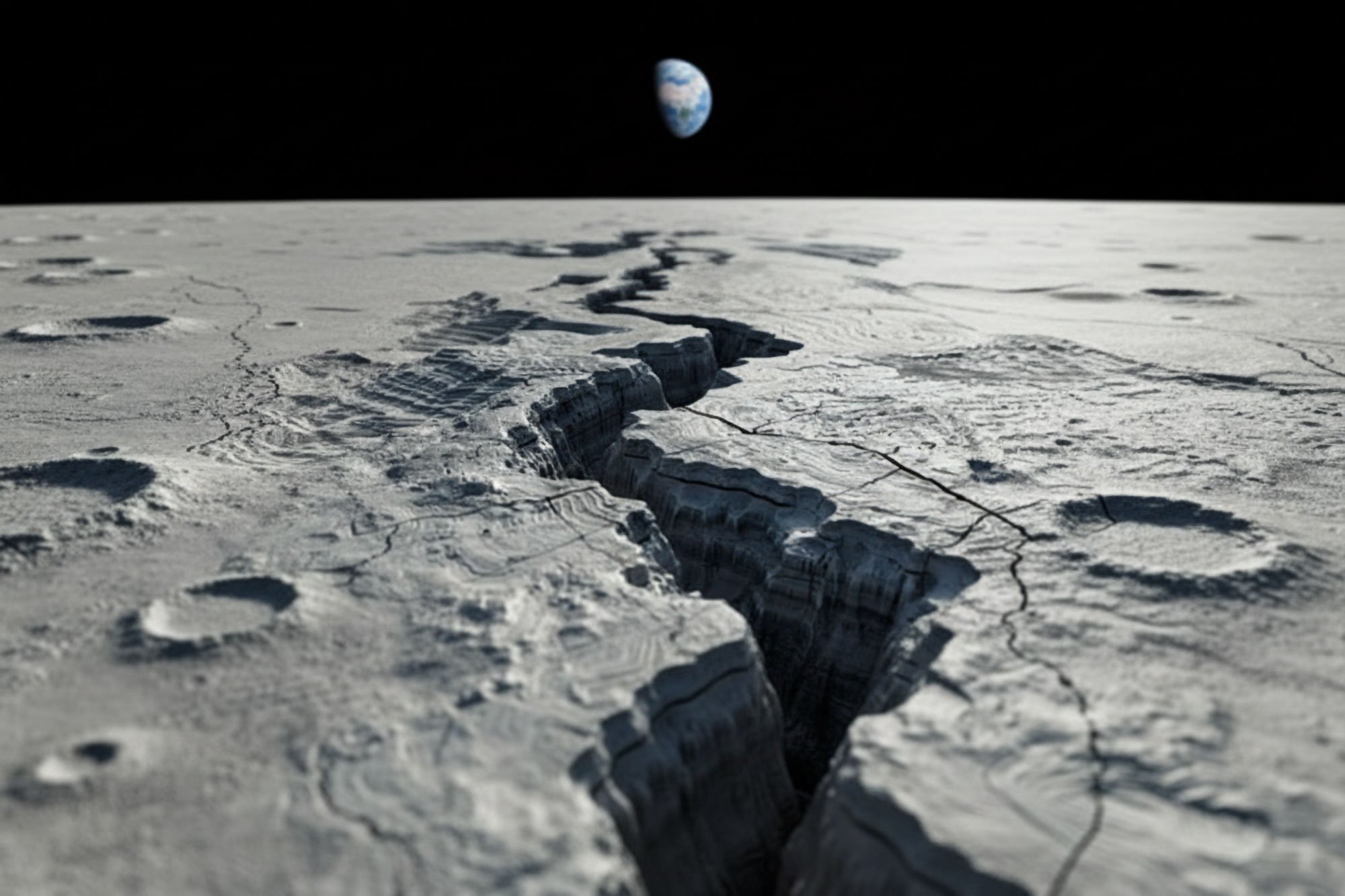
A new study reveals that seismic activity on the Moon may threaten the stability of future long-term infrastructure.
A recent study found that ground shaking caused by moonquakes, not meteorite impacts, was responsible for altering the terrain in the Taurus-Littrow valley, the site of the Apollo 17 landing in 1972. The research also identified a likely source of these surface changes and evaluated the potential hazards by applying new seismic models, with results that carry important implications for both future lunar exploration and the development of permanent bases on the Moon.
The paper authored by Smithsonian Senior Scientist Emeritus Thomas R. Watters and University of Maryland Associate Professor of Geology Nicholas Schmerr was published in the journal Science Advances.
Geological evidence from Apollo 17 site
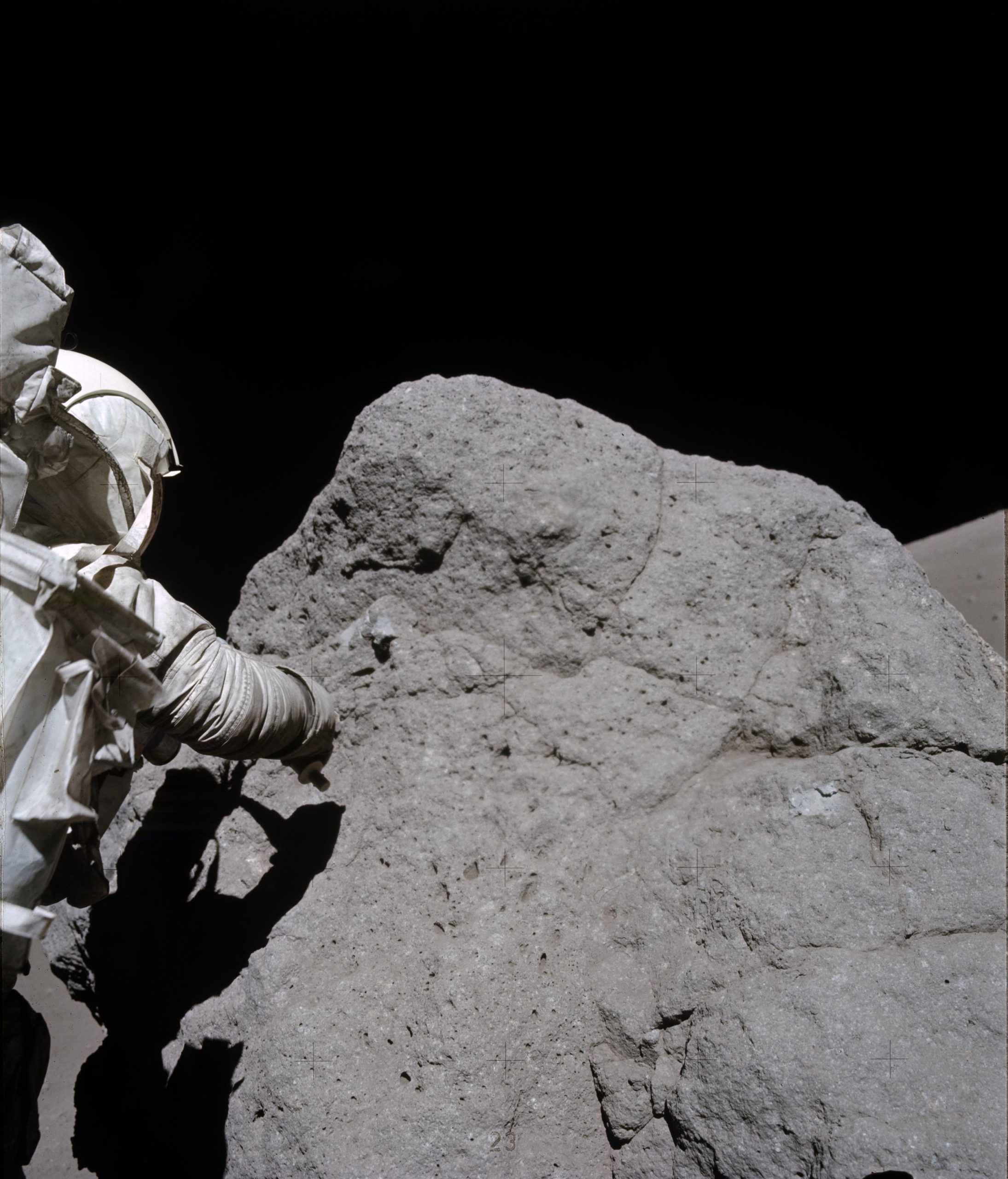
The research team examined data from the Apollo 17 site, where astronauts had gathered rock samples from boulder falls and landslides believed to have been triggered by moonquakes. By analyzing these geological traces, they were able to estimate the intensity of past moonquakes and determine their most likely origin.
“We don’t have the sort of strong motion instruments that can measure seismic activity on the moon like we do on Earth, so we had to look for other ways to evaluate how much ground motion there may have been, like boulder falls and landslides that get mobilized by these seismic events,” Schmerr said.
A computer simulation depicting the seismic waves emanating from a shallow moonquake occurring on the Lee-Lincoln scarp in the Taurus-Littrow Valley on the Moon and interacting with the Apollo 17 Lunar Module landing site. The audio is the corresponding vertical ground motion from the simulation. Both audio and video are sped up by a factor of 10. The background image is a globe mosaic image from the Lunar Reconnaissance Orbiter Camera Wide Angle Camera (LROC-WAC). Red and blue are positive (upward ground motion) and negative (downward ground motion) polarities of the wave. Credit: University of Maryland, Nicholas Schmerr
Their findings indicate that moonquakes measuring around magnitude 3.0—considered minor by Earth’s standards but potentially powerful when occurring nearby—have repeatedly shaken the region for the last 90 million years. These quakes were linked to the Lee-Lincoln fault, a fracture running across the valley floor, and the evidence suggests that this fault, one among thousands scattered across the lunar surface, may still be active today.
Assessing risks of active lunar faults
“The global distribution of young thrust faults like the Lee-Lincoln fault, their potential to be still active, and the potential to form new thrust faults from ongoing contraction should be considered when planning the location and assessing stability of permanent outposts on the moon,” Watters said.
Watters and Schmerr also calculated lunar seismic risk, estimating a one in 20 million chance of a potentially damaging moonquake occurring on any given day near an active fault.
“It doesn’t sound like much, but everything in life is a calculated risk,” Schmerr noted. “The risk of something catastrophic happening isn’t zero, and while it’s small, it’s not something you can completely ignore while planning long-term infrastructure on the lunar surface.”
Implications for future missions
The researchers found that short-term missions, such as Apollo 17, were relatively low-risk, but longer-duration projects face incrementally higher exposure. Future missions with higher aspect ratio landers—such as the Starship Human Landing System—could be vulnerable to ground acceleration from nearby moonquakes that would threaten their stability. The findings are particularly relevant as NASA continues the Artemis program, which aims to establish a sustained human presence on the moon. Watters and Schmerr emphasized that future missions face additional considerations beyond Apollo-era risks.
“If astronauts are there for a day, they’d just have very bad luck if there was a damaging event,” Schmerr added. “But if you have a habitat or crewed mission up on the moon for a whole decade, that’s 3,650 days times 1 in 20 million, or the risk of a hazardous moonquake becoming about 1 in 5,500. It’s similar to going from the extremely low odds of winning a lottery to much higher odds of being dealt a four of a kind poker hand.”
Lunar paleoseismology and safe exploration
Schmerr believes that his work with Watters represents a new frontier in lunar paleoseismology—the study of ancient earthquakes. Unlike on Earth, where scientists can dig trenches to study historic seismic activity, lunar researchers must rely on creative approaches using existing data and samples. Schmerr expects this field to rapidly advance with new technology, high-resolution orbital imaging, and future Artemis missions that will deploy seismometers with 50-plus years of technological improvements over the Apollo-era instruments.
“We want to make sure that our exploration of the moon is done safely and that investments are made in a way that’s carefully thought out,” Schmerr said. “The conclusion we came to is: don’t build right on top of a scarp, or recently active fault. The farther away from a scarp, the lesser the hazard.”
This article was adapted from text provided by the Earth and Planetary Studies of the National Air and Space Museum, Smithsonian Institution.
Reference: “Paleoseismic activity in the moon’s Taurus-Littrow valley inferred from boulder falls and landslides” by Thomas R. Watters and Nicholas C. Schmerr, 30 July 2025, Science Advances.
DOI: 10.1126/sciadv.adu3201
This research was funded by NASA’s Lunar Reconnaissance Orbiter mission, launched on 18 June 2009. LRO is managed by the NASA Goddard Space Flight Center for the Science Mission Directorate. This article does not necessarily reflect the views of this organization.
Never miss a breakthrough: Join the SciTechDaily newsletter.
Follow us on Google and Google News.
1 Comment
Moonquakes aren’t gonna kill anybody. The Sun will beat them to it every time.
Astronauts that went to orbit die younger on average, than the ones that have only trained but never went up. And astronauts that have been to the Moon die younger on average than the ones that have just been to orbit. So moonquakes are the last thing I’d worry about if I were in NASA’s shoes.