
Close Menu
    Facebook X (Twitter) Instagram
    SciTechDaily
    • Biology
    • Chemistry
    • Earth
    • Health
    • Physics
    • Science
    • Space
    • Technology
    Facebook X (Twitter) Pinterest YouTube RSS
    SciTechDaily
    Home»Health»New Research Provides Hope for Better Wound Healing for Diabetics
    Health

    New Research Provides Hope for Better Wound Healing for Diabetics

    By Max Planck InstituteOctober 17, 2016No Comments3 Mins Read
    Facebook Twitter Pinterest Telegram LinkedIn WhatsApp Email Reddit
    Share
    Facebook Twitter LinkedIn Pinterest Telegram Email Reddit
    New Hope for Better Wound Healing for People with Diabetes
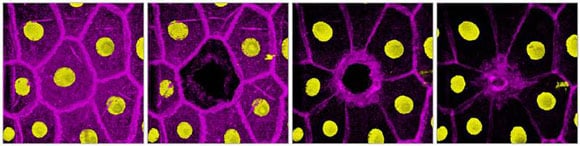
    Time-lapse of a wound healing in Drosophila (from left to right): After removal of the nucleus (yellow) the cell membrane (pink) seals off the gap caused by the wound.

    New research from the Max Planck Institute could lead to the development of new wound treatment methods for people with diabetes.

    Diabetics often have to contend with wounds that heal poorly. Researchers at the Max Planck Institute for Biology of Ageing, the CECAD Excellence Cluster, and the Institute of Genetics of the University of Cologne have now gained fresh insights into the underlying cellular mechanisms. Their findings could lead to the development of new treatment methods.

    According to estimates by the International Diabetes Federation (IDF), some six million people in Germany suffer from diabetes mellitus, around 90 percent of whom have the type 2 form. The disease, which is triggered by a disturbance of insulin metabolism, has serious effects on the entire body. One problem these patients face is poor wound healing.

    It had previously been assumed that high levels of glucose in the blood damages vessels and neurons and impairs the immune system, thereby accounting for the wound-healing problems. A Cologne-based research group headed by Linda Partridge, Director of the Max Planck Institute for Biology of Ageing, and Maria Leptin, research group head at the Institute of Genetics of the University of Cologne, has now shown in a study that slowed insulin metabolism at the wound site directly affects neighboring cells involved in wound healing.

    Investigations of fly skin

    Parisa Kakanj, the author of the study, examined the skin of larvae of the fruit fly Drosophila melanogaster. These flies serve as models for diabetes because insulin metabolism has been strongly conserved over the course of evolution, meaning that flies and mammals are very similar in this respect. Using a precision laser, Kakanj removed a cell from the outermost skin layer of fruit fly larvae and then observed what happens in the neighboring cells live under the microscope.

    “Immediately after a skin injury, the neighboring cells respond by forming an actomyosin cable,” Kakanj explains. The cable consists of proteins that otherwise occur in muscle fibers, which are responsible for muscular contraction. After an injury, the cable forms a contractile ring around the wound. It then contracts, sealing off the gap caused by the wound. “However, if insulin metabolism is impaired, as in our genetically modified flies, the cable is weaker and forms much later. This results in incomplete or slow wound healing,” as Kakanj relates.

    Local treatment for better wound healing

    New treatments for impaired wound healing could precisely target this mechanism. “Our findings raise hope of a potential treatment for diabetics. In the future, it may be possible to treat wound sites with drugs that locally activate insulin metabolism,” Kakanj explains. The research team is now working closely with Sabine Eming, a dermatologist at the University of Cologne, and the Excellence Cluster for Ageing Research at the University of Cologne in order to investigate ways to implement this approach.

    Reference: “Insulin and TOR signal in parallel through FOXO and S6K to promote epithelial wound healing” by Parisa Kakanj, Bernard Moussian, Sebastian Grönke, Victor Bustos, Sabine A. Eming, Linda Partridge and Maria Leptin, 7 October 2016, Nature Communications.
    DOI: 10.1038/ncomms12972

    Never miss a breakthrough: Join the SciTechDaily newsletter.
    Follow us on Google and Google News.

    Diabetes Disease Max Planck Institute Medicine
    Share. Facebook Twitter Pinterest LinkedIn Email Reddit

    Related Articles

    Inhibition of FKBP51 Protein Reduces Obesity and Diabetes

    Study Shows Parkinson’s Disease Involves Degeneration of the Olfactory System

    Yale Study Identifies Apelin as a Therapeutic Target for Diabetes

    Scientists Reveal the Role of Gut Bacteria in Averting Type 1 Diabetes

    Triple Sugar Molecule Protects Against the Pneumococcal Strain ST8

    Max Planck Scientists Discover a New Genetic Disease Mechanism

    Study Shows Diabetes Drug Significantly Reduces Risk of Heart Failure

    Intensive Glycemic Control Does Not Definitively Reduce the Risk of Impaired Kidney Function

    Amorfrutins in Liquorice Root Have Important Anti-Diabetic Effects

    Leave A Reply Cancel Reply

    • Facebook
    • Twitter
    • Pinterest
    • YouTube

    Don't Miss a Discovery

    Subscribe for the Latest in Science & Tech!

    Trending News

    Researchers Have Found a Dietary Compound That Increases Longevity

    Scientists Baffled by Bizarre “Living Fossil” From 275 Million Years Ago

    Your IQ at 23 Could Predict Your Wealth at 27, Study Finds

    320 Light-Years Away, a Planet Confirms a Fundamental Cosmic Assumption

    The Crown Jewel of Dentistry? Breakthrough Tech Could Transform Tooth Repair

    Python Blood Could Hold the Secret to Weight Loss Without Side Effects

    Naturally Occurring Bacteria Completely Eradicate Tumors in Mice With a Single Dose

    New “Nanozyme Hypothesis” Could Rewrite the Story of Life’s Origins

    Follow SciTechDaily
    • Facebook
    • Twitter
    • YouTube
    • Pinterest
    • Newsletter
    • RSS
    SciTech News
    • Biology News
    • Chemistry News
    • Earth News
    • Health News
    • Physics News
    • Science News
    • Space News
    • Technology News
    Recent Posts
    • 34-Million-Year-Old Snake Found in Wyoming Rewrites Our Understanding of Evolution
    • Prehistoric “Vomit Fossil” Reveals Never-Before-Seen Flying Reptile
    • Scientists Discover Bizarre Crocodile Relative That Walked on Two Legs
    • How Quantum Mechanics Went From Baffling Theory to Revolutionizing Modern Technology
    • Scientists May Have Found the Key to Jupiter and Saturn’s Moon Mystery
    Copyright © 1998 - 2026 SciTechDaily. All Rights Reserved.
    • Science News
    • About
    • Contact
    • Editorial Board
    • Privacy Policy
    • Terms of Use

    Type above and press Enter to search. Press Esc to cancel.