
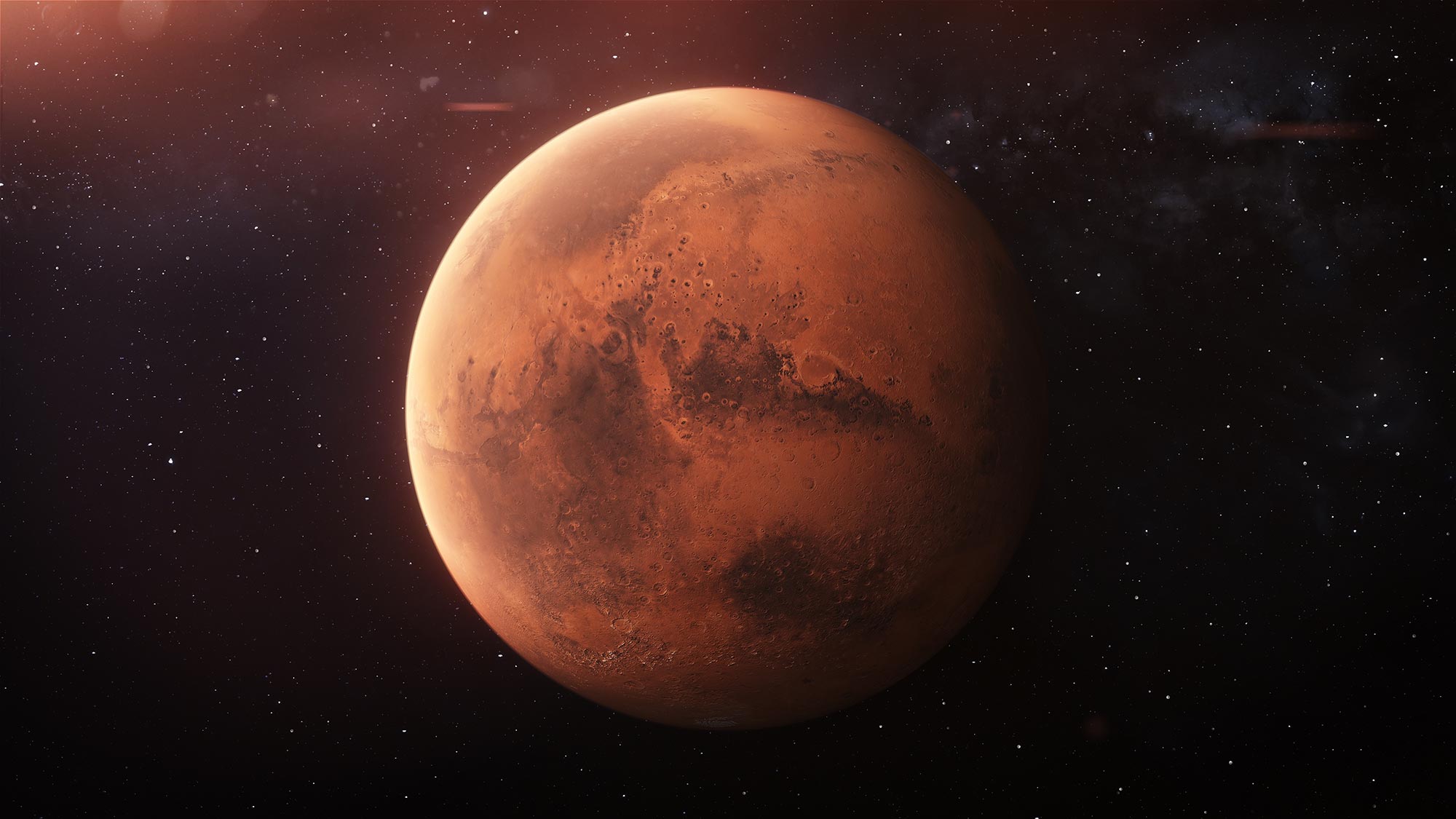
Analysis of Martian clay minerals suggests early Mars had sustained rainfall and potentially habitable conditions billions of years ago.
New evidence suggests that Mars may once have had a warm and wet climate billions of years ago, offering a very different picture from the long-standing view that the planet was mostly cold and icy. This shift in understanding raises important questions about whether early Mars could have supported life.
The question of Mars’ past habitability has been studied for decades. Like Earth, Mars formed about 4.5 billion years ago, and scientists divide its history into distinct geological periods to better understand how its environment changed over time.
The latest research focuses on the Noachian epoch, which lasted from roughly 4.1 to 3.7 billion years ago. This period coincided with the Late Heavy Bombardment (LHB), a phase in solar system history marked by frequent and massive meteorite impacts that affected many planetary bodies.
Impact era shaped early Mars
Among the most prominent remnants of this violent period are the Hellas and Argyre impact basins. Each spans well over a thousand miles and is large enough to contain more water than the entire Mediterranean Sea.
One might not imagine such a time being conducive to the existence of fragile lifeforms, yet it is likely to be the era in which Mars was most habitable. Evidence of landforms sculpted by water from this time is plentiful and include dried-up river valleys, lake beds, ancient coastlines, and river deltas.
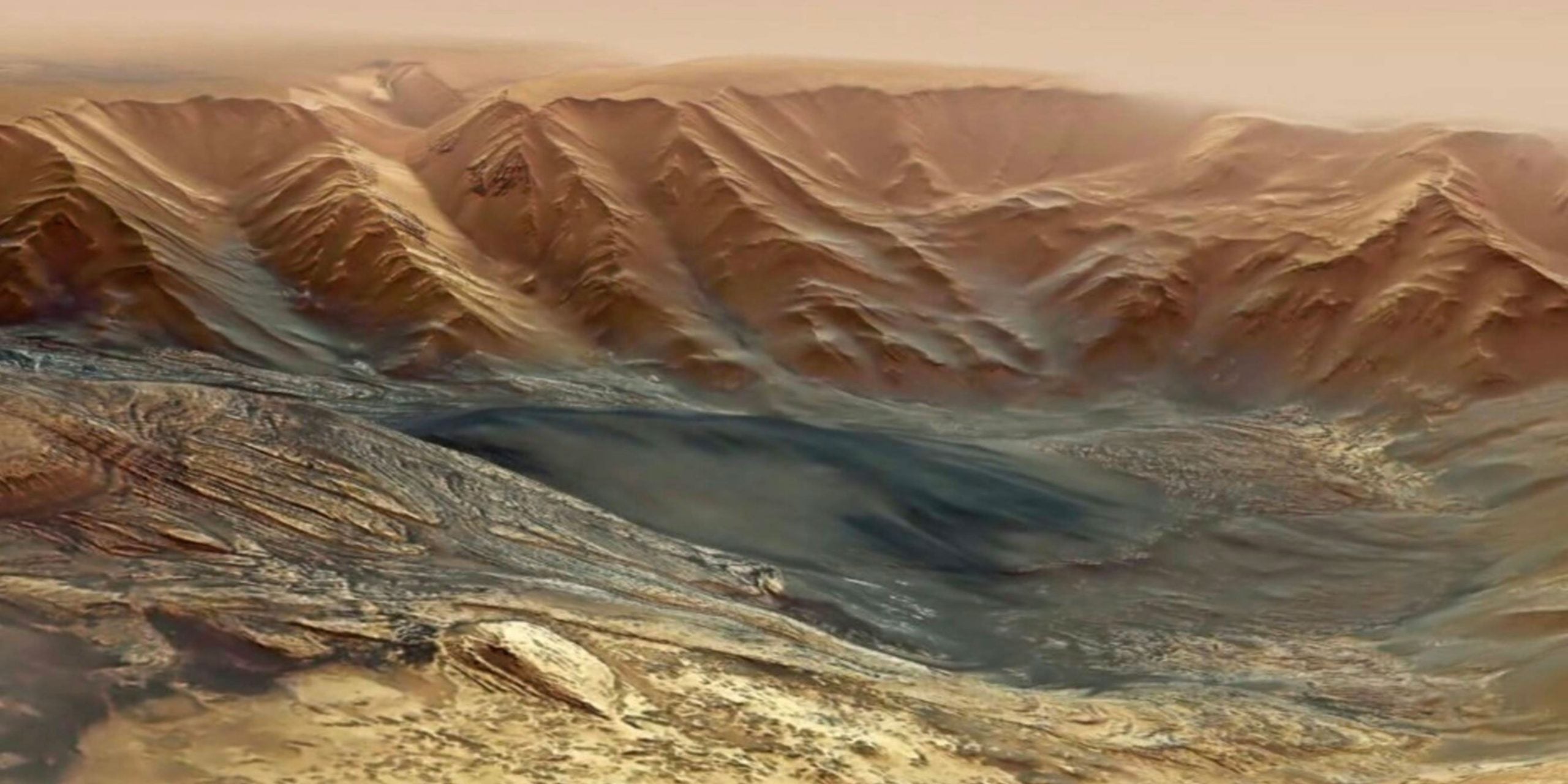
The prevailing climatic conditions of the Noachian are still a matter of intense debate. Two alternative scenarios are typically posited: that this time was cold and icy, with occasional melting of large volumes of frozen water by meteorite impact and volcanic eruptions, or that it was warm, wet, and largely ice-free.
Climate debate centers on water
All stars, including the Sun, brighten with age. In the early solar system, during the Noachian, the Sun was about 30% dimmer than it is today, so less heat was reaching Mars (and all the planets). To sustain a warm, wet climate at this time, the Martian atmosphere would have needed to be very substantial – much thicker than it is today – and abundant in greenhouse gases like CO2.
But when reaching high enough atmospheric pressure, CO2 tends to condense out of the air to form clouds and reduce the greenhouse effect. Given these issues, the cold, icy scenario is perhaps more believable.
One of the main science goals of the Mars 2020 Perseverance Rover, which landed spectacularly in February 2021, is to seek evidence to support either of these two scenarios, and the new paper using data from Perseverance may have done just that.
Rover data points to rainfall
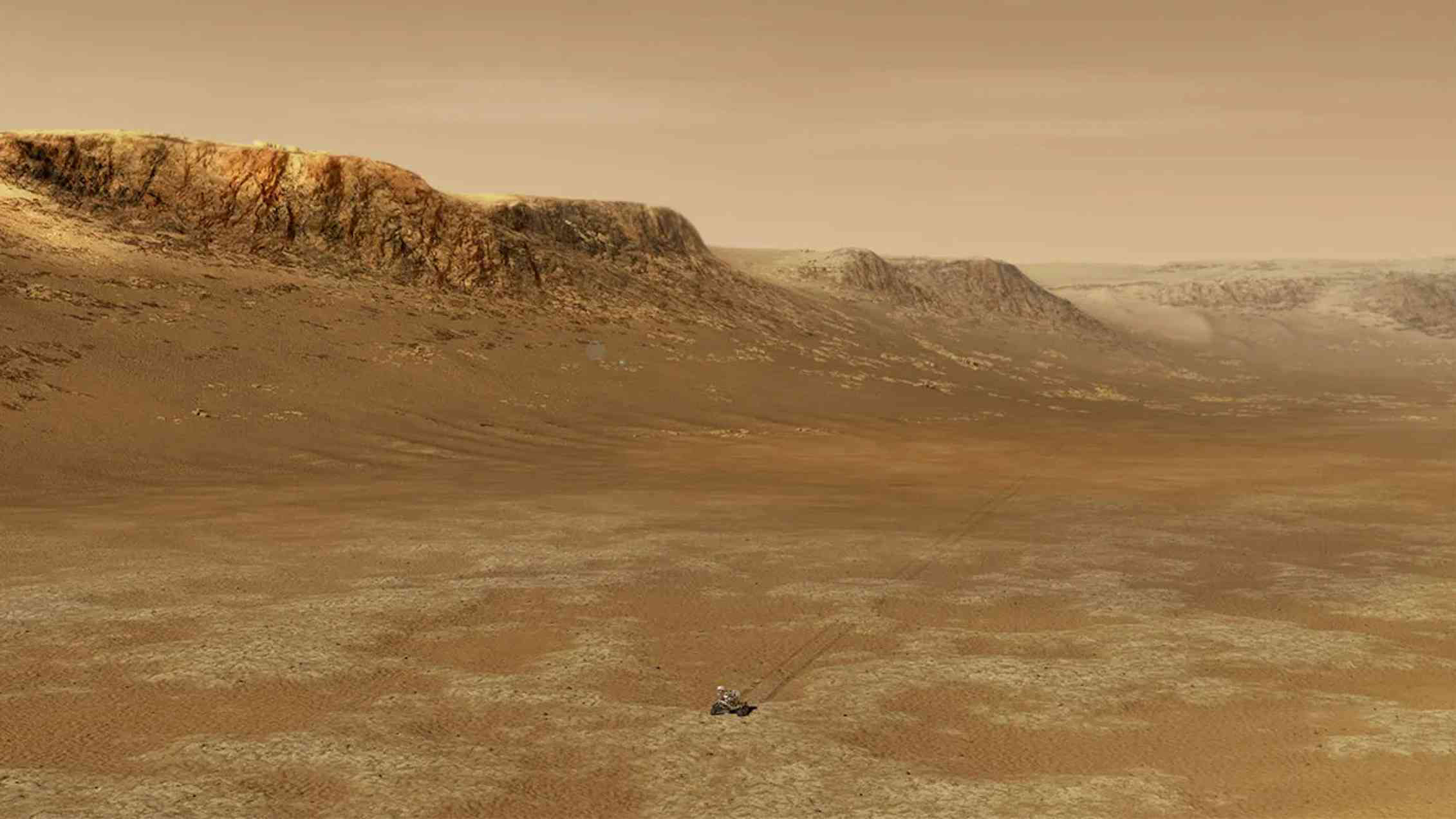
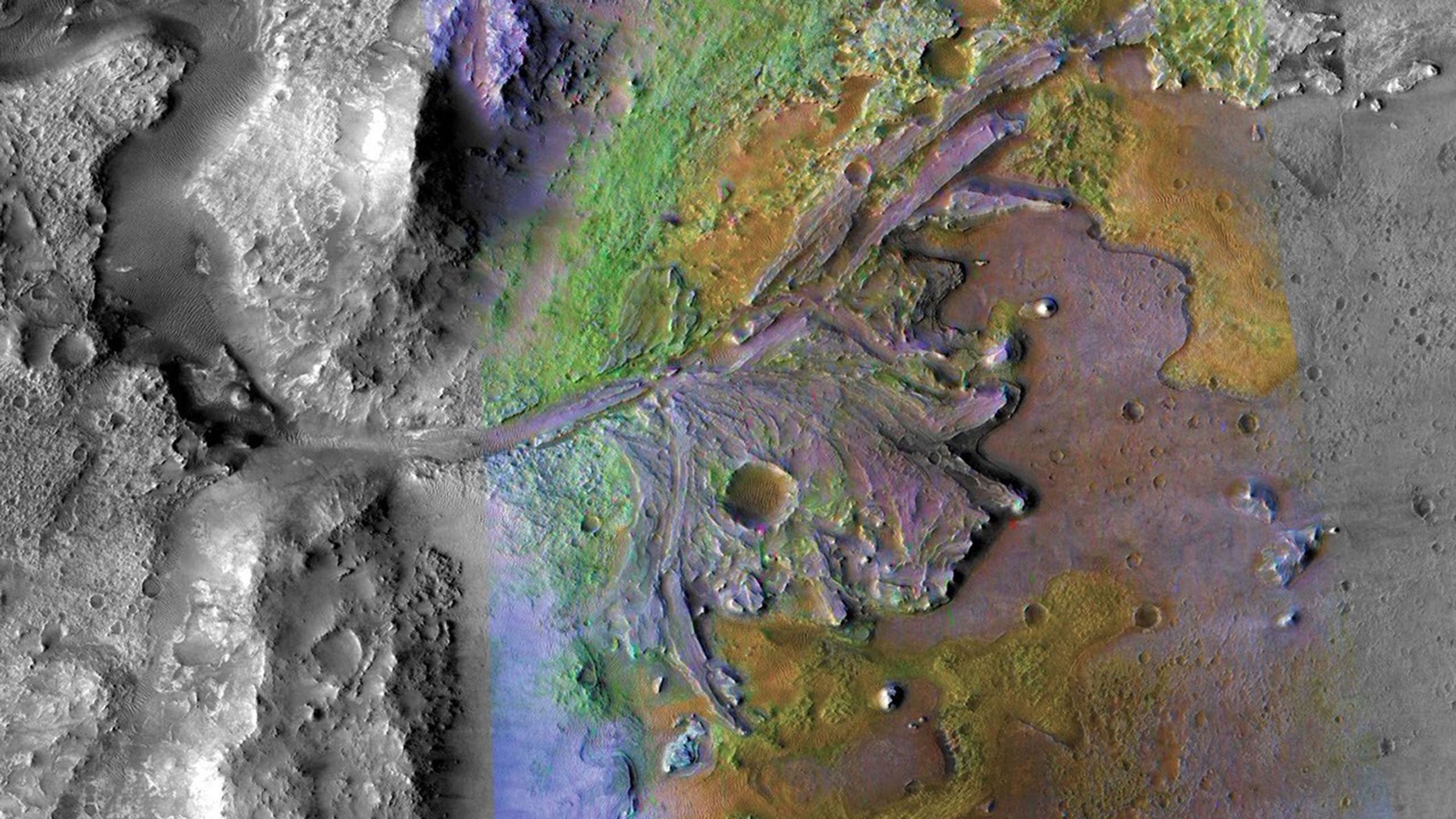
Perseverance landed at the Martian location of Jezero crater, which was selected as the landing site because it once contained a lake. Views of the crater from orbit show several distinct fan-shaped deposits emanating from channels carved through the crater walls by flowing water. Within these channels are abundant deposits of clay minerals.
The new paper details recent analysis of aluminum-rich clay pebbles, called kaolinite, located within one of the ancient flow channels. The pebbles appear to have been subjected to intense weathering and chemical alteration by water during the Noachian.
While this is perhaps not surprising for a known ancient watery environment, what is interesting is that these clays are strongly depleted in iron and magnesium, and enriched in titanium and aluminum.
This is important because it means these rocks were less likely to have been altered in a hydrothermal environment, where scalding hot water was temporarily released by melting ice caused by volcanism or a meteorite impact.
Instead, they appear to have been altered under modest temperatures and persistent heavy rainfall. The authors found distinct similarities between the chemical composition of these clay pebbles with similar clays found on Earth dating from periods in our planet’s history when the climate was much warmer and wetter.
The paper concludes that these kaolinite pebbles were altered under high rainfall conditions comparable to “past greenhouse climates on Earth” and that they “likely represent some of the wettest intervals and possibly most habitable portions of Mars’ history.”
Implications for past life
Furthermore, the paper concludes that these conditions may have persisted over time periods ranging from thousands to millions of years. Perseverance recently made headlines also for the discovery of possible biosignatures in samples it collected last year, also from within Jezero crater.
These precious samples have now been cached in special sealed containers on the rover for collection by a future Mars sample return mission. Unfortunately, the mission has recently been cancelled by NASA, and so what vital evidence they may or may not contain will probably not be examined in an Earth-based laboratory for many years.
Crucial to this future analysis is the so-called “Knoll criterion” – a concept formulated by astrobiologist Andrew Knoll, which states that for something to be evidence of life, an observation has to not just be explicable by biology; it has to be inexplicable without it. Whether these samples ever satisfy the Knoll criterion will only be known if they can be brought to Earth.
Either way, it is quite striking to imagine a time on Mars, billions of years before the first humans walked the Earth, that a tropical climate with – possibly – a living ecosystem once existed in the now desolate and wind-swept landscape of Jezero crater.
Adapted from an article originally published in The Conversation.
Never miss a breakthrough: Join the SciTechDaily newsletter.
Follow us on Google and Google News.
1 Comment
thanks