

A study has identified the key role of lateral septum neurons in the effects of the anti-obesity drug liraglutide, offering new insights for obesity treatment.
A research team led by Prof. Yingjie Zhu from the Shenzhen Institute of Advanced Technology (SIAT) at the Chinese Academy of Sciences (CAS) has uncovered the crucial role of lateral septum (LS) neurons in mediating the anorectic and weight-reducing effects of the anti-obesity drug liraglutide in mice.
The study was recently published in the Journal of Clinical Investigation.
Obesity is now among the top ten chronic diseases worldwide, causing a range of health issues and increasing the medical burden. Anti-obesity medications have shown greater efficacy than lifestyle changes and diet, with lower risks and fewer side effects than surgery. Since 2014, GLP-1 receptor agonists have emerged as a groundbreaking class of medications, significantly outperforming other weight loss drugs in both effectiveness and safety. They have been showing a trend toward becoming the next generation of “blockbuster” drugs, particularly in diabetes management and weight loss.
Mechanisms of GLP-1 and Liraglutide
Glucagon-like peptide-1 (GLP-1) is an incretin hormone encoded by the proglucagon gene (GCG), primarily secreted by intestinal L cells and a subset of neurons in the brainstem. Its effects are mediated through the GLP-1 receptor (GLP-1R), a class B G protein-coupled receptor widely expressed in both the peripheral and central nervous systems.
Liraglutide, a short-acting GLP-1R agonist, reduces appetite and slows gastric emptying, making it the first GLP-1-based anti-obesity drug on the market. Despite the widespread expression of GLP-1R in the brain, the precise neural mechanisms through which its agonists regulate food intake and body weight remain poorly understood.
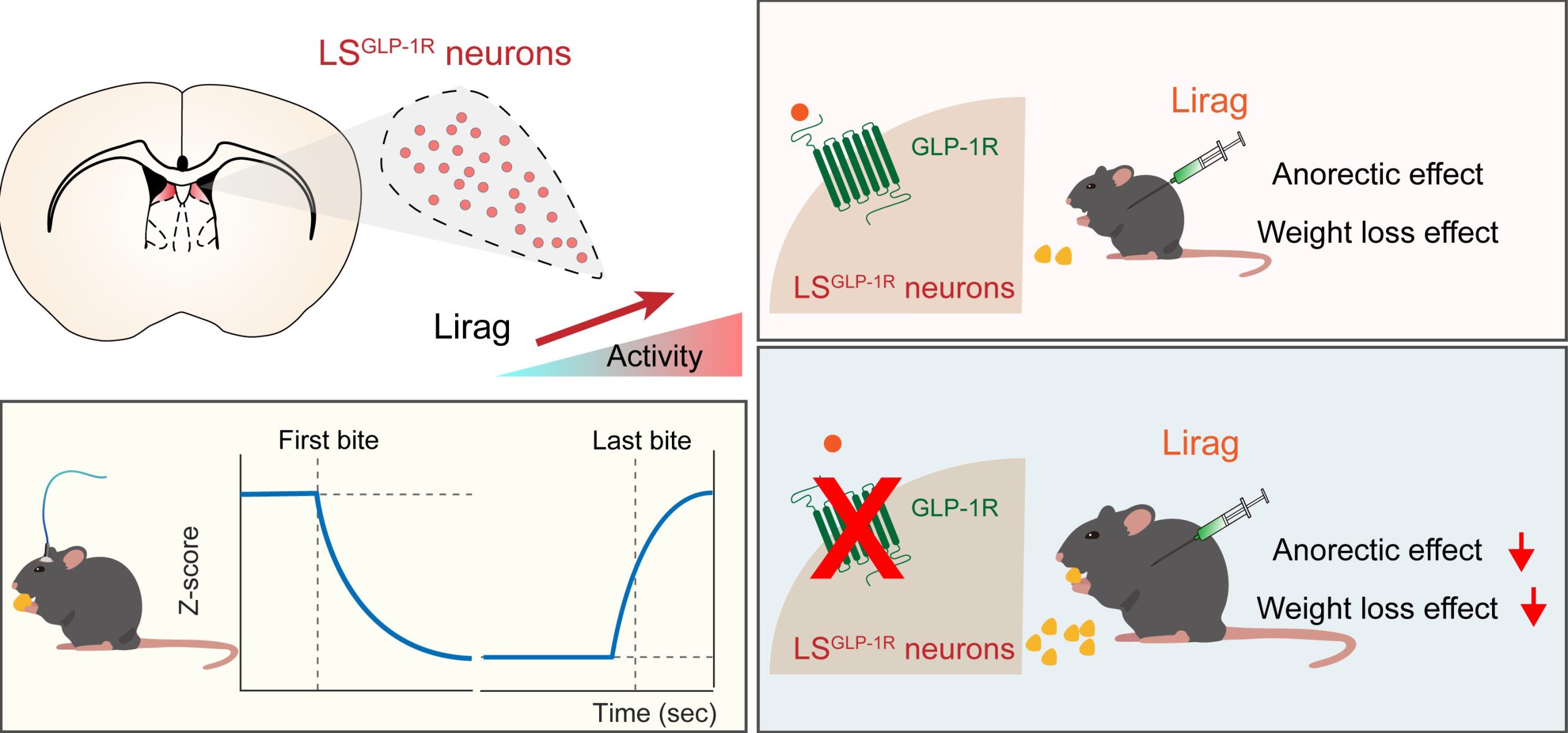
In this study, researchers discovered that GLP-1 receptors (GLP-1Rs) are abundantly expressed in the dorsal LS, and they found that liraglutide strongly activated GLP-1R-positive (LSGLP-1R) neurons in this region. Knockdown of GLP-1Rs in the LS attenuates liraglutide’s effects on feeding suppression and weight-lowering, whereas targeted knockdown in the hypothalamic regions, such as the paraventricular nucleus of the hypothalamus (PVN) and arcuate nucleus of the hypothalamus (Arc), fails to replicate the effect. This suggests that GLP-1Rs in LS mediated the anorectic effect of liraglutide.
Neural Activity and Behavioral Implications
Furthermore, researchers investigated the intrinsic activity of LSGLP-1R neurons during natural feeding by using fiber photometry in freely moving mice. They observed a significant decrease in Ca2+ signals at the start of food consumption, which continued throughout the eating period and returned to baseline after feeding ended. The activation of these neurons suppresses feeding and reduces body weight, mimicking the effects of liraglutide. Conversely, the inactivation of these neurons substantially attenuates liraglutide’s anorectic and weight-reducing efficacy.
This study provides valuable insights into the neural mechanisms underlying feeding behavior, paving the way for new strategies to treat eating disorders and obesity, as well as further exploration of the GLP-1 signaling pathway.
Reference: “GLP-1R–positive neurons in the lateral septum mediate the anorectic and weight-lowering effects of liraglutide in mice” by Zijun Chen, Xiaofei Deng, Cuijie Shi, Haiyang Jing, Yu Tian, Jiafeng Zhong, Gaowei Chen, Yunlong Xu, Yixiao Luo and Yingjie Zhu, 3 September 2024, The Journal of Clinical Investigation.
DOI: 10.1172/JCI178239
Never miss a breakthrough: Join the SciTechDaily newsletter.
Follow us on Google and Google News.
2 Comments
“The activation of these neurons suppresses feeding and reduces body weight, mimicking the effects of liraglutide.” Isn’t it the liraglutide mimicking the effects of natural feeding?
Furthermore, how exactly does a drug with numerous bad side effects in humans relate in mice to obesity and a number of other now epidemic conditions (e.g., anxiety, dementia, depression, insomnia, etc.) caused in humans with medically undiagnosed nearly subclinical non-IgE-mediated food allergies (e.g., Dr. Arthur F. Coca, by 1935) aggravated (or not) with officially (FDA in the US) approved added artificially cultured “free” (can cross the blood-brain barrier) MSG, since 1980. In 2024 an “ounce of prevention” is now worth a “ton of cure.”
Obesity was practically an unknown thing back in the day, before the advent of modern agriculture and processed food. So it’s clearly a cultural and a lifestyle problem.
No “miracle” drug is going to alleviate it – particularly the one that hasn’t been tested line enough – without creating serious new problems down the line.
People are not simple machines that you can just tweak a little and fix.