

Enhanced neuron growth in the hippocampus, achieved through exercise or genetic methods, aids mice in forgetting strong, maladaptive memories, offering potential for new treatments for PTSD or drug addiction.
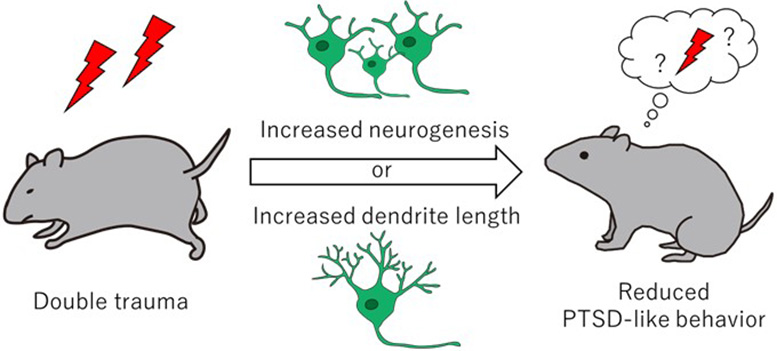
Researchers at the University of Toronto, Canada, and Kyushu University, Japan, discovered that enhancing neuron production and subsequently altering neural connections in the hippocampus—through exercise or genetic intervention—enables mice to forget memories associated with trauma or drugs. The findings, reported in the journal Molecular Psychiatry, could offer a new approach to treating mental health conditions like post-traumatic stress disorder (PTSD) or drug addiction.
PTSD is a mental health condition that can be triggered by experiencing or seeing a traumatic event, such as a natural disaster, serious accident, or attack. Worldwide, around 3.9% of the general population has PTSD, with symptoms including vivid flashbacks and avoidance behaviors, such as staying away from places or pushing away people that remind them of the traumatic event.
Currently, PTSD is often treated through therapy or medications such as anti-depressants. However, many people do not respond effectively, so researchers are still looking for different treatments.
Study Details and Neurogenesis
In this study on mice, Assistant Professor Risako Fujikawa from Kyushu University’s Faculty of Pharmaceutical Sciences, her former supervisor Professor Paul Frankland from the University of Toronto, and their team members including Adam Ramsaran focused on how neurogenesis—the process of forming new neurons—in the hippocampus impacts the ability to forget fear memories. The hippocampus, a brain region important for forming memories linked to specific places and contexts, produces new neurons daily in an area called the dentate gyrus.
“Neurogenesis is important for forming new memories but also for forgetting memories. We think this happens because when new neurons integrate into neural circuits, new connections are forged and older connections are lost, disrupting the ability to recall memories,” explains Fujikawa. “We wanted to see if this process could help mice forget stronger, traumatic memories too.”
Experimentation and Findings
The researchers gave mice two strong shocks in different settings. First, the mice were shocked after leaving a brightly lit, white box and entering a dark, ethanol-scented compartment. After the second shock in another distinct environment, the mice showed PTSD-like behaviors. Over a month later, the mice were still fearful and hesitant to enter the original dark compartment, indicating they couldn’t forget the traumatic memory. This fear extended to other dark compartments, showing generalized fear. Additionally, the mice explored less in open spaces and avoided the center, suggesting anxiety.
The researchers then explored whether these PTSD-like behaviors could be alleviated through exercise, which studies had shown boosted neurogenesis. The double-shocked mice were split into two groups and one group was provided with a running wheel. Four weeks later, these mice showed increased numbers of newly-formed neurons in their hippocampi, and importantly, the PTSD-like behaviors were less severe, compared to the double-shocked mice without wheel access.
Furthermore, when the mice were free to exercise before the second shock, it also prevented some PTSD-like behaviors from developing.
Genetic Approaches to Enhancing Neurogenesis
However, since exercise impacts the brain and body in many different ways, it wasn’t clear whether the effect of exercise was due to hippocampal circuit rewiring by neurogenesis, or other factors. The researchers therefore used two different genetic approaches to assess the impact of newborn neuron integration into the hippocampus, exclusively.
Firstly, the researchers used a technique called optogenetics, where they added light-sensitive proteins to newly formed neurons in the dentate gyrus, allowing the neurons to be activated by light. When they shone blue light on these cells, the new neurons matured faster. After 14 days, the neurons had grown longer, had more branches, and integrated more quickly into the neural circuits of the hippocampus.
In the second approach, the research team used genetic engineering to remove a protein in the newly formed neurons that slows down neuron growth. This also resulted in the neurons growing faster and increased incorporation into neural circuits.
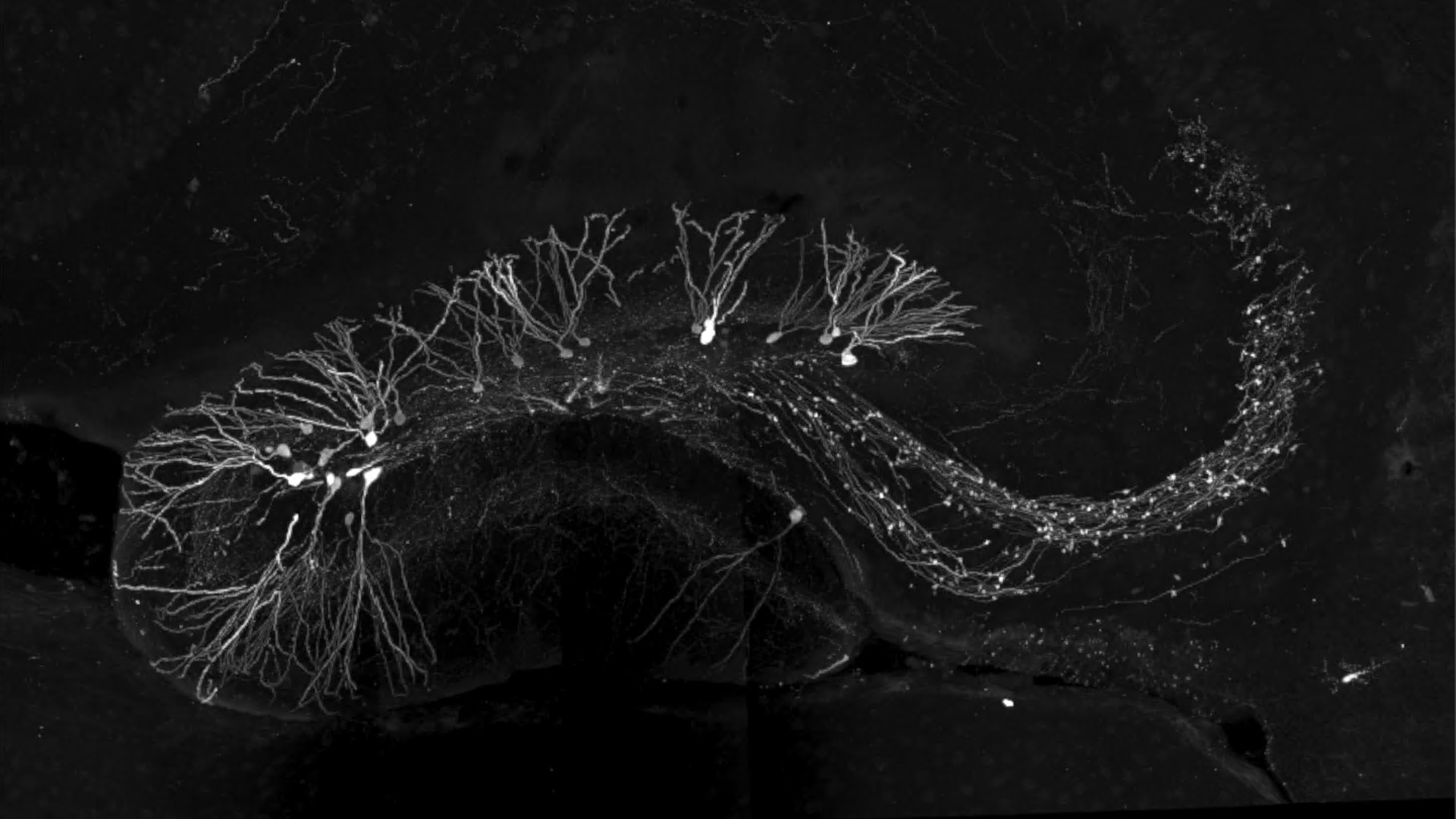
Both these genetic approaches reduced PTSD-like symptoms in mice after double-shocking and shortened the time taken for the mice to forget the fear memory. However, the researchers found that the effect was weaker than they saw with exercise, and did not reduce the level of the mice’s anxiety.
“It could be that the neurogenesis and the re-modeling of the hippocampus circuits disrupt fear memory, but have less effect on mood or emotions,” suggests Fujikawa. “Exercise also has broader physiological effects, which may contribute to the stronger outcomes seen.”
Finally, the research team explored whether increased neurogenesis and hippocampus re-modeling could also help in other mental disorders where memory plays an important role, such as substance use disorders. For people battling drug dependency, relapse often happens when reminders, like being in a similar environment where the drug was used, trigger powerful cravings.
The researchers placed mice in a cage with two rooms. In one room, the mice were given a saline solution and in the other room, they were given cocaine. Afterward, when given free access to both rooms, the mice spent more time in the room in which they had received cocaine.
However, when the researchers used exercise and genetic methods to boost neurogenesis and hippocampus re-modeling, they found that the mice stopped showing a preference for the room where they had taken cocaine, suggesting the mice had forgotten the link between the room and the drug.
For future research, Risako is planning to find a drug that can boost neurogenesis or hippocampus re-modeling, in the hopes that it could be tested as a potential treatment for PTSD and drug dependence. However, she also stressed the importance of exercise.
“In our experiments, exercise had the most powerful impact on reducing symptoms of PTSD and drug dependence in mice, and clinical studies in humans also show it is effective,” says Risako. “I think this is the most important takeaway.”
Reference: “Neurogenesis-dependent remodeling of hippocampal circuits reduces PTSD-like behaviors in adult mice” by Risako Fujikawa, Adam I. Ramsaran, Axel Guskjolen, Juan de la Parra, Yi Zou, Andrew J. Mocle, Sheena A. Josselyn and Paul W. Frankland, 8 May 2024, Molecular Psychiatry.
DOI: 10.1038/s41380-024-02585-7
The study was funded by the Canadian Institutes of Health Research, the National Institute of Mental Health, the Japan Society for the Promotion of Science, and the National Institutes of Health.
Never miss a breakthrough: Join the SciTechDaily newsletter.
Follow us on Google and Google News.