
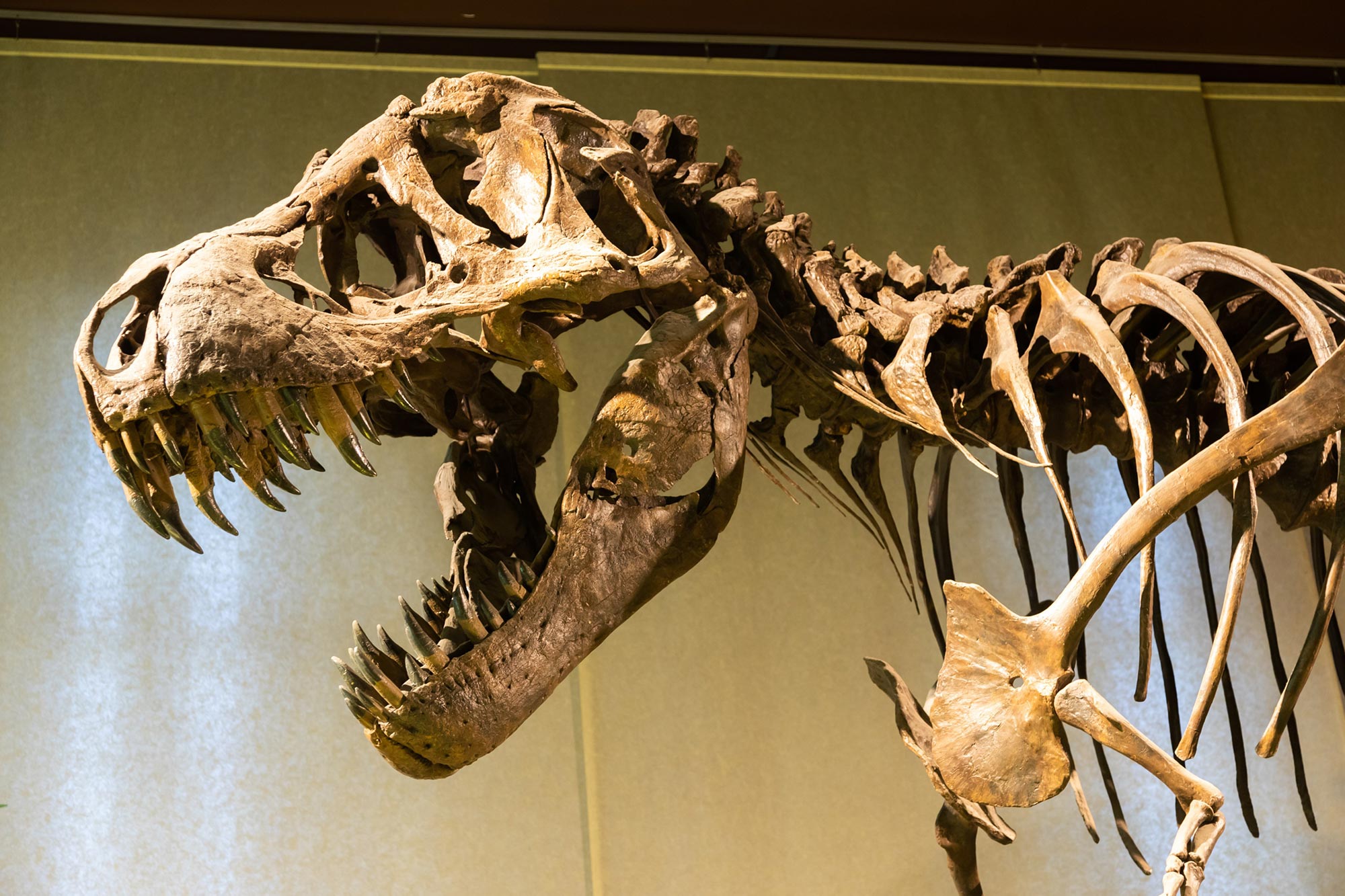
The largest study ever conducted on the growth of Tyrannosaurus rex reveals that the dinosaur took a far longer and slower route to adulthood than scientists had previously believed.
For many years, researchers have estimated the age and growth rate of Tyrannosaurus rex by examining annual growth rings inside fossilized leg bones, much like the rings seen in trees. Based on earlier analyses, scientists concluded that T. rex usually reached its full size and stopped growing at about 25 years of age.
Rethinking how T. rex grew up
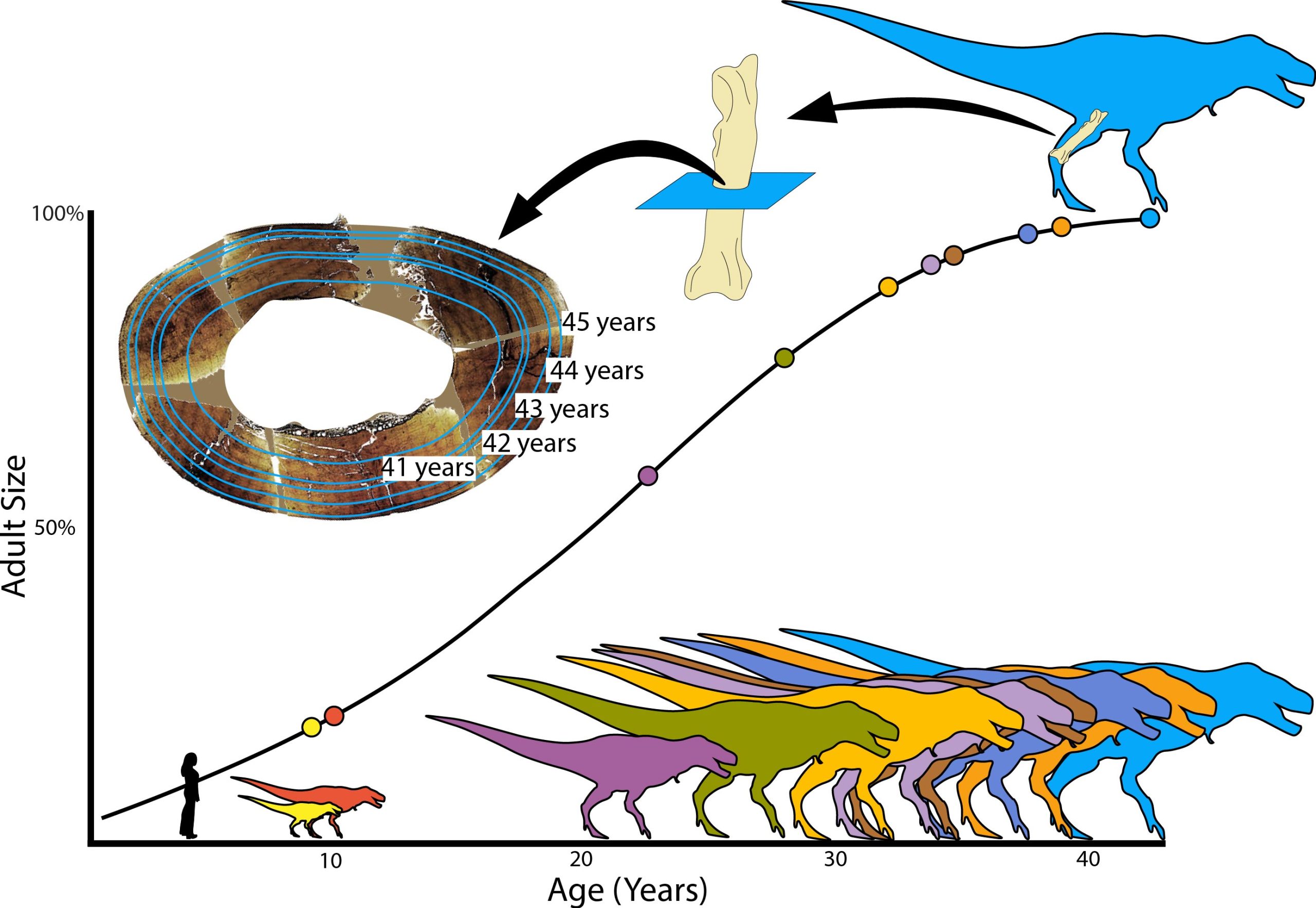
New research now paints a very different picture of how this famous predator matured. A large study examining 17 tyrannosaur fossils, from young juveniles to enormous adults, suggests that T. rex took closer to 40 years to reach its adult mass of roughly eight tons. This work represents the most detailed reconstruction of the dinosaur’s life history to date and was published in the journal PeerJ.
To achieve this, the research team combined advanced statistical modeling with microscopic analysis of bone slices viewed under specialized lighting. This approach revealed previously overlooked growth rings that earlier studies had missed. By extending the known growth period by about 15 years, the findings also raise the possibility that some fossils traditionally classified as T. rex may actually belong to other species, or differ for other biological reasons.
“This is the largest data set ever assembled for Tyrannosaurus rex,” says Holly Woodward, a professor of anatomy at Oklahoma State University who led the research effort. “Examining the growth rings preserved in the fossilized bones allowed us to reconstruct the animals’ year-by-year growth histories.” Unlike the rings visible on a tree stump, a cross-section of T. rex bone records only the last 10 to 20 years of the animal’s life.
“We came up with a new statistical approach that stitches together growth records from different specimens to estimate the growth trajectory of T. rex across all stages of life in greater detail than any previous study,” explains Nathan Myhrvold, a mathematician and paleobiologist at Intellectual Ventures who led the statistical analysis. “The composite growth curve provides a much more realistic view of how Tyrannosaurus grew and how much they varied in size.”
Slow growth, flexible lives
Rather than racing to adulthood, Tyrannosaurus grew more slowly and steadily than previously believed. “A four-decade growth phase may have allowed younger tyrannosaurs to fill a variety of ecological roles within their environments,” says coauthor Jack Horner of Chapman University. “That could be one factor that allowed them to dominate the end of the Cretaceous Period as apex carnivores.”
The findings also feed into an ongoing debate about tyrannosaur diversity. While Tyrannosaurus rex is the most famous member of this group, some researchers argue that certain fossils labeled as T. rex could represent different species. In particular, smaller specimens have been proposed as belonging to a separate species called Nanotyrannus rather than being juveniles of T. rex. This new growth analysis adds fresh data to that discussion, though it does not settle the question outright.
Others have suggested that even the large specimens might belong to two or three different species.
These proposals remain controversial, however.
To help shed light on the question, the new study includes data from 17 specimens as part of the “Tyrannosaurus rex species complex,” noting that the complex could include other species or subspecies. One important finding of the study is that the growth curves of two of the more famous specimens, known by their nicknames “Jane” and “Petey,” are statistically incompatible with the others. Although growth records alone cannot establish whether they were separate species, the evidence suggests that intriguing possibility, among other possible explanations. An independent analysis in a recent paper by Zanno and Napoli used different methods to classify Jane and Petey as each belonging to a different species of Nanotyrannus.
New tools reshape dinosaur biology
The discovery by Woodward, Myhrvold, and Horner that circularly polarized and cross-polarized light reveal a new kind of dinosaur growth ring helps to resolve longstanding problems reconciling the growth of some specimens. This discovery, backed up in the paper by robust statistical evidence, could be important in reevaluating the growth of other dinosaurs beyond T. rex. “Interpreting multiple closely spaced growth marks is tricky,” Myhrvold says. “We found strong evidence that the protocols typically used in growth studies may need to be revised.”
Even after more than a century of study, Tyrannosaurus rex continues to surprise paleontologists. By combining expanded sampling, innovative statistics, and careful bone analysis, the new study offers a clearer, more accurate picture of Tyrannosaurus rex as a living animal, growing from juvenile to giant.
Reference: “Prolonged growth and extended subadult development in the Tyrannosaurus rex species complex revealed by expanded histological sampling and statistical modeling” by Holly N. Woodward, Nathan P. Myhrvold and John R. Horner, 14 January 2026, PeerJ.
DOI: 10.7717/peerj.20469
Never miss a breakthrough: Join the SciTechDaily newsletter.
Follow us on Google and Google News.
3 Comments
Cool
good article
And how are they doing on the cloning? Any progress?!?