
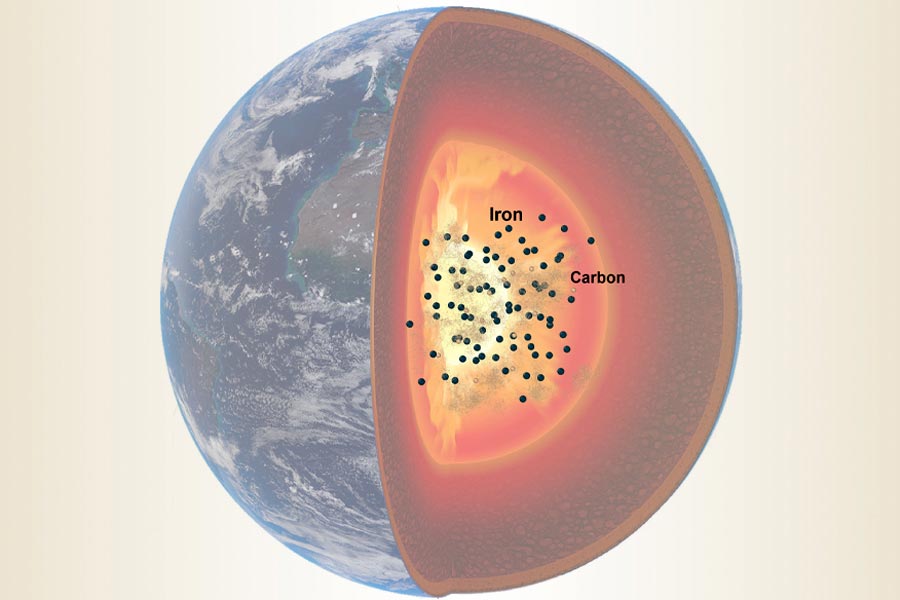
By comparing seismic data with new simulations, scientists estimate that up to 2% of Earth’s outer core is carbon, possibly accounting for up to 95% of Earth’s total carbon.
New research from Florida State University and Rice University is providing a better estimate of the amount of carbon in the Earth’s outer core, and the work suggests the core could be the planet’s largest reservoir of that element.
The research, published in the journal Communications Earth & Environment, estimates that 0.3 to 2.0 percent of the Earth’s outer core is carbon.
Though the percentage of carbon there is low, it’s still an enormous amount because the outer core is so large. The researchers estimated that the outer core contains between 5.5 and 36.8 × 10^24 grams of carbon — an immense number.
Solving the Density Puzzle
“Understanding the composition of the Earth’s core is one of the key problems in the solid-earth sciences,” said co-author Mainak Mookherjee, an associate professor of geology in the Department of Earth, Ocean and Atmospheric Science. “We know the planet’s core is largely iron, but the density of iron is greater than that of the core. There must be lighter elements in the core that reduce its density. Carbon is one consideration, and we are providing better constraints as to how much might be there.”
Previous research has estimated the total amount of carbon on the planet. This work refines the estimates for the carbon content of Earth to a range between about 990 parts per million and more than 6,400 parts per million. That would mean the core of the Earth — which includes both the outer core and the inner core — could contain 93 to 95 percent of the planet’s carbon.
Because humans can’t access the Earth’s core, they have to use indirect methods to analyze it. The research team compared the known speed of compressional sound waves traveling through the Earth to computer models that simulated different compositions of iron, carbon and other light elements at the pressure and temperature conditions of the Earth’s outer core.
“When the velocity of the sound waves in our simulations matched the observed velocity of sound waves traveling through the Earth, we knew the simulations were matching the actual chemical composition of the outer core,” said lead author and postdoctoral researcher Suraj Bajgain.
Scientists have attempted to give a range of the amount of carbon in the outer core before. This research narrows that possible range by including other light elements — namely oxygen, sulfur, silicon, hydrogen, and nitrogen — in the models estimating the outer core’s composition.
Just like hydrogen and oxygen and other elements, carbon is a life-essential element. It’s part of what makes life possible on Earth.
Carbon Inventory and the Origins of Life
“It’s a natural question to ask where did this carbon that we are all made of come from and how much carbon was originally supplied when the Earth formed,” Mookherjee said. “Where is the bulk of the carbon residing now? How has it been residing and how has it transferred between different reservoirs? Understanding the total inventory of carbon is what this study gives us insight into.”
Knowing how much carbon exists on Earth will help scientists improve their understanding of the composition of both our planet and rocky planets elsewhere in the universe.
“There have been a lot of activities over the last decade to determine the carbon budget of the Earth’s core using cosmochemical and geochemical models,” said study co-author Rajdeep Dasgupta, the Maurice Ewing Professor of Earth, Environmental and Planetary Sciences at Rice University. “However, it remained an open question because of a lot of uncertain parameters on the accretion process and the building blocks of rocky planets. What is neat about this study is that it provides a direct estimate on the Earth’s outer core’s present-day carbon budget. Therefore, this will in turn help the community bracket the possible planetary ingredients and the early processes better.”
Reference: “Earth’s core could be the largest terrestrial carbon reservoir” by Suraj K. Bajgain, Mainak Mookherjee and Rajdeep Dasgupta, 19 August 2021, Communications Earth & Environment.
DOI: 10.1038/s43247-021-00222-7
The National Science Foundation and NASA supported this research, and the Extreme Science and Engineering Discovery computing (XSEDE) and the Research Computing Center (RCC) at FSU provided computing resources for this work.
Never miss a breakthrough: Join the SciTechDaily newsletter.
Follow us on Google and Google News.
3 Comments
This publication needs to start a “What If” column. Leave this side for proven science and the other for articles like this and all the others you publish. There would be nothing left in this one. Try printing the truth now and again. Wishes and maybes don’t pay the bills.
If you want absolutes, you’re better off looking at a religion site than a science site.
For just about everything new and interesting, there is evidence for it, but it is not definitively proven. A good scientist uses words like ‘could’ and ‘may’ and goes on to list the data and evidence that supports the theory.
Believe you all are correct 🌏🌎🌍🗺👽🤓