
The below four-minute ScienceCast video explores the possibility that the Alpha Magnetic Spectrometer onboard the International Space Station has detected signs of dark matter.
In science fiction, finding antimatter on board your spaceship is not good news. Usually, it means you’re moments away from an explosion.
In real life, though, finding antimatter could lead to a Nobel Prize.
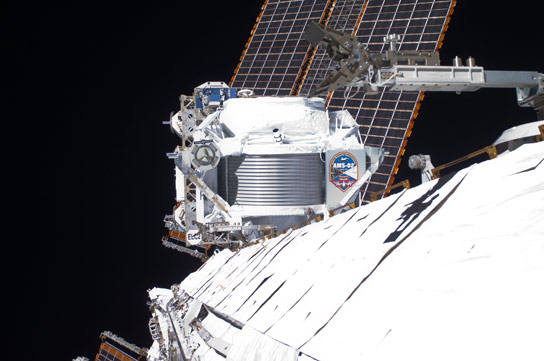
On April 3rd, researchers led by Nobel Laureate Samuel Ting of MIT announced that the Alpha Magnetic Spectrometer, a particle detector operating onboard the International Space Station since 2011, has counted more than 400,000 positrons, the antimatter equivalent of electrons. There’s no danger of an explosion, but the discovery is sending shock waves through the scientific community.
A new ScienceCast video explores the possibility that signs of dark matter have been detected onboard the International Space Station.
“These data show the existence of a new physical phenomenon,” wrote Ting and colleagues in an article published in the Physical Review Letters. “It could be a sign of dark matter.”
The Alpha Magnetic Spectrometer (“AMS” for short) was delivered to the ISS by the space shuttle Endeavour on its final flight in May 2011. In its first 18 months of operations, from May 19, 2011, to December 10, 2012, the AMS analyzed 25 billion cosmic ray events. Of these, an unprecedented number were unambiguously identified as positrons.
Cosmic rays are subatomic particles such as protons and helium nuclei accelerated to near-light speed by supernova explosions and other violent events in the cosmos. Researchers have long known that cosmic rays contain a sprinkling of antimatter. Italy’s PAMELA satellite detected high-energy positrons in 2009, and NASA’s Fermi gamma-ray observatory confirmed the find two years later.
But where do the positrons come from? The Universe is almost completely devoid of antimatter, so the positron fraction of cosmic ray electrons–as much as 10%–is a little surprising.
One idea is dark matter. Astronomers know that the vast majority of the material Universe is actually made of dark matter rather than ordinary matter. They just don’t know what dark matter is. It exerts gravity, but emits no light, which makes it devilishly difficult to study.
A leading theory holds that dark matter is made of a particle called the neutralino. Collisions between neutralinos should produce a large number of high-energy positrons, which the AMS should be able to detect with unprecedented sensitivity.
“The accuracy of our measurements is 1%, which is excellent, and we have statistics unmatched by any other spacecraft,” says Ting.
“So far the evidence supports the hypothesis of dark matter. But,” he cautions,” it does not rule out another possibility–pulsars.”
Pulsars are strongly magnetized neutron stars formed in the aftermath of supernova explosions. They can spin on their axes thousands of times a second, flinging particles into space with fantastic energies that accelerators on Earth can’t match. Among these particles are pairs of electrons and positrons.
AMS can distinguish between pulsars and dark matter–but not yet. “We need more data at higher energies to decide which is the correct explanation,” says Ting. “It is only a matter of time, perhaps months or a few years.”
Built by scientists from 16 countries with support from the US Dept. of Energy, the Alpha Magnetic Spectrometer will continue operating for the rest of the life of the space station at least until 2020. Between now and then, the mystery of dark matter could be solved, once and for all.
Reference: “First Result from the Alpha Magnetic Spectrometer on the International Space Station: Precision Measurement of the Positron Fraction in Primary Cosmic Rays of 0.5–350 GeV” by M. Aguilar et al. (AMS Collaboration), 3 April 2013, Physical Review Letters.
DOI:10.1103/PhysRevLett.110.141102
Never miss a breakthrough: Join the SciTechDaily newsletter.
Follow us on Google and Google News.
1 Comment
Our achievement of being able to detect this unusual matter comes close to rivaling our past achievements. Putting the continually astonishing findings of pre history in context, the event or events that produce these unusual matter constituents must have been both detectable and temporary as we are here noting the difference yet again.