
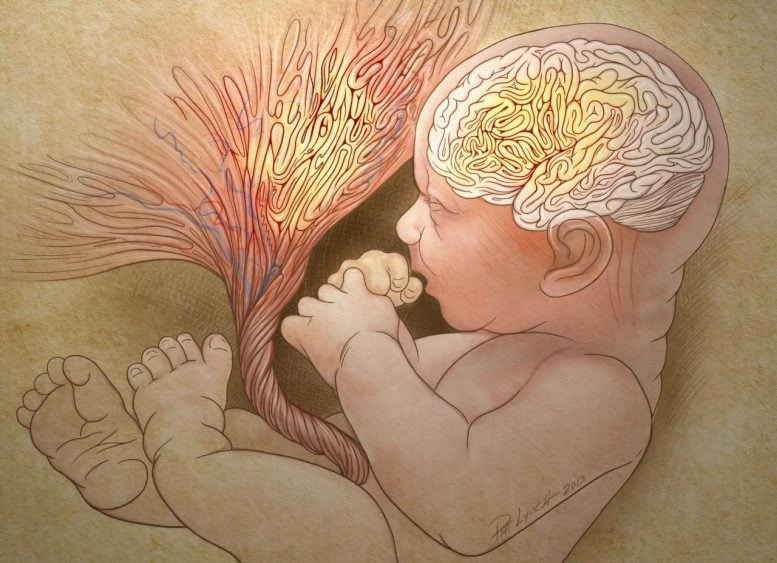
Scientists from the Yale School of Medicine, with research collaborators at the MIND Institute, have found that abnormal placental folds and abnormal cell growths called trophoblast inclusions are key markers to identify newborns that are at risk for autism.
Researchers at the Yale School of Medicine have figured out how to measure an infant’s risk of developing autism by looking for abnormalities in his/her placenta at birth, allowing for earlier diagnosis and treatment for the developmental disorder. The findings are reported in the April 25 online issue of Biological Psychiatry.
One out of 50 children are diagnosed with an autism spectrum disorder in the United States each year, according to the Centers for Disease Control and Prevention (CDC), but the diagnosis is usually made when these children are 3 to 4 years of age or older. By then the best opportunities for intervention have been lost because the brain is most responsive to treatment in the first year of life.
Senior author Dr. Harvey Kliman, research scientist in the Department of Obstetrics, Gynecology & Reproductive Sciences at the Yale School of Medicine, and research collaborators at the MIND Institute at the University of California, Davis, have found that abnormal placental folds and abnormal cell growths called trophoblast inclusions are key markers to identify newborns who are at risk for autism.
Kliman and his team examined 117 placentas from infants of at-risk families, those with one or more previous children with autism. These families were participating in a study called Markers of Autism Risk in Babies – Learning Early Signs. Kliman compared these at-risk placentas to 100 control placentas collected by the UC Davis researchers from the same geographic area.
The at-risk placentas had as many as 15 trophoblast inclusions, while none of the control placentas had more than two trophoblast inclusions. Kliman said a placenta with four or more trophoblast inclusions conservatively predicts an infant with a 96.7% probability of being at risk for autism.
Currently, the best early marker of autism risk is family history. Couples with a child with autism are nine times more likely to have another child with autism. Kliman said that when these at-risk families have subsequent children they could employ early intervention strategies to improve outcomes. “Regrettably couples without known genetic susceptibility must rely on identification of early signs or indicators that may not overtly manifest until the child’s second or third year of life,” said Kliman.
“I hope that diagnosing the risk of developing autism by examining the placenta at birth will become routine, and that the children who are shown to have increased numbers of trophoblast inclusions will have early interventions and an improved quality of life as a result of this test,” Kliman added.
Reference: “Trophoblast Inclusions Are Significantly Increased in the Placentas of Children in Families at Risk for Autism” by Cheryl K. Walker, Kaitlin W. Anderson, Kristin M. Milano, Saier Ye, Daniel J. Tancredi, Isaac N. Pessah, Irva Hertz-Picciotto and Harvey J. Kliman, 26 April 2013, Biological Psychiatry.
DOI: 10.1016/j.biopsych.2013.03.006
Other authors on the study include Kaitlin Anderson, Kristin Milano, and Saier Ye of Yale University; and Cheryl Walker, Daniel Tancredi, Isaac Pessah, and Irva Hertz-Picciotto of UC Davis.
This work was supported by the National Institutes of Health (1 P01 ES11269 and R01 ES 015359), the U.S. Environmental Protection Agency through the Science to Achieve Results (STAR) program (R829388 and R833292), the MIND Institute at the University of California, Davis, and the Yale University Reproductive and Placental Research Unit.
Never miss a breakthrough: Join the SciTechDaily newsletter.
Follow us on Google and Google News.